QUESTION IMAGE
Question
ionic bonding
name
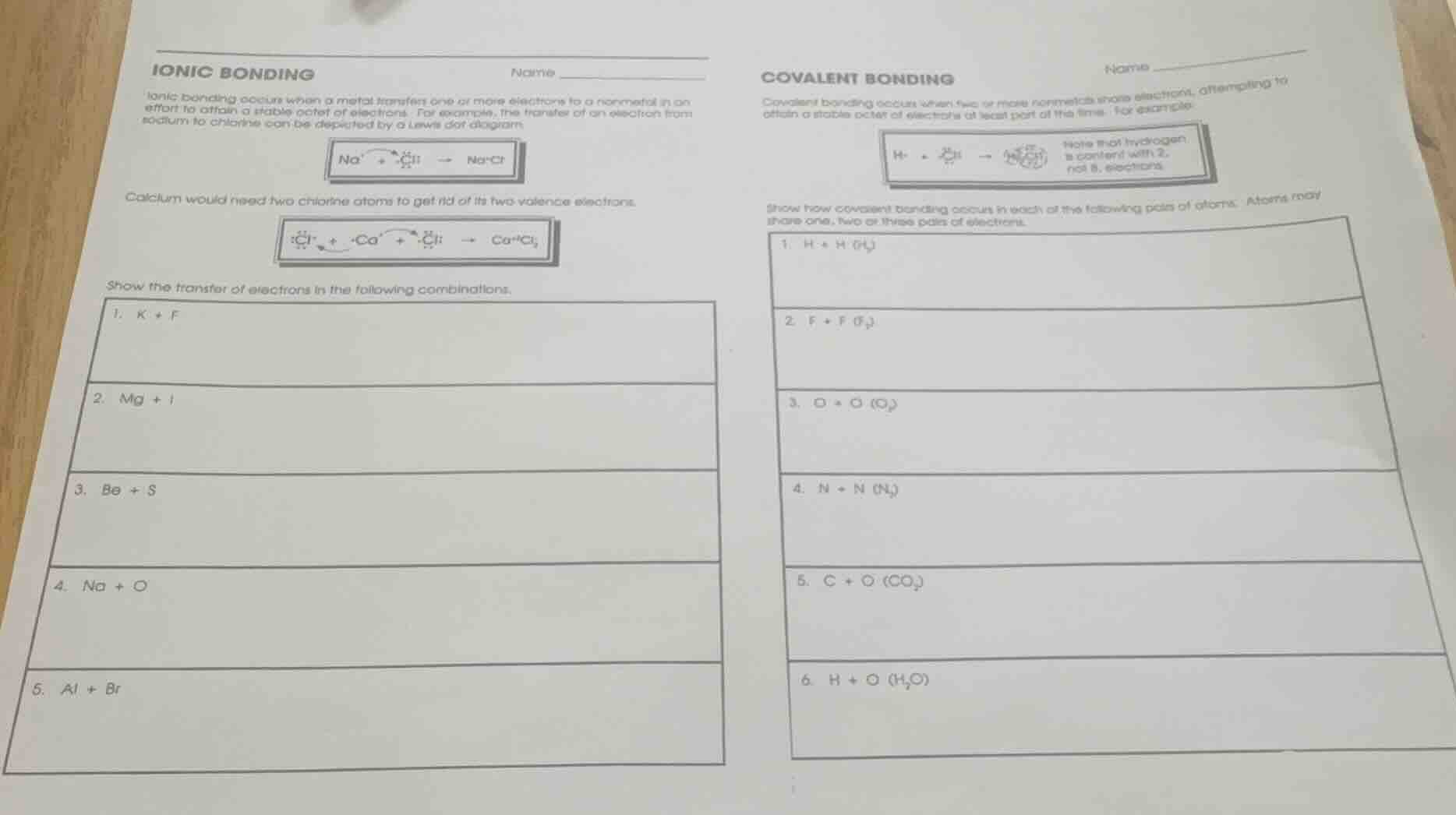
ionic bonding occurs when a metal transfers one or more electrons to a nonmetal in an effort to attain a stable octet of electrons. for example, the transfer of an electron from sodium to chlorine can be depicted by a lewis dot diagram
na· + ·cl: → nacl
calcium would need two chlorine atoms to get rid of its two valence electrons.
:cl· + ·ca· + ·cl: → cacl₂
show the transfer of electrons in the following combinations.
- k + f
- mg + i
- be + s
- na + o
- al + br
covalent bonding
name
covalent bonding occurs when two or more nonmetals share electrons, attempting to attain a stable octet of electrons at least part of the time. for example
h· + ·h → h₂
note that hydrogen is content with 2, not 8, electrons.
show how covalent bonding occurs in each of the following pairs of atoms. atoms may share one, two or three pairs of electrons.
- h + h (h₂)
- f + f (f₂)
- o + o (o₂)
- n + n (n₂)
- c + o (co₂)
- h + o (h₂o)
Ionic Bonding Section (Step-by-Step Format)
Step1: K + F electron transfer
Potassium (K, 1 valence e⁻) transfers 1 electron to fluorine (F, 7 valence e⁻) to form ions.
$\text{K}^{\cdot} + \cdot\ddot{\text{F}}:
ightarrow \text{K}^+ + :\ddot{\text{F}}^- \quad (\text{KF})$
Step2: Mg + I electron transfer
Magnesium (Mg, 2 valence e⁻) transfers 1 electron to each of 2 iodine (I, 7 valence e⁻) atoms.
$\cdot\text{Mg}\cdot + 2\cdot\ddot{\text{I}}:
ightarrow \text{Mg}^{2+} + 2:\ddot{\text{I}}^- \quad (\text{MgI}_2)$
Step3: Be + S electron transfer
Beryllium (Be, 2 valence e⁻) transfers 2 electrons to sulfur (S, 6 valence e⁻).
$\cdot\text{Be}\cdot + \cdot\ddot{\text{S}}\cdot
ightarrow \text{Be}^{2+} + :\ddot{\text{S}}^{2-} \quad (\text{BeS})$
Step4: Na + O electron transfer
2 sodium (Na, 1 valence e⁻) atoms each transfer 1 electron to oxygen (O, 6 valence e⁻).
$2\text{Na}^{\cdot} + \cdot\ddot{\text{O}}\cdot
ightarrow 2\text{Na}^+ + :\ddot{\text{O}}^{2-} \quad (\text{Na}_2\text{O})$
Step5: Al + Br electron transfer
Aluminum (Al, 3 valence e⁻) transfers 1 electron to each of 3 bromine (Br, 7 valence e⁻) atoms.
$\cdot\text{Al}\cdot + 3\cdot\ddot{\text{Br}}:
ightarrow \text{Al}^{3+} + 3:\ddot{\text{Br}}^- \quad (\text{AlBr}_3)$
Step1: H + H (H₂) electron sharing
Each H shares 1 electron to form a single bond.
$\text{H}^{\cdot} + \cdot\text{H}
ightarrow \text{H}:\text{H}$
Step2: F + F (F₂) electron sharing
Each F shares 1 electron to form a single bond.
$\cdot\ddot{\text{F}}: + :\ddot{\text{F}}\cdot
ightarrow :\ddot{\text{F}}:\ddot{\text{F}}:$
Step3: O + O (O₂) electron sharing
Each O shares 2 electrons to form a double bond.
$\cdot\ddot{\text{O}}\cdot + \cdot\ddot{\text{O}}\cdot
ightarrow :\ddot{\text{O}}::\ddot{\text{O}}:$
Step4: N + N (N₂) electron sharing
Each N shares 3 electrons to form a triple bond.
$\cdot\text{N}\cdot + \cdot\text{N}\cdot
ightarrow :\text{N}:::\text{N}:$
Step5: C + O (CO₂) electron sharing
Carbon shares 2 electrons with each O to form two double bonds.
$\cdot\text{C}\cdot + 2\cdot\ddot{\text{O}}\cdot
ightarrow :\ddot{\text{O}}::\text{C}::\ddot{\text{O}}:$
Step6: H + O (H₂O) electron sharing
2 H atoms each share 1 electron with O to form two single bonds.
$2\text{H}^{\cdot} + \cdot\ddot{\text{O}}\cdot
ightarrow \text{H}:\ddot{\text{O}}:\text{H}$

Snap & solve any problem in the app
Get step-by-step solutions on Sovi AI
Photo-based solutions with guided steps
Explore more problems and detailed explanations
- $\text{K}^{\cdot} + \cdot\ddot{\text{F}}:
ightarrow \text{K}^+:\ddot{\text{F}}^-$ (KF)
- $\cdot\text{Mg}\cdot + 2\cdot\ddot{\text{I}}:
ightarrow \text{Mg}^{2+}2:\ddot{\text{I}}^-$ (MgI₂)
- $\cdot\text{Be}\cdot + \cdot\ddot{\text{S}}\cdot
ightarrow \text{Be}^{2+}:\ddot{\text{S}}^{2-}$ (BeS)
- $2\text{Na}^{\cdot} + \cdot\ddot{\text{O}}\cdot
ightarrow 2\text{Na}^+:\ddot{\text{O}}^{2-}$ (Na₂O)
- $\cdot\text{Al}\cdot + 3\cdot\ddot{\text{Br}}:
ightarrow \text{Al}^{3+}3:\ddot{\text{Br}}^-$ (AlBr₃)
---