QUESTION IMAGE
Question
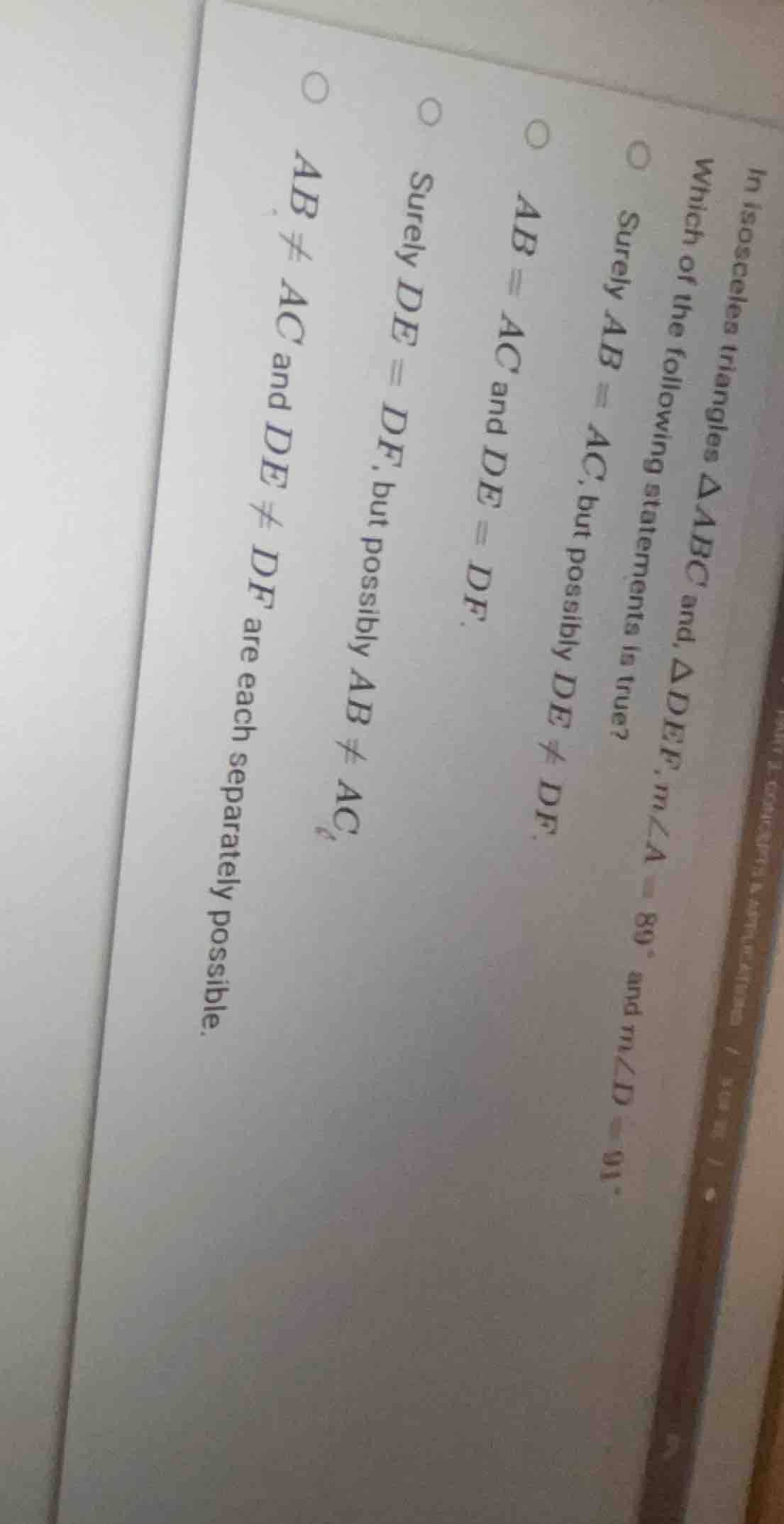
in isosceles triangles $\triangle abc$ and $\triangle def$, $m\angle a = 89^\circ$ and $m\angle d = 91^\circ$. which of the following statements is true?
\bigcirc surely $ab = ac$, but possibly $de \
eq df$.
\bigcirc $ab = ac$ and $de = df$.
\bigcirc surely $de = df$, but possibly $ab \
eq ac$.
\bigcirc $ab \
eq ac$ and $de \
eq df$ are each separately possible.
Step1: Analyze △ABC properties
In isosceles $\triangle ABC$, $m\angle A = 89^\circ$. Since a triangle can only have one obtuse/right angle, the equal sides must be the ones opposite the equal acute angles. The two equal angles are $\angle B$ and $\angle C$, so $AB = AC$.
Step2: Analyze △DEF properties
In isosceles $\triangle DEF$, $m\angle D = 91^\circ$. This is an obtuse angle, so it must be the unique angle, meaning the equal sides are the ones adjacent to it: $DE = DF$.
Step3: Compare triangle side pairs
We confirm $AB=AC$ is certain, while there is no relation given between the sides of $\triangle ABC$ and $\triangle DEF$, so $DE$ could be equal or not equal to $DF$? No, wait, $DE=DF$ is certain for $\triangle DEF$, but the question is about the statements. Wait, no: the first statement says "Surely $AB=AC$, but possibly $DE
eq DF$" — no, $DE$ must equal $DF$. Wait, no: wait, in $\triangle DEF$, vertex D is 91°, so the equal sides are DE and DF, so DE=DF is sure. But for $\triangle ABC$, vertex A is 89°, so the equal sides are AB and AC (since the two base angles are equal, so sides opposite are AB and AC? Wait, no: side opposite angle A is BC, so if angle A is 89°, the two equal angles are B and C, so sides opposite are AC and AB, so AB=AC is sure. Then, the first statement says "Surely AB=AC, but possibly DE≠DF" — no, DE must equal DF. Wait, no, wait: could the isosceles triangle have the equal sides including the vertex? Wait, no: in an isosceles triangle, the vertex angle is the unique angle if it's obtuse. So for $\triangle DEF$, angle D is 91°, so it's the vertex angle, so DE=DF (the two sides forming angle D) are equal. So DE=DF is sure. For $\triangle ABC$, angle A is 89°, acute, so it can be the vertex angle (so AB=AC) or a base angle? Wait, no! Wait, if angle A is a base angle, then the equal sides would be AB=BC, not AB=AC. Oh right! I made a mistake here.
Step1 correction: Re-analyze △ABC
In isosceles $\triangle ABC$, $m\angle A=89^\circ$. This angle can be either the vertex angle (so $AB=AC$) or a base angle (so either $AB=BC$ or $AC=BC$). Wait no, no: if angle A is a base angle, then the other base angle is equal to it, but 89+89=178, so the third angle is 2°, which is valid. So actually, $AB$ may not equal $AC$? Wait no, wait the problem says "isosceles triangles △ABC and △DEF" — so △ABC has at least two equal sides, but angle A is 89°. If angle A is the vertex angle, then AB=AC. If angle A is a base angle, then the equal sides are AB=BC (if angle C=89°) or AC=BC (if angle B=89°). So $AB=AC$ is not necessarily true? Wait no, wait the problem says "isosceles triangles △ABC" — so it has two equal sides, but we don't know which ones. Wait no, wait the problem says "m∠A=89°" — angle at A is 89°. So if the triangle is isosceles with AB=AC, then angles B and C are equal: (180-89)/2=45.5°, which is valid. If the triangle is isosceles with AB=BC, then angle A=angle C=89°, so angle B=180-89-89=2°, which is also valid. Similarly, AC=BC would mean angle A=angle B=89°, angle C=2°. So $AB=AC$ is possible but not sure? Wait no, wait the options: let's look at the options again.
Wait the options:
- Surely AB=AC, but possibly DE≠DF.
- AB=AC and DE=DF.
- Surely DE=DF, but possibly AB≠AC.
- AB≠AC and DE≠DF are each separately possible.
Ah, right! So for △DEF, angle D=91°, which is obtuse. So in a triangle, you can only have one obtuse angle, so the obtuse angle must be the vertex angle, meaning the two sides forming angle D (DE and DF) must be equal. So DE=DF is surely true. For △ABC, angle A=89° (acute), so this a…

Snap & solve any problem in the app
Get step-by-step solutions on Sovi AI
Photo-based solutions with guided steps
Explore more problems and detailed explanations
Surely $DE = DF$, but possibly $AB
eq AC$.