QUESTION IMAGE
Question
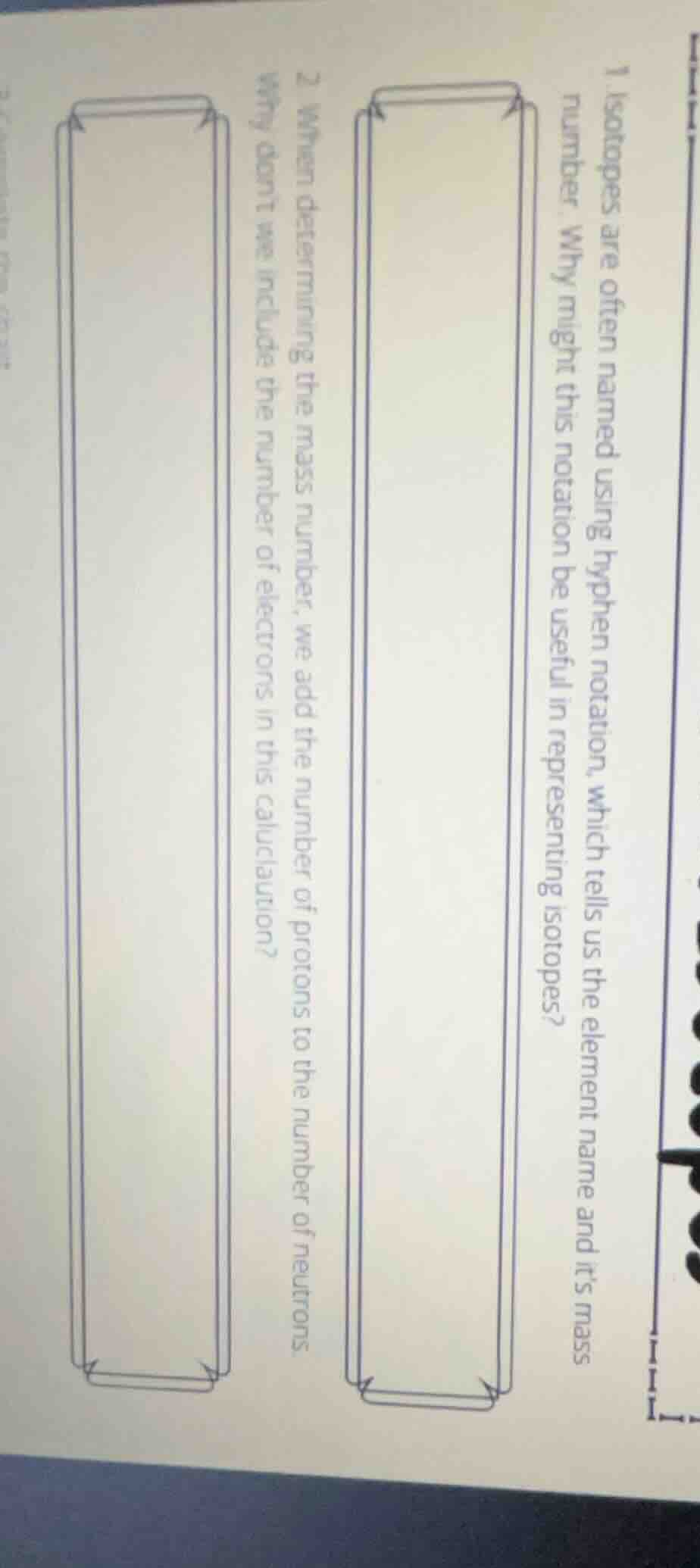
- isotopes are often named using hyphen notation, which tells us the element name and its mass number. why might this notation be useful in representing isotopes?
- when determining the mass number, we add the number of protons to the number of neutrons. why dont we include the number of electrons in this calculation?
Question 1
Isotopes are variants of an element with the same number of protons (atomic number) but different numbers of neutrons, so different mass numbers. Hyphen notation (e.g., Carbon - 14) directly gives the element name and its mass number. This is useful because it quickly identifies the isotope by its mass (sum of protons and neutrons), which is the key difference between isotopes (since protons are fixed for an element, neutrons vary). It simplifies communication about the isotope's mass - related properties like stability, radioactivity, or use in applications (e.g., Carbon - 14 in dating).
The mass number is defined as the sum of the number of protons and neutrons in an atom's nucleus. Electrons have a much smaller mass (about 1/1836 of a proton's mass) and are not considered in the mass number calculation because the mass of an atom is predominantly determined by the nucleus (protons + neutrons). Also, in a neutral atom, the number of electrons equals the number of protons, but electrons can be gained or lost (forming ions) without changing the atom's identity (which is defined by protons/neutrons in the nucleus for mass - related properties). So, since the mass contribution of electrons is negligible and the mass number is about the nucleus's mass, we exclude electrons.

Snap & solve any problem in the app
Get step-by-step solutions on Sovi AI
Photo-based solutions with guided steps
Explore more problems and detailed explanations
Hyphen notation (e.g., Element - MassNumber) is useful for isotopes as it directly provides the element name and its mass number. Isotopes of an element have the same atomic number (protons) but different mass numbers (due to different neutrons), so this notation quickly identifies the isotope by its mass - related identity, aiding in communication about properties (e.g., stability, use in dating/medical applications) that depend on the mass number.