QUESTION IMAGE
Question
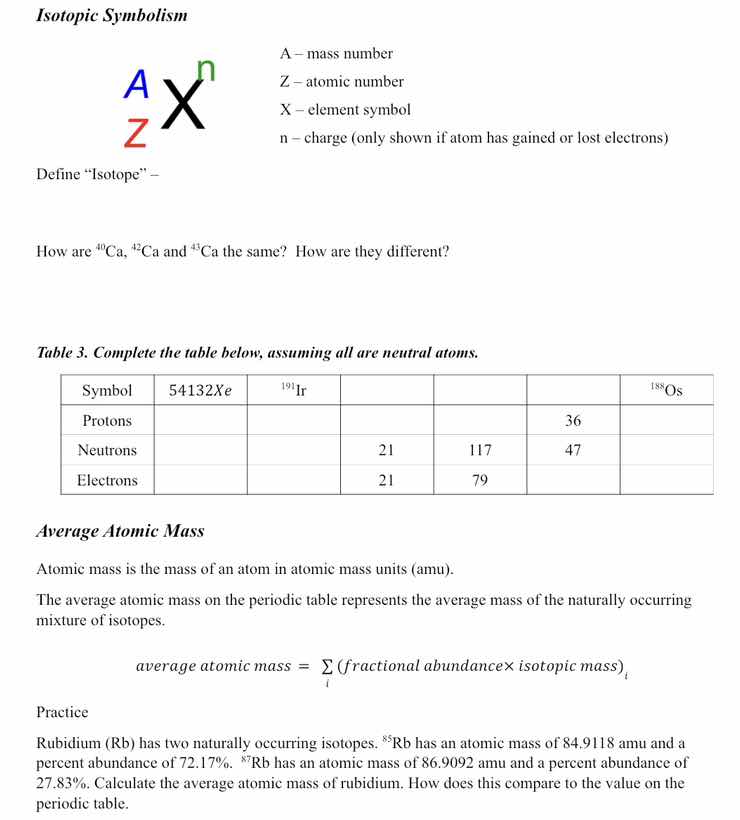
isotopic symbolism
\\(\ce{^{a}_{z}x^{n}}\\)
a – mass number
z – atomic number
x – element symbol
n – charge (only shown if atom has gained or lost electrons)
define \isotope\ –
how are \\(^{40}\ce{ca}\\), \\(^{42}\ce{ca}\\) and \\(^{43}\ce{ca}\\) the same? how are they different?
table 3. complete the table below, assuming all are neutral atoms.
| symbol | \\(54132\ce{xe}\\) | \\(^{193}\ce{ir}\\) | \\(^{198}\ce{os}\\) | |||
|---|---|---|---|---|---|---|
| neutrons | 21 | 117 | 47 | |||
| electrons | 21 | 79 |
average atomic mass
atomic mass is the mass of an atom in atomic mass units (amu).
the average atomic mass on the periodic table represents the average mass of the naturally occurring mixture of isotopes.
\\\text{average atomic mass} = \sum_{i} (\text{fractional abundance} \times \text{isotopic mass})_{i}\\
practice
rubidium (rb) has two naturally occurring isotopes. \\(^{85}\ce{rb}\\) has an atomic mass of 84.9118 amu and a percent abundance of 72.17%. \\(^{87}\ce{rb}\\) has an atomic mass of 86.9092 amu and a percent abundance of 27.83%. calculate the average atomic mass of rubidium. how does this compare to the value on the periodic table.
Step1: Define isotope
Isotopes are atoms of the same element (same atomic number Z) that have different mass numbers (A) due to differing numbers of neutrons.
Step2: Analyze calcium isotopes
All three ($^{40}$Ca, $^{42}$Ca, $^{43}$Ca) are calcium isotopes:
- Same: Same atomic number (Z=20, so 20 protons, 20 electrons in neutral atoms; same element, same chemical properties).
- Different: Different mass numbers, so different numbers of neutrons: $^{40}$Ca has 20 neutrons, $^{42}$Ca has 22 neutrons, $^{43}$Ca has 23 neutrons.
Step3: Complete neutral atom table
For neutral atoms: Protons = Atomic number (Z), Electrons = Protons, Neutrons = Mass number (A) - Z
For $^{54}_{32}$Xe:
Protons = 54, Neutrons = 132 - 54 = 78, Electrons = 54
For $^{191}$Ir:
Iridium (Ir) has Z=77, so Protons=77, Neutrons=191-77=114, Electrons=77
For atom with 21 protons/electrons:
Element is Scandium (Sc, Z=21), Mass number=21+21=42, Symbol: $^{42}_{21}$Sc
For atom with 117 neutrons, 79 electrons:
Protons=79, element is Gold (Au, Z=79), Mass number=79+117=196, Symbol: $^{196}_{79}$Au
For atom with 36 protons, 47 neutrons:
Element is Krypton (Kr, Z=36), Mass number=36+47=83, Symbol: $^{83}_{36}$Kr, Electrons=36
For $^{190}$Os:
Osmium (Os) has Z=76, so Protons=76, Neutrons=190-76=114, Electrons=76
Step4: Calculate average atomic mass
Convert percent abundance to fractional abundance:
- $^{85}$Rb: $\frac{72.17}{100}=0.7217$
- $^{87}$Rb: $\frac{27.83}{100}=0.2783$
Use formula:
$$\text{average atomic mass} = (0.7217 \times 84.9118) + (0.2783 \times 86.9092)$$
Calculate each term:
$0.7217 \times 84.9118 \approx 61.28$
$0.2783 \times 86.9092 \approx 24.19$
Sum: $61.28 + 24.19 = 85.47$ amu

Snap & solve any problem in the app
Get step-by-step solutions on Sovi AI
Photo-based solutions with guided steps
Explore more problems and detailed explanations
- Definition of Isotope: Atoms of the same element (same atomic number) with different mass numbers due to different neutron counts.
- Calcium Isotopes:
- Same: All are calcium atoms, so they have 20 protons and 20 electrons (neutral), identical chemical properties.
- Different: They have different mass numbers, so different neutron counts (20, 22, 23 respectively).
- Completed Table:
| Symbol | $^{132}_{54}$Xe | $^{191}_{77}$Ir | $^{42}_{21}$Sc | $^{196}_{79}$Au | $^{83}_{36}$Kr | $^{190}_{76}$Os |
|---|---|---|---|---|---|---|
| Neutrons | 78 | 114 | 21 | 117 | 47 | 114 |
| Electrons | 54 | 77 | 21 | 79 | 36 | 76 |
- Average Atomic Mass of Rubidium:
The average atomic mass is $\approx 85.47$ amu, which matches the value for rubidium on the periodic table (≈85.47 amu).