QUESTION IMAGE
Question
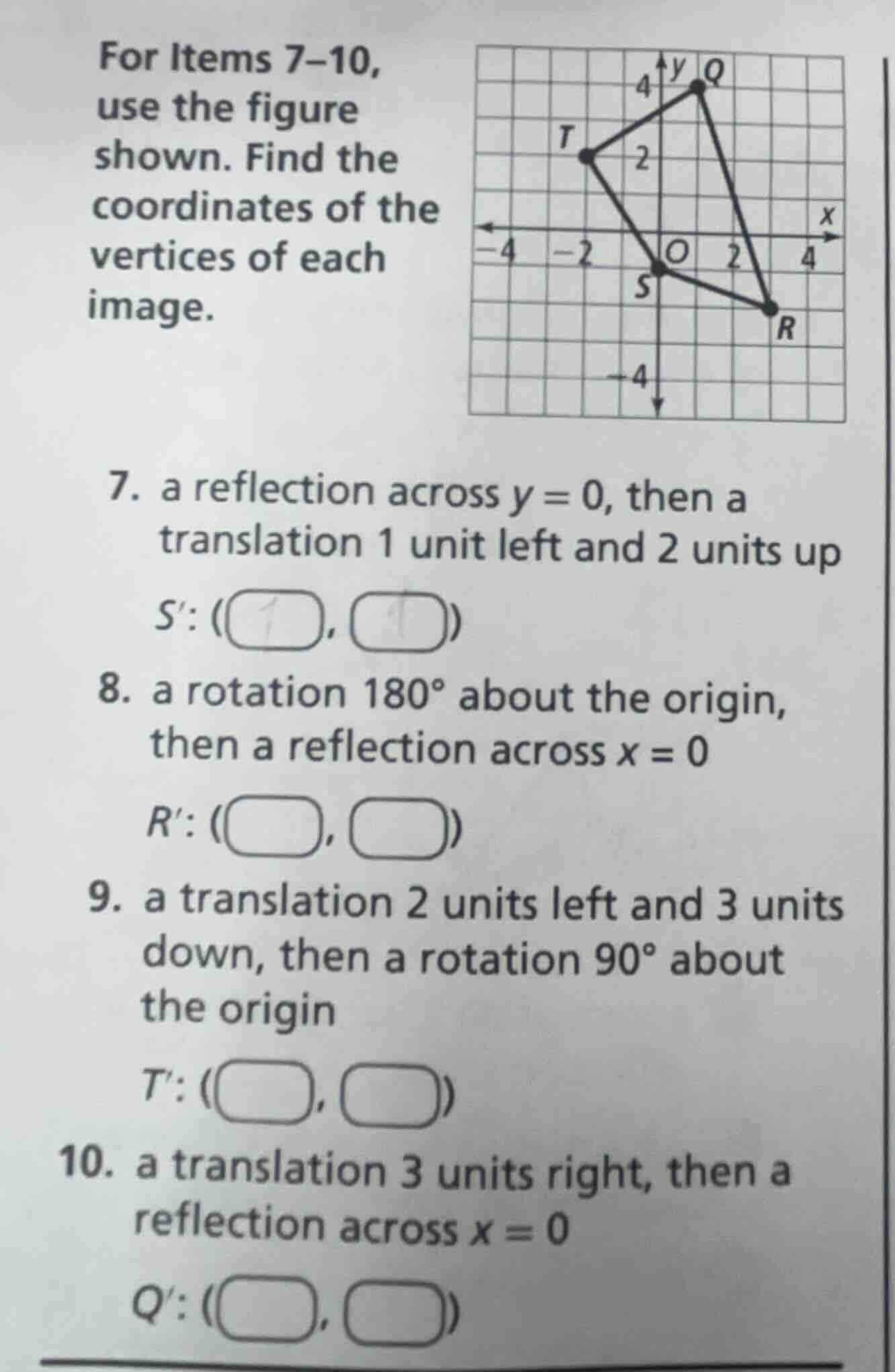
for items 7–10, use the figure shown. find the coordinates of the vertices of each image. 7. a reflection across ( y = 0 ), then a translation 1 unit left and 2 units up ( s : (square, square) ) 8. a rotation ( 180^circ ) about the origin, then a reflection across ( x = 0 ) ( r : (square, square) ) 9. a translation 2 units left and 3 units down, then a rotation ( 90^circ ) about the origin ( t : (square, square) ) 10. a translation 3 units right, then a reflection across ( x = 0 ) ( q : (square, square) )
Item 7:
Step1: Find original coordinates of S
From the graph, \( S \) is at \( (0, -1) \).
Step2: Reflect across \( y = 0 \) (x - axis)
The rule for reflection across \( y = 0 \) is \( (x, y) \to (x, -y) \). So \( S \) becomes \( (0, 1) \).
Step3: Translate 1 unit left and 2 units up
The rule for translation 1 unit left (subtract 1 from x) and 2 units up (add 2 to y) is \( (x, y) \to (x - 1, y + 2) \). So \( (0 - 1, 1 + 2)=(-1, 3) \).
Step1: Find original coordinates of R
From the graph, \( R \) is at \( (3, -2) \).
Step2: Rotate \( 180^\circ \) about the origin
The rule for \( 180^\circ \) rotation about the origin is \( (x, y) \to (-x, -y) \). So \( R \) becomes \( (-3, 2) \).
Step3: Reflect across \( x = 0 \) (y - axis)
The rule for reflection across \( x = 0 \) is \( (x, y) \to (-x, y) \). So \( (-3, 2) \to (3, 2) \).
Step1: Find original coordinates of T
From the graph, \( T \) is at \( (-2, 2) \).
Step2: Translate 2 units left and 3 units down
The rule for translation 2 units left (subtract 2 from x) and 3 units down (subtract 3 from y) is \( (x, y) \to (x - 2, y - 3) \). So \( (-2 - 2, 2 - 3)=(-4, -1) \).
Step3: Rotate \( 90^\circ \) about the origin (counter - clockwise, assuming standard rotation)
The rule for \( 90^\circ \) counter - clockwise rotation about the origin is \( (x, y) \to (-y, x) \). So \( (-4, -1) \to (1, -4) \). (If clockwise, the rule is \( (x, y)\to(y, -x) \), but usually \( 90^\circ \) rotation in coordinate geometry is counter - clockwise unless specified otherwise. Let's re - check: For \( 90^\circ \) counter - clockwise, \( (x,y)\to(-y,x) \). For \( (-4,-1) \), \( -y = 1 \), \( x=-4 \), so \( (1, - 4) \))

Snap & solve any problem in the app
Get step-by-step solutions on Sovi AI
Photo-based solutions with guided steps
Explore more problems and detailed explanations
\( S' : (-1, 3) \)