QUESTION IMAGE
Question
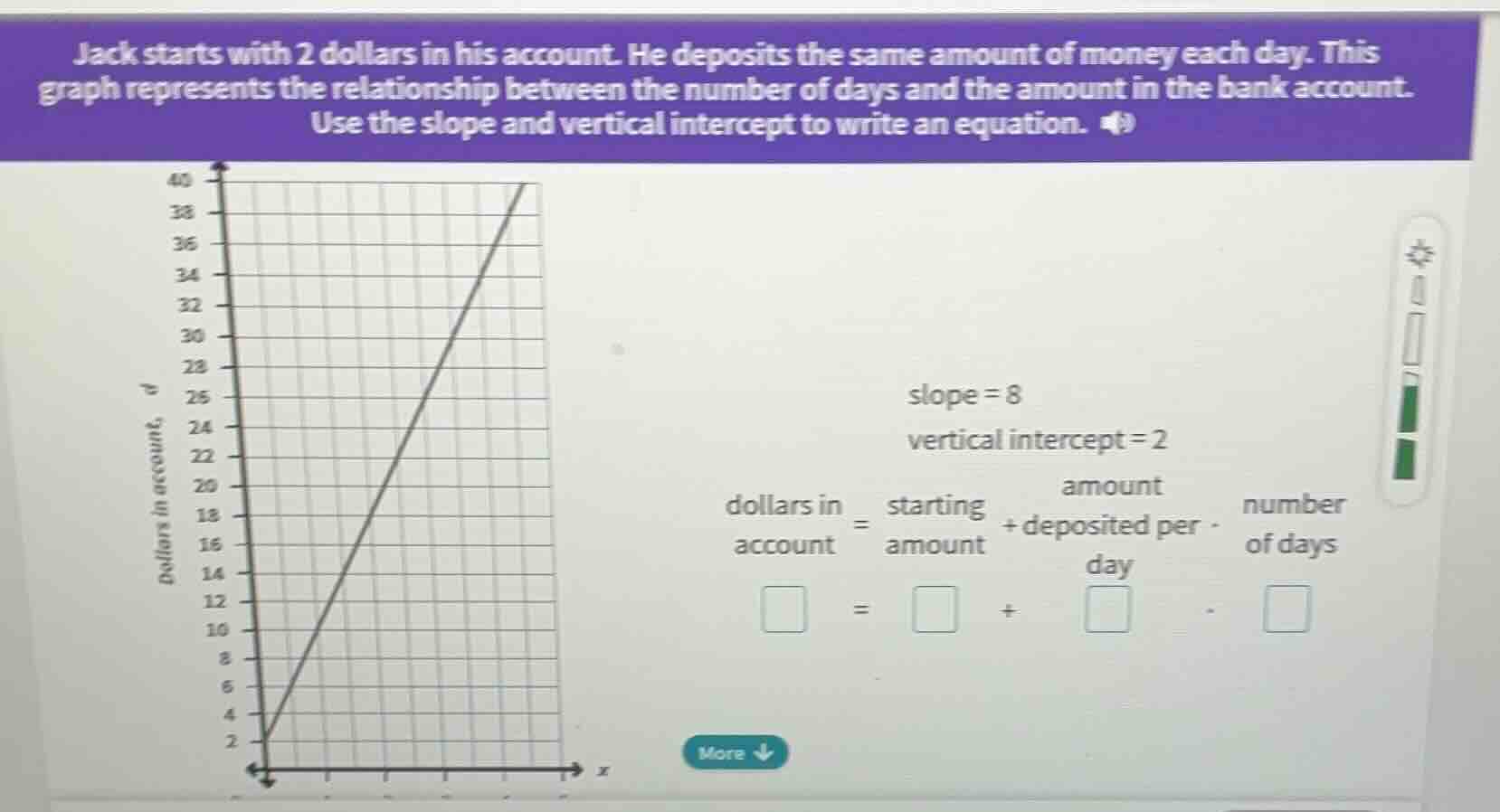
jack starts with 2 dollars in his account. he deposits the same amount of money each day. this graph represents the relationship between the number of days and the amount in the bank account. use the slope and vertical intercept to write an equation. slope = 8 vertical intercept = 2 dollars in account = starting amount + amount deposited per day · number of days \square = \square + \square \cdot \square
Step1: Identify the variables and components
The "dollars in account" is the dependent variable (let's call it \( d \)), the "starting amount" is the vertical intercept (2), the "amount deposited per day" is the slope (8), and the "number of days" is the independent variable (let's call it \( x \)).
Step2: Substitute into the formula
Using the given formula: \( \text{dollars in account} = \text{starting amount} + \text{amount deposited per day} \cdot \text{number of days} \), we substitute the values. So \( d = 2 + 8 \cdot x \). In the boxed form for each part: the first box (dollars in account) can be represented as \( d \), the second (starting amount) is 2, the third (amount deposited per day) is 8, and the fourth (number of days) is \( x \). But looking at the structure, if we fill the boxes with the values as per the formula's placeholders:
First box (dollars in account): Let's use \( d \) (or we can think in terms of the equation structure, but the formula given is a word - formula to be filled with numbers and variable. Wait, the starting amount is 2, amount deposited per day is 8 (slope), number of days is \( x \), and dollars in account is \( d \). So filling the boxes:
\( \boldsymbol{d} = \boldsymbol{2} + \boldsymbol{8} \cdot \boldsymbol{x} \)

Snap & solve any problem in the app
Get step-by-step solutions on Sovi AI
Photo-based solutions with guided steps
Explore more problems and detailed explanations
\( d = 2 + 8 \cdot x \) (Filling the boxes from left to right: \( d \), \( 2 \), \( 8 \), \( x \))