QUESTION IMAGE
Question
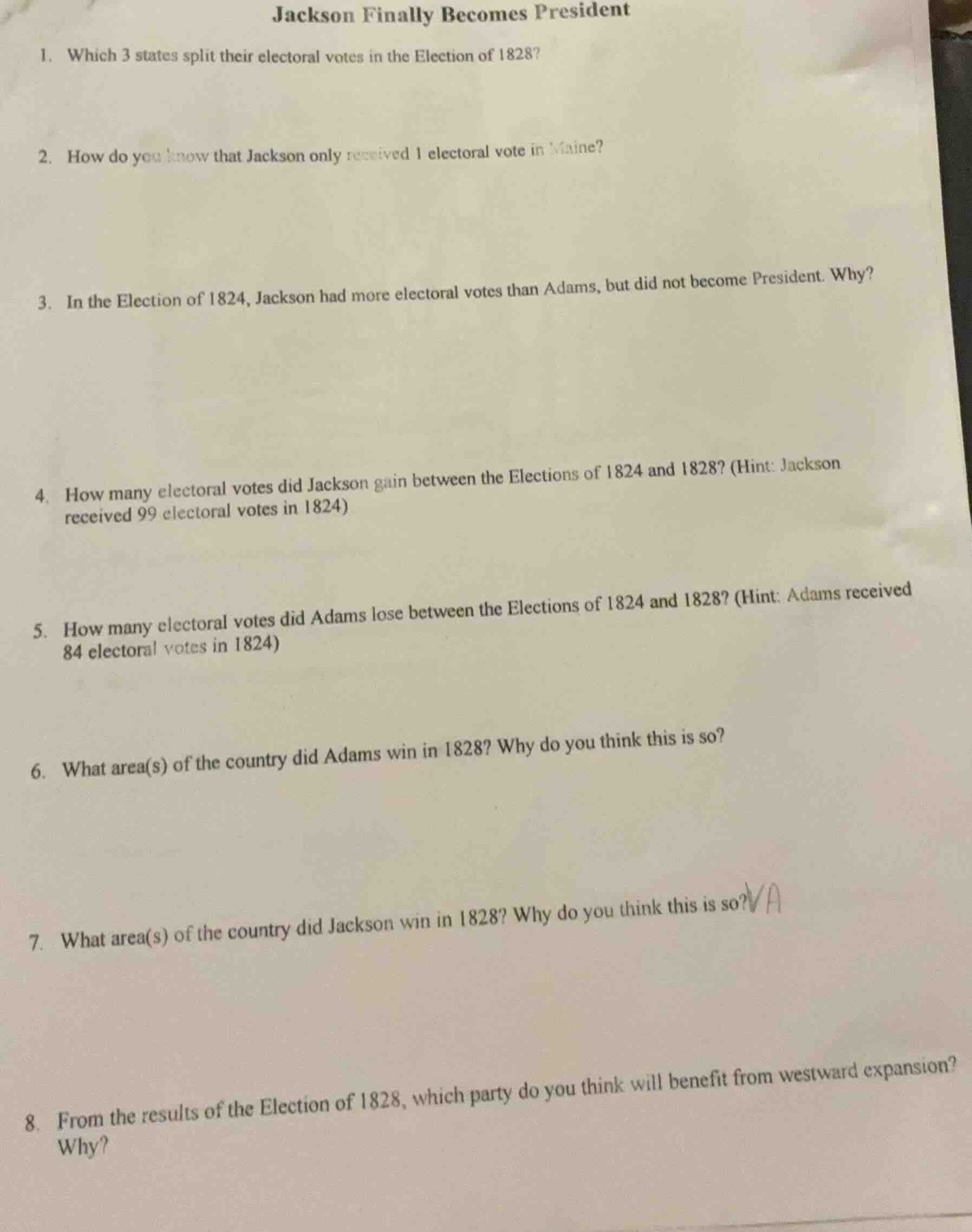
jackson finally becomes president
- which 3 states split their electoral votes in the election of 1828?
- how do you know that jackson only received 1 electoral vote in maine?
- in the election of 1824, jackson had more electoral votes than adams, but did not become president. why?
- how many electoral votes did jackson gain between the elections of 1824 and 1828? (hint: jackson received 99 electoral votes in 1824)
- how many electoral votes did adams lose between the elections of 1824 and 1828? (hint: adams received 84 electoral votes in 1824)
- what area(s) of the country did adams win in 1828? why do you think this is so?
- what area(s) of the country did jackson win in 1828? why do you think this is so?
- from the results of the election of 1828, which party do you think will benefit from westward expansion? why?
Brief Explanations
- Historical election records document the three states that split their electoral votes in 1828.
- Official 1828 election returns for Maine track Jackson's electoral vote count there.
- U.S. presidential election rules require a majority of electoral votes; if no candidate wins a majority, the House of Representatives selects the president.
- Calculate using 1824 and 1828 electoral vote totals for Jackson.
- Calculate using 1824 and 1828 electoral vote totals for Adams.
- Adams' support was concentrated in regions aligned with his policy base.
- Jackson's support came from regions favoring his populist platform.
- Jackson's party's regional strength aligns with westward expansion trends.

Snap & solve any problem in the app
Get step-by-step solutions on Sovi AI
Photo-based solutions with guided steps
Explore more problems and detailed explanations
- Maryland, Kentucky, and Missouri
- Official electoral vote tallies from the 1828 U.S. presidential election for Maine show Jackson received only 1 of the state's 9 electoral votes.
- No candidate won a majority of electoral votes (Jackson had 99, short of the 131 needed), so the House of Representatives chose John Quincy Adams as president per the 12th Amendment.
- Jackson won 178 electoral votes in 1828. $178 - 99 = 79$, so he gained 79 electoral votes.
- Adams won 83 electoral votes in 1828. $84 - 83 = 1$, so he lost 1 electoral vote.
- Adams won New England and parts of the Mid-Atlantic. This is because these regions were home to wealthy merchants, industrialists, and established elites who supported his pro-business, federal infrastructure policies.
- Jackson won the South, the West, and most of the Mid-Atlantic. This is because he positioned himself as a populist champion of ordinary farmers, frontiersmen, and working people, who opposed Adams' elite-focused agenda.
- The Democratic Party (Jackson's party) will benefit. Westward expansion created more new states with populations of frontiersmen and small farmers, who aligned with Jackson's populist, pro-agriculture platform.