QUESTION IMAGE
Question
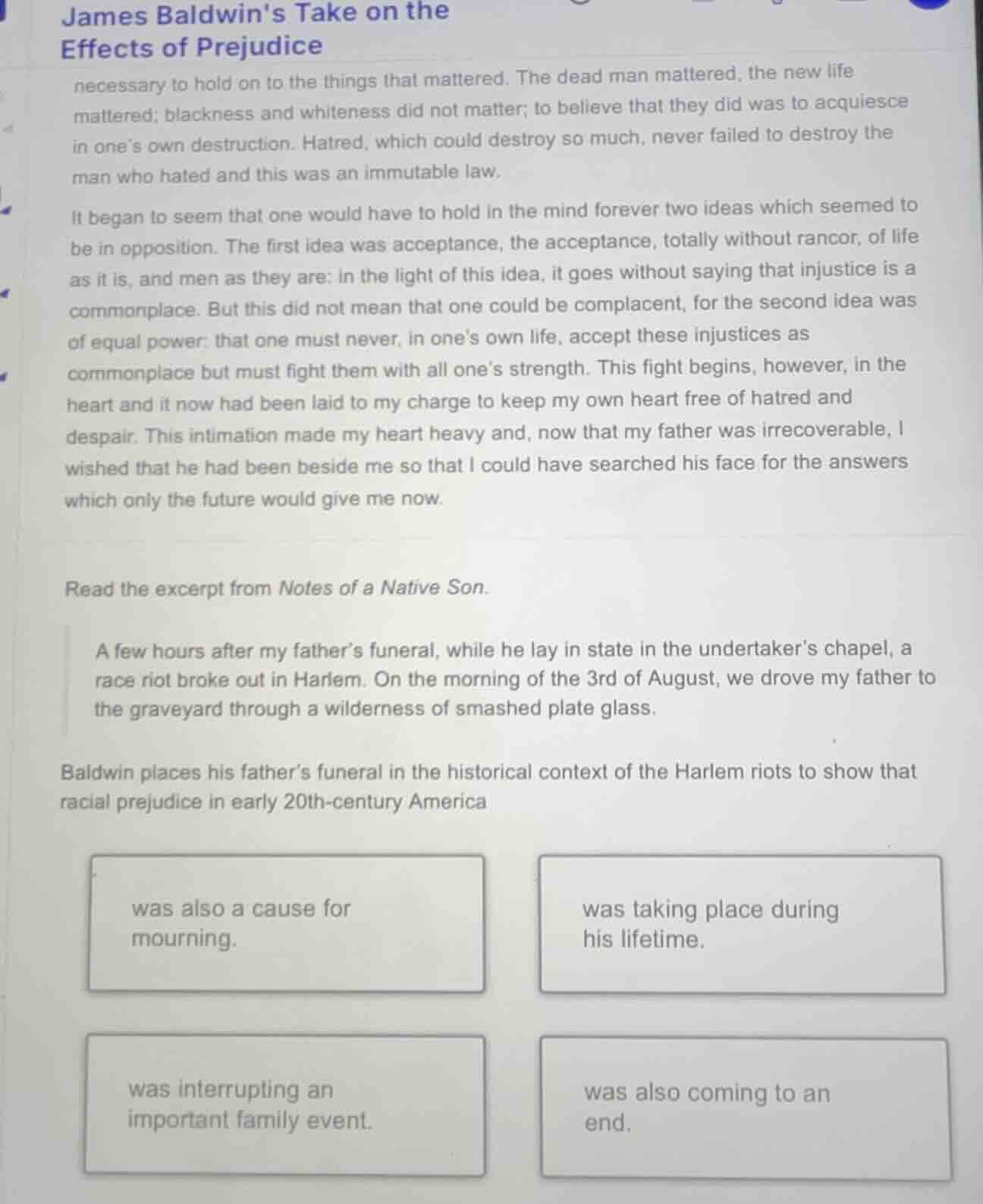
james baldwins take on the effects of prejudice necessary to hold on to the things that mattered. the dead man mattered, the new life mattered; blackness and whiteness did not matter; to believe that they did was to acquiesce in one’s own destruction. hatred, which could destroy so much, never failed to destroy the man who hated and this was an immutable law. it began to seem that one would have to hold in the mind forever two ideas which seemed to be in opposition. the first idea was acceptance, the acceptance, totally without rancor, of life as it is, and men as they are: in the light of this idea, it goes without saying that injustice is a commonplace. but this did not mean that one could be complacent, for the second idea was of equal power: that one must never, in one’s own life, accept these injustices as commonplace but must fight them with all one’s strength. this fight begins, however, in the heart and it now had been laid to my charge to keep my own heart free of hatred and despair. this intimation made my heart heavy and, now that my father was irrecoverable, i wished that he had been beside me so that i could have searched his face for the answers which only the future would give me now. read the excerpt from notes of a native son. a few hours after my father’s funeral, while he lay in state in the undertaker’s chapel, a race riot broke out in harlem. on the morning of the 3rd of august, we drove my father to the graveyard through a wilderness of smashed plate glass. baldwin places his father’s funeral in the historical context of the harlem riots to show that racial prejudice in early 20th - century america was also a cause for mourning. was taking place during his lifetime. was interrupting an important family event. was also coming to an end.
To solve this, we analyze each option:
- Option "was also a cause for mourning": The text emphasizes the broader context of racial prejudice in society, not that it caused mourning for the father's death.
- Option "was taking place during his lifetime": The father has passed away, and the riot happens during the funeral, showing prejudice existed while he was alive (as the funeral is post - death, but the prejudice was a lifelong issue).
- Option "was interrupting an important family event": The focus is on the historical context of prejudice, not just the interruption of the funeral.
- Option "was also coming to an end": The text shows prejudice was ongoing (riot during funeral), not ending.

Snap & solve any problem in the app
Get step-by-step solutions on Sovi AI
Photo-based solutions with guided steps
Explore more problems and detailed explanations
B. was taking place during his lifetime.