QUESTION IMAGE
Question
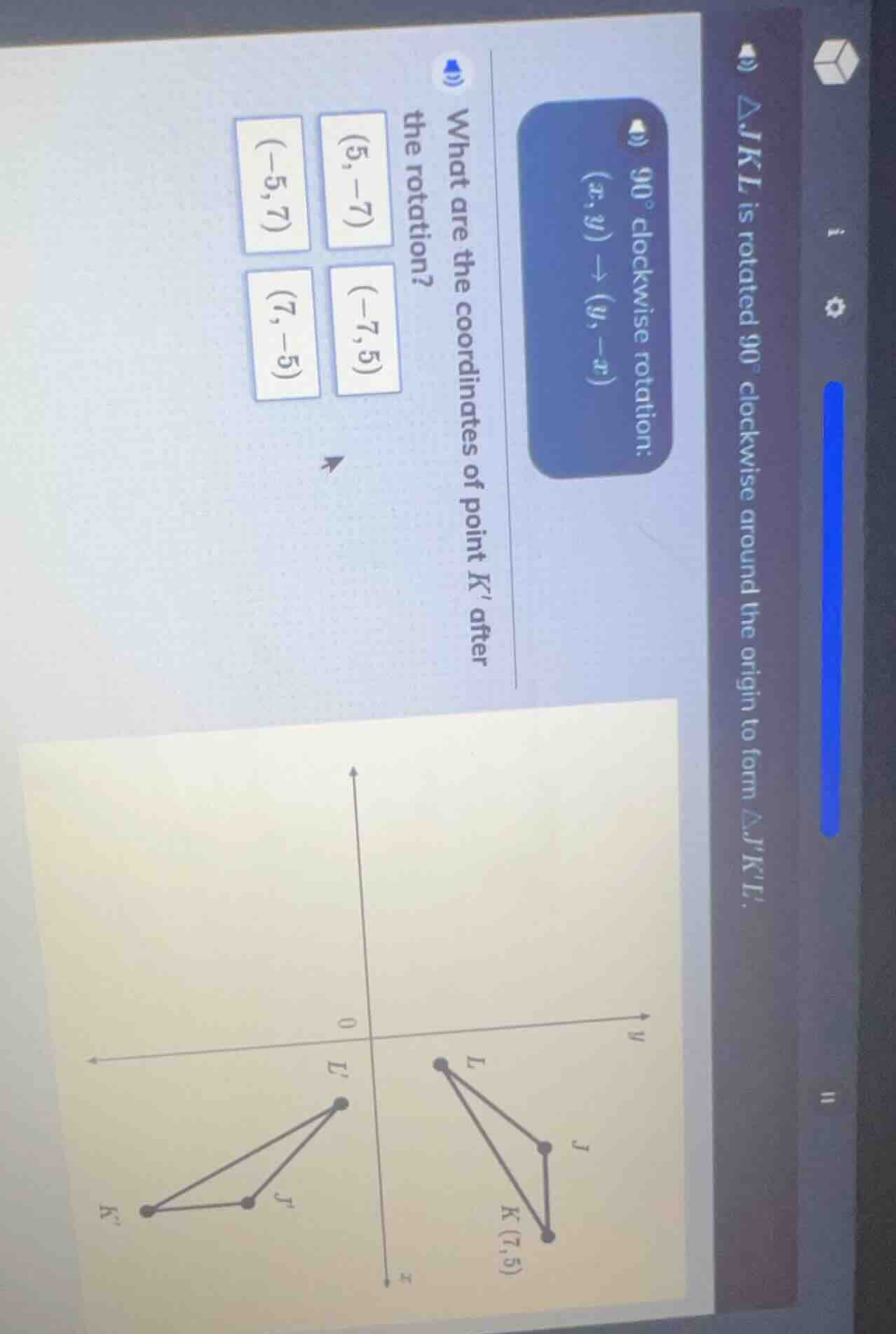
△jkl is rotated 90° clockwise around the origin to form △jkl. 90° clockwise rotation: ((x, y) \to (y, -x)) what are the coordinates of point (k) after the rotation? options: ((5, -7)), ((-7, 5)), ((-5, 7)), ((7, -5)) (note: the image shows the triangle and the coordinate of (k) as ((7, 5)))
Step1: Identify the original coordinates of K
From the graph, the coordinates of point \( K \) are \( (7, 5) \).
Step2: Apply the 90° clockwise rotation rule
The rule for a 90° clockwise rotation about the origin is \( (x, y) \to (y, -x) \).
Substitute \( x = 7 \) and \( y = 5 \) into the rule:
New \( x \)-coordinate: \( y = 5 \)
New \( y \)-coordinate: \( -x = -7 \)
Wait, no, wait. Wait, the rule given in the problem is \( (x, y) \to (y, -x) \)? Wait, no, let's check again. Wait, the problem says "90° clockwise rotation: \( (x, y) \to (y, -x) \)"? Wait, no, actually, the standard 90° clockwise rotation rule is \( (x, y) \to (y, -x) \)? Wait, no, standard 90° clockwise rotation is \( (x, y) \to (y, -x) \)? Wait, no, let's confirm. Wait, the standard 90° clockwise rotation about the origin: the transformation is \( (x, y) \mapsto (y, -x) \). Wait, but let's use the given rule. The problem states the 90° clockwise rotation rule as \( (x, y) \to (y, -x) \). So for point \( K(7, 5) \), applying the rule:
\( x = 7 \), \( y = 5 \)
New \( x \)-coordinate: \( y = 5 \)
New \( y \)-coordinate: \( -x = -7 \)
Wait, but that would give \( (5, -7) \)? Wait, no, wait, maybe I made a mistake. Wait, no, let's check the graph. Wait, the original triangle \( \triangle JKL \) is in the first quadrant (since \( K \) is at \( (7,5) \), which is first quadrant). After 90° clockwise rotation, the image \( \triangle J'K'L' \) should be in the fourth quadrant? Wait, no, 90° clockwise rotation of a point \( (x, y) \) in the first quadrant (x>0, y>0) would result in \( (y, -x) \), which is (positive, negative), so fourth quadrant. Wait, but looking at the options, \( (5, -7) \) is one of the options. Wait, but let's re-express the rule. Wait, the problem says "90° clockwise rotation: \( (x, y) \to (y, -x) \)". So for \( K(7,5) \), applying the rule:
\( x = 7 \), \( y = 5 \)
So new coordinates: \( (y, -x) = (5, -7) \). Wait, but let's check the options. One of the options is \( (5, -7) \). Wait, but let's confirm again. Wait, the original coordinates of \( K \) are \( (7, 5) \). Applying 90° clockwise rotation: \( (x, y) \to (y, -x) \). So \( (7, 5) \to (5, -7) \). So the coordinates of \( K' \) are \( (5, -7) \).

Snap & solve any problem in the app
Get step-by-step solutions on Sovi AI
Photo-based solutions with guided steps
Explore more problems and detailed explanations
\( (5, -7) \)