QUESTION IMAGE
Question
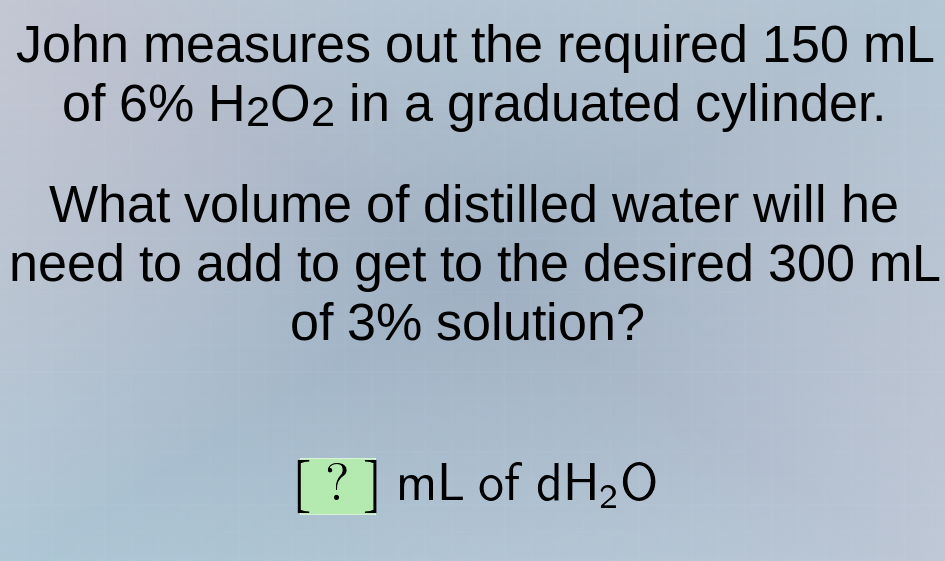
john measures out the required 150 ml of 6% h₂o₂ in a graduated cylinder. what volume of distilled water will he need to add to get to the desired 300 ml of 3% solution? ? ml of dh₂o
Step1: Understand the dilution principle
The amount of solute (H₂O₂) before and after dilution remains the same. The formula for dilution is \( C_1V_1 = C_2V_2 \), where \( C_1 \) is the initial concentration, \( V_1 \) is the initial volume, \( C_2 \) is the final concentration, and \( V_2 \) is the final volume. But here we can also calculate the volume of water by subtracting the initial volume from the final volume after considering the solute amount. First, find the volume of H₂O₂ in the initial solution. The initial volume \( V_1 = 150 \, \text{mL} \) and concentration \( C_1 = 6\% \), so the volume of H₂O₂ \( V_{\text{H}_2\text{O}_2} = 150 \times 0.06 \) (but we can also use the fact that in the final solution, the amount of H₂O₂ should be the same. The final volume \( V_2 = 300 \, \text{mL} \) and concentration \( C_2 = 3\% \), so the volume of H₂O₂ in the final solution is \( 300 \times 0.03 = 9 \, \text{mL} \). In the initial solution, the volume of H₂O₂ is \( 150 \times 0.06 = 9 \, \text{mL} \), which matches. Now, to find the volume of water, we can use the fact that the final volume is 300 mL and the initial volume of the solution (H₂O₂ + water initially) is 150 mL. Wait, actually, the initial solution is 150 mL of 6% H₂O₂, so the volume of water to add is final volume minus initial volume of the solution. Wait, no: the initial solution has 150 mL (H₂O₂ + some water), and we need to add distilled water to make it 300 mL of 3% solution. Since the amount of H₂O₂ is constant, let's confirm:
Initial amount of H₂O₂: \( 150 \, \text{mL} \times 6\% = 9 \, \text{mL} \)
Final amount of H₂O₂: \( 300 \, \text{mL} \times 3\% = 9 \, \text{mL} \), which is the same, so that checks out.
Now, the initial volume of the solution (H₂O₂ + water) is 150 mL. The final volume of the solution (H₂O₂ + added water) is 300 mL. So the volume of added water is final volume - initial volume of the solution. Wait, but is the initial solution's volume just the 150 mL? Yes, because John measured out 150 mL of the 6% solution. So to get to 300 mL, he needs to add \( 300 - 150 = 150 \, \text{mL} \) of distilled water. Wait, that seems too simple? Wait, let's think again. The initial solution has 150 mL (with 6% H₂O₂), and we need to make 300 mL of 3% solution. Since the amount of H₂O₂ is the same (9 mL), the total volume of the solution is 300 mL, so the volume of water is 300 - 9 = 291 mL? No, that's wrong. Wait, no: the solution is H₂O₂ + water. So in the initial solution, volume of H₂O₂ is 9 mL, so volume of water initially is 150 - 9 = 141 mL. In the final solution, volume of H₂O₂ is 9 mL, volume of water is 300 - 9 = 291 mL. So the volume of water added is 291 - 141 = 150 mL. Ah, so that's the same as 300 - 150 = 150 mL. So that's correct.
Wait, another way: the formula for dilution when adding solvent (water) is \( V_{\text{solvent}} = V_2 - V_1 \), where \( V_1 \) is the initial volume of the solution, \( V_2 \) is the final volume of the solution. Since the amount of solute is constant, \( C_1V_1 = C_2V_2 \), which we saw gives the same amount of solute, so \( V_2 = \frac{C_1V_1}{C_2} = \frac{6\% \times 150}{3\%} = 300 \, \text{mL} \), which is the final volume. So the volume of solvent (water) to add is \( V_2 - V_1 = 300 - 150 = 150 \, \text{mL} \).
Step2: Calculate the volume of water
Final volume \( V_2 = 300 \, \text{mL} \)
Initial volume \( V_1 = 150 \, \text{mL} \)
Volume of distilled water to add \( = V_2 - V_1 = 300 - 150 = 150 \, \text{mL} \)

Snap & solve any problem in the app
Get step-by-step solutions on Sovi AI
Photo-based solutions with guided steps
Explore more problems and detailed explanations
150