QUESTION IMAGE
Question
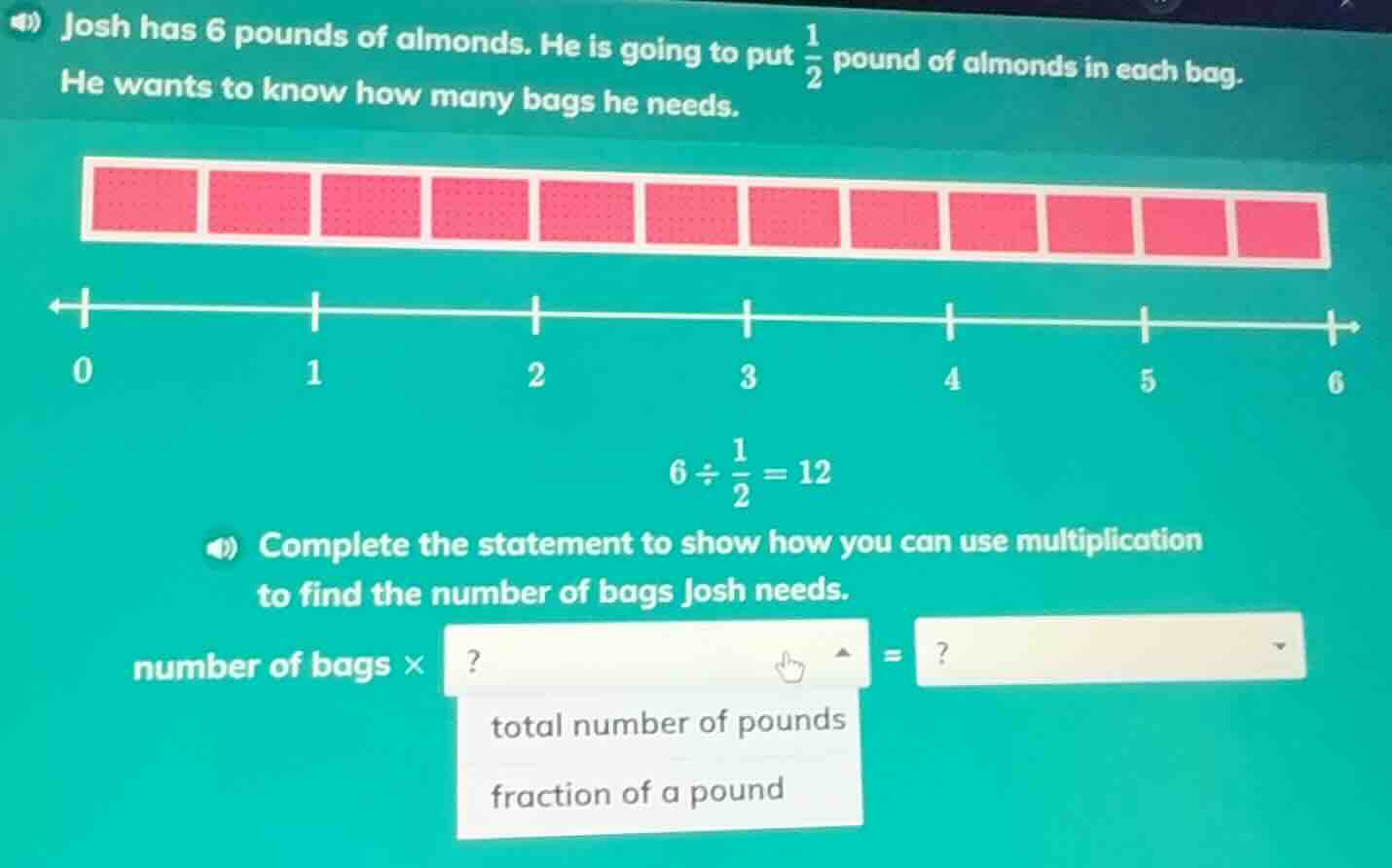
josh has 6 pounds of almonds. he is going to put \\(\frac{1}{2}\\) pound of almonds in each bag. he wants to know how many bags he needs. \\(6 \div \frac{1}{2} = 12\\) complete the statement to show how you can use multiplication to find the number of bags josh needs. number of bags \\(\times\\) ? = ? total number of pounds fraction of a pound
Step1: Understand the relationship
We know that the amount in each bag (fraction of a pound) times the number of bags should equal the total number of pounds. Let the number of bags be \( n \), the fraction per bag be \( \frac{1}{2} \), and total pounds be \( 6 \). So the relationship is \( n\times\frac{1}{2}=6 \), but we can also think in terms of the multiplication that relates to the division. Since \( 6\div\frac{1}{2}=6\times2 = 12 \), and from the multiplication perspective, number of bags \( \times \) fraction of a pound \( = \) total number of pounds. Wait, no, actually, if each bag has \( \frac{1}{2} \) pound, then number of bags \( \times \) (fraction of a pound per bag) \( = \) total pounds. So here, fraction of a pound per bag is \( \frac{1}{2} \), total pounds is \( 6 \). So the first blank (the multiplier) is "fraction of a pound" (which is \( \frac{1}{2} \)) and the second blank is "total number of pounds" (which is \( 6 \))? Wait, no, let's re-express. Let \( b \) be the number of bags. Each bag has \( \frac{1}{2} \) pound, so total pounds is \( b\times\frac{1}{2} \). We know total pounds is \( 6 \), so \( b\times\frac{1}{2}=6 \), but we can also use the inverse: since \( 6\div\frac{1}{2}=12 \), which is the number of bags. But the question is to complete \( \text{number of bags} \times \text{[?]} = \text{[?]} \). So from the formula: \( \text{number of bags} \times \text{fraction of a pound (per bag)} = \text{total number of pounds} \). So the first "?" is "fraction of a pound" (because that's the amount per bag) and the second "?" is "total number of pounds" (because that's the total amount). Wait, but let's check with numbers. If number of bags is \( 12 \), then \( 12\times\frac{1}{2}=6 \), which matches. So yes, the first blank is "fraction of a pound" and the second blank is "total number of pounds".

Snap & solve any problem in the app
Get step-by-step solutions on Sovi AI
Photo-based solutions with guided steps
Explore more problems and detailed explanations
number of bags \( \times \) fraction of a pound \( = \) total number of pounds
So the first "?" is "fraction of a pound" and the second "?" is "total number of pounds".