QUESTION IMAGE
Question
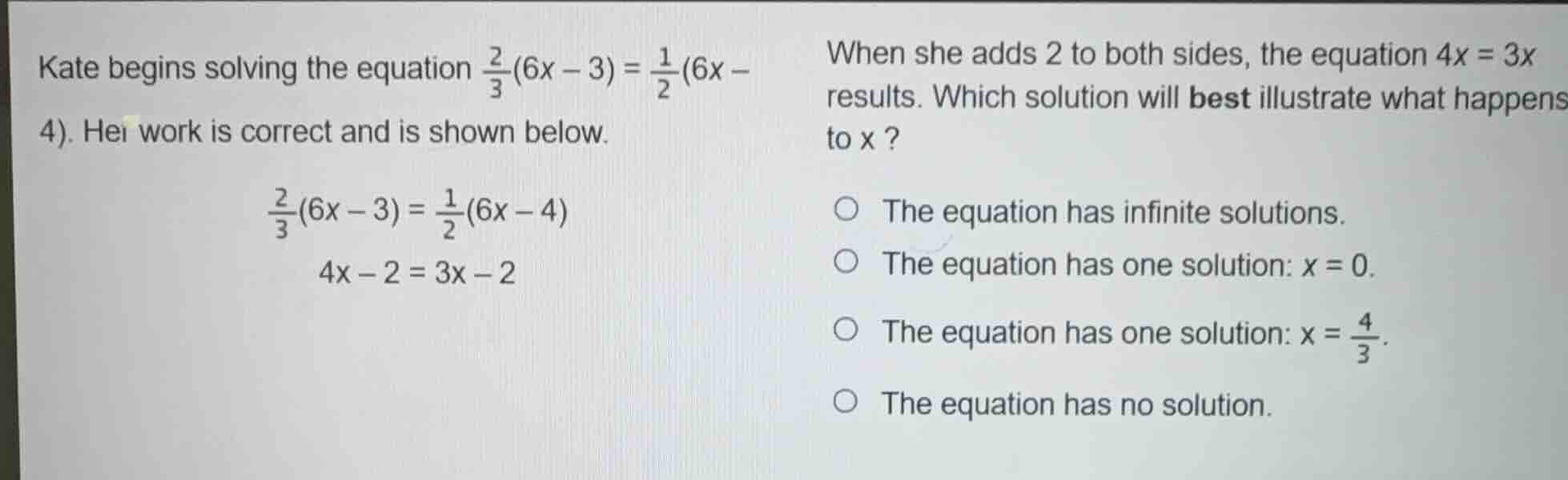
kate begins solving the equation \\(\frac{2}{3}(6x - 3) = \frac{1}{2}(6x - 4)\\). her work is correct and is shown below.\\(\frac{2}{3}(6x - 3) = \frac{1}{2}(6x - 4)\\)\\(4x - 2 = 3x - 2\\)when she adds 2 to both sides, the equation \\(4x = 3x\\) results. which solution will best illustrate what happens to x ?\\(\circ\\) the equation has infinite solutions.\\(\circ\\) the equation has one solution: \\(x = 0\\).\\(\circ\\) the equation has one solution: \\(x = \frac{4}{3}\\).\\(\circ\\) the equation has no solution.
Step1: Analyze the equation after adding 2
We start with the equation \(4x - 2 = 3x - 2\). After adding 2 to both sides, we get \(4x=3x\).
Step2: Solve for x
Subtract \(3x\) from both sides of the equation \(4x = 3x\). So \(4x-3x=3x - 3x\), which simplifies to \(x = 0\).

Snap & solve any problem in the app
Get step-by-step solutions on Sovi AI
Photo-based solutions with guided steps
Explore more problems and detailed explanations
The equation has one solution: \(x = 0\) (corresponding to the option "The equation has one solution: \(x = 0\)")