QUESTION IMAGE
Question
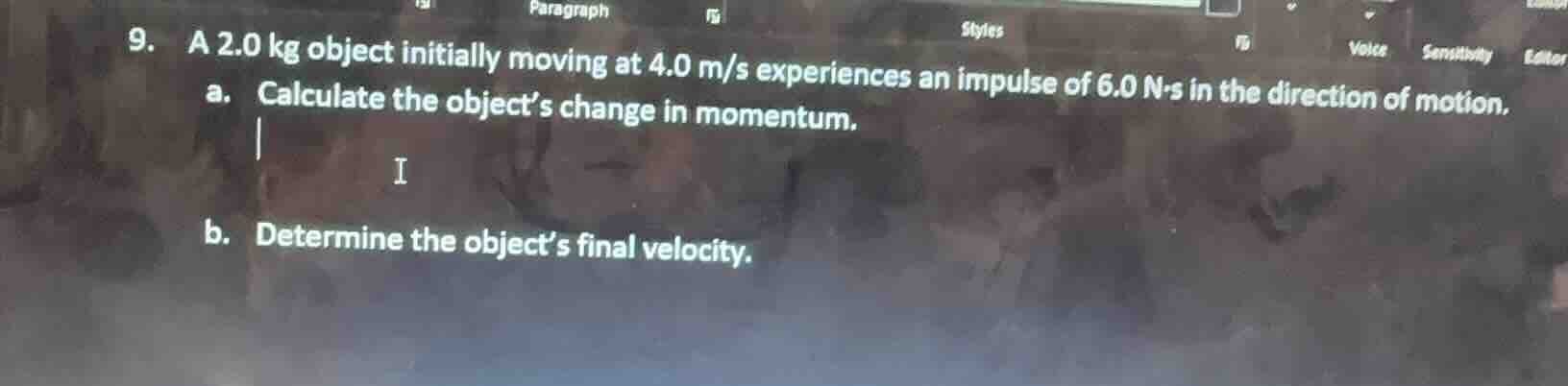
- a 2.0 kg object initially moving at 4.0 m/s experiences an impulse of 6.0 n·s in the direction of motion,
a. calculate the object’s change in momentum.
b. determine the object’s final velocity.
Part a
Step1: Recall impulse-momentum theorem
The impulse-momentum theorem states that the impulse (\(I\)) applied to an object is equal to the change in its momentum (\(\Delta p\)). So, \(\Delta p = I\).
Step2: Substitute the given value
We are given \(I = 6.0\space N\cdot s\). So, \(\Delta p=6.0\space kg\cdot m/s\) (since \(1\space N\cdot s = 1\space kg\cdot m/s\)).
Step1: Recall the formula for momentum change
The change in momentum \(\Delta p=m(v_f - v_i)\), where \(m\) is the mass, \(v_f\) is the final velocity and \(v_i\) is the initial velocity. We know \(\Delta p = 6.0\space kg\cdot m/s\), \(m = 2.0\space kg\) and \(v_i=4.0\space m/s\).
Step2: Rearrange the formula to solve for \(v_f\)
From \(\Delta p=m(v_f - v_i)\), we can rearrange it as \(v_f=\frac{\Delta p}{m}+v_i\)
Step3: Substitute the values
Substitute \(\Delta p = 6.0\space kg\cdot m/s\), \(m = 2.0\space kg\) and \(v_i = 4.0\space m/s\) into the formula:
\(v_f=\frac{6.0}{2.0}+ 4.0\)
\(v_f = 3.0+4.0=7.0\space m/s\)

Snap & solve any problem in the app
Get step-by-step solutions on Sovi AI
Photo-based solutions with guided steps
Explore more problems and detailed explanations
The object's change in momentum is \(\boldsymbol{6.0\space kg\cdot m/s}\)