QUESTION IMAGE
Question
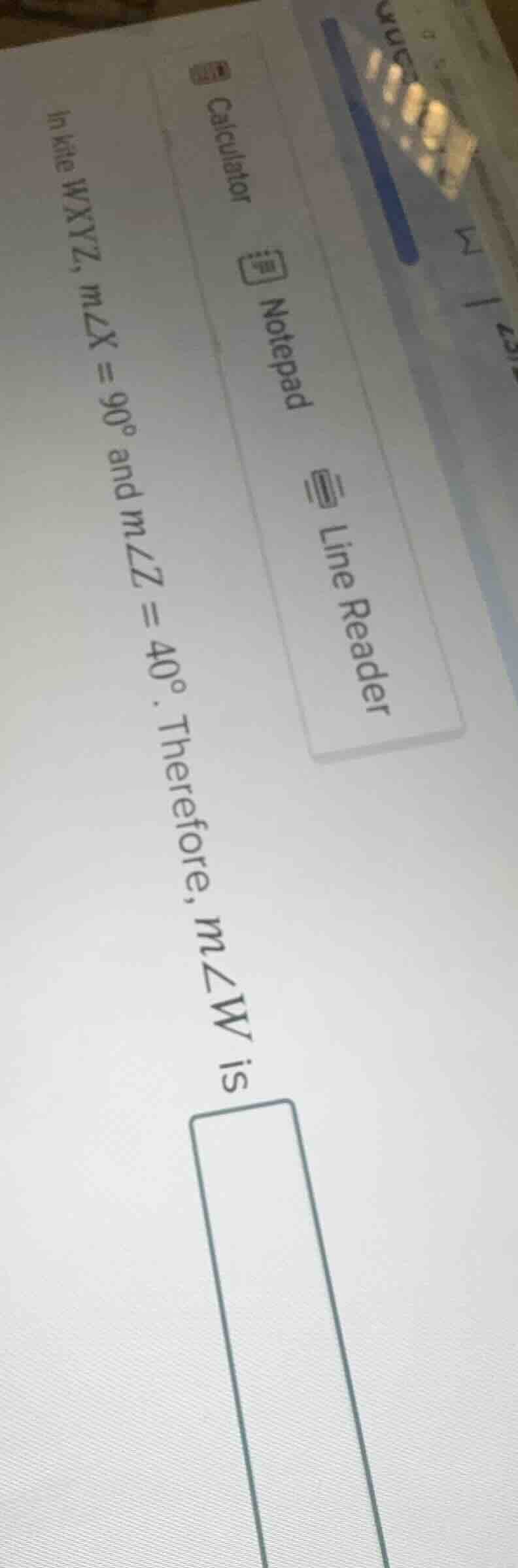
in kite wxyz, m∠x = 90° and m∠z = 40°. therefore, m∠w is
Step1: Recall the property of a kite's interior angles.
The sum of the interior angles of any quadrilateral is \(360^\circ\). In a kite, one pair of opposite angles (the ones between the unequal sides) are equal. Let's denote the angles of kite \(WXYZ\) as \(\angle W\), \(\angle X\), \(\angle Y\), \(\angle Z\). We know that in a kite, \(\angle W=\angle Y\) (assuming the kite is labeled such that \(W\) and \(Y\) are the vertices between the unequal sides; or depending on the kite's structure, but here we know \(\angle X = 90^\circ\) and \(\angle Z=40^\circ\), and we need to find \(\angle W\)).
The sum of interior angles of a quadrilateral is given by the formula: \(\angle W+\angle X+\angle Y+\angle Z = 360^\circ\). Since in a kite, \(\angle W=\angle Y\) (let's confirm: in a kite, two distinct pairs of adjacent sides are equal. The angles between the unequal sides are equal. So if \(WX = WZ\) and \(XY = ZY\), then \(\angle W\) and \(\angle Y\) are the angles between the equal sides? Wait, maybe better to recall that in a kite, one pair of opposite angles are equal. Let's assume that \(\angle W=\angle Y\) here.
So we have \(\angle X = 90^\circ\), \(\angle Z = 40^\circ\), and \(\angle W=\angle Y\). Let \(\angle W = x\), then \(\angle Y=x\).
Step2: Set up the equation for the sum of angles.
Using the sum of interior angles: \(x + 90^\circ+x + 40^\circ=360^\circ\).
Combine like terms: \(2x+130^\circ = 360^\circ\).
Step3: Solve for \(x\) (which is \(\angle W\)).
Subtract \(130^\circ\) from both sides: \(2x=360^\circ - 130^\circ=230^\circ\)? Wait, no, that can't be. Wait, maybe I made a mistake in the angle equality. Wait, maybe in the kite, the angles adjacent to the unequal sides are equal. Wait, let's re - examine. In a kite, two pairs of adjacent sides are equal. Let's say \(WX = XY\) and \(WZ = ZY\) (no, that would be a rhombus if all adjacent sides are equal). Wait, correct definition: a kite has two distinct pairs of adjacent sides that are equal. So, for example, \(WX = WZ\) and \(XY = ZY\). Then the angles at \(X\) and \(Z\) are the angles between the unequal sides? No, maybe the angles at \(W\) and \(Y\) are the ones that are equal. Wait, let's check the sum again.
Wait, maybe I mixed up the angles. Let's start over. The sum of interior angles of a quadrilateral is \(360^\circ\). So \(\angle W+\angle X+\angle Y+\angle Z = 360^\circ\). We know \(\angle X = 90^\circ\), \(\angle Z = 40^\circ\). In a kite, one pair of opposite angles are equal. Let's assume that \(\angle W=\angle Y\) is incorrect. Wait, maybe \(\angle X\) and \(\angle Z\) are not the equal angles. Wait, maybe the equal angles are \(\angle W\) and \(\angle Z\)? No, the problem states \(m\angle X = 90^\circ\) and \(m\angle Z = 40^\circ\), and we need to find \(m\angle W\).
Wait, maybe the kite has \(\angle X\) and \(\angle Z\) as two angles, and \(\angle W\) and \(\angle Y\) as the other two, with \(\angle W=\angle Y\). Wait, but when we calculated \(2x + 90+40 = 360\), we get \(2x=230\), \(x = 115\). Wait, that seems off. Wait, no, maybe the equal angles are \(\angle X\) and \(\angle Y\)? No, the problem says \(m\angle X = 90^\circ\) and \(m\angle Z = 40^\circ\). Wait, maybe I made a mistake in the angle equality. Let's check a reference: in a kite, one pair of opposite angles are equal. The sum of the interior angles is \(360^\circ\). So if \(\angle X = 90^\circ\), \(\angle Z = 40^\circ\), and let the equal angles be \(\angle W\) and \(\angle Y\), then:
\(\angle W+\angle X+\angle Y+\angle Z=360\)
Since \(\angle W = \angle Y\), let \(\angle W = y\), th…

Snap & solve any problem in the app
Get step-by-step solutions on Sovi AI
Photo-based solutions with guided steps
Explore more problems and detailed explanations
\(115^\circ\)