QUESTION IMAGE
Question
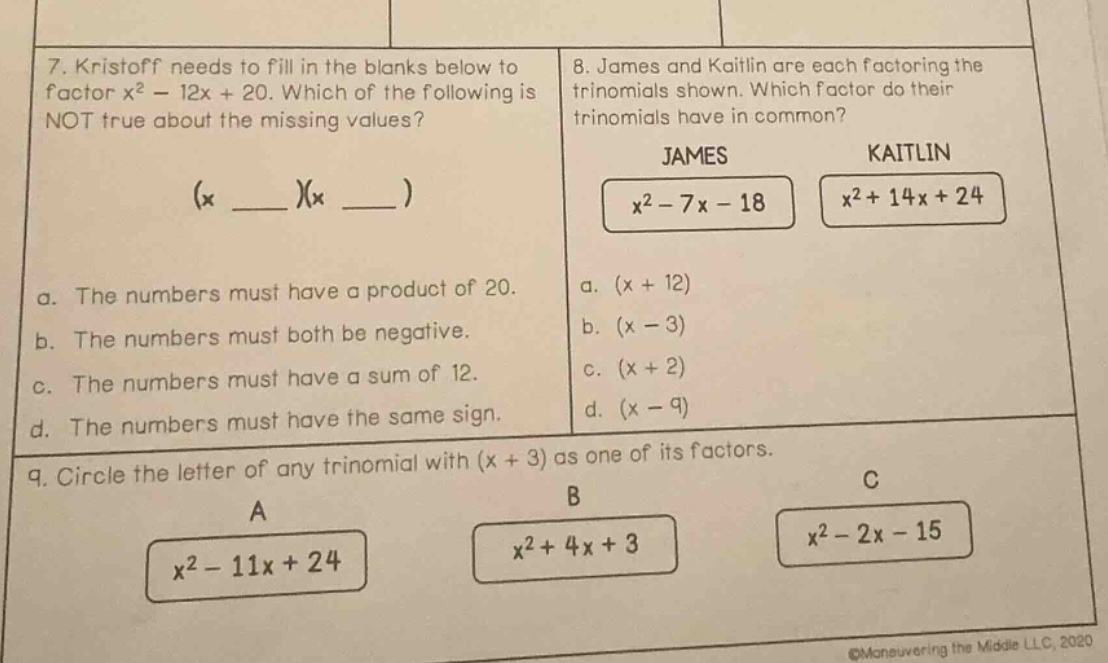
- kristoff needs to fill in the blanks below to factor ( x^2 - 12x + 20 ). which of the following is not true about the missing values?
( (x _)(x _) )
( a. ) the numbers must have a product of 20.
( b. ) the numbers must both be negative.
( c. ) the numbers must have a sum of 12.
( d. ) the numbers must have the same sign.
- james and kaitlin are each factoring the trinomials shown. which factor do their trinomials have in common?
james
( x^2 - 7x - 18 )
kaitlin
( x^2 + 14x + 24 )
( a. ) ( (x + 12) )
( b. ) ( (x - 3) )
( c. ) ( (x + 2) )
( d. ) ( (x - 9) )
- circle the letter of any trinomial with ( (x + 3) ) as one of its factors.
a
( x^2 - 11x + 24 )
b
( x^2 + 4x + 3 )
c
( x^2 - 2x - 15 )
Question 7
Step1: Recall factoring trinomials
For a trinomial \(x^2 + bx + c\), when factoring as \((x + m)(x + n)\), we have \(m \times n = c\) and \(m + n = b\). Here, the trinomial is \(x^2 - 12x + 20\), so \(b=-12\) and \(c = 20\).
Step2: Analyze each option
- Option a: The product of the two numbers should be \(20\) (since \(m \times n = c = 20\)), so this is true.
- Option b: Since the sum is \(-12\) (negative) and the product is \(20\) (positive), both numbers must be negative (because negative \(\times\) negative = positive and negative + negative = negative), so this is true.
- Option c: The sum of the two numbers should be \(-12\) (not \(12\)) because \(m + n = b=-12\), so this is NOT true.
- Option d: As explained in option b, both numbers have the same sign (negative), so this is true.
Step1: Factor James' trinomial
Factor \(x^2 - 7x - 18\). We need two numbers that multiply to \(-18\) and add to \(-7\). The numbers are \(-9\) and \(2\) (since \(-9\times2=-18\) and \(-9 + 2=-7\)). So \(x^2 - 7x - 18=(x - 9)(x + 2)\).
Step2: Factor Kaitlin's trinomial
Factor \(x^2 + 14x + 24\). We need two numbers that multiply to \(24\) and add to \(14\). The numbers are \(12\) and \(2\) (since \(12\times2 = 24\) and \(12+2 = 14\)). So \(x^2 + 14x + 24=(x + 12)(x + 2)\).
Step3: Find the common factor
From the factorizations, the common factor is \((x + 2)\).
Step1: Factor each trinomial
- For trinomial A: \(x^2 - 11x + 24\). We need two numbers that multiply to \(24\) and add to \(-11\). The numbers are \(-3\) and \(-8\), so \(x^2 - 11x + 24=(x - 3)(x - 8)\). No \((x + 3)\) factor.
- For trinomial B: \(x^2 + 4x + 3\). We need two numbers that multiply to \(3\) and add to \(4\). The numbers are \(1\) and \(3\), so \(x^2 + 4x + 3=(x + 1)(x + 3)\). This has \((x + 3)\) as a factor.
- For trinomial C: \(x^2 - 2x - 15\). We need two numbers that multiply to \(-15\) and add to \(-2\). The numbers are \(-5\) and \(3\), so \(x^2 - 2x - 15=(x - 5)(x + 3)\). This has \((x + 3)\) as a factor.

Snap & solve any problem in the app
Get step-by-step solutions on Sovi AI
Photo-based solutions with guided steps
Explore more problems and detailed explanations
c