QUESTION IMAGE
Question
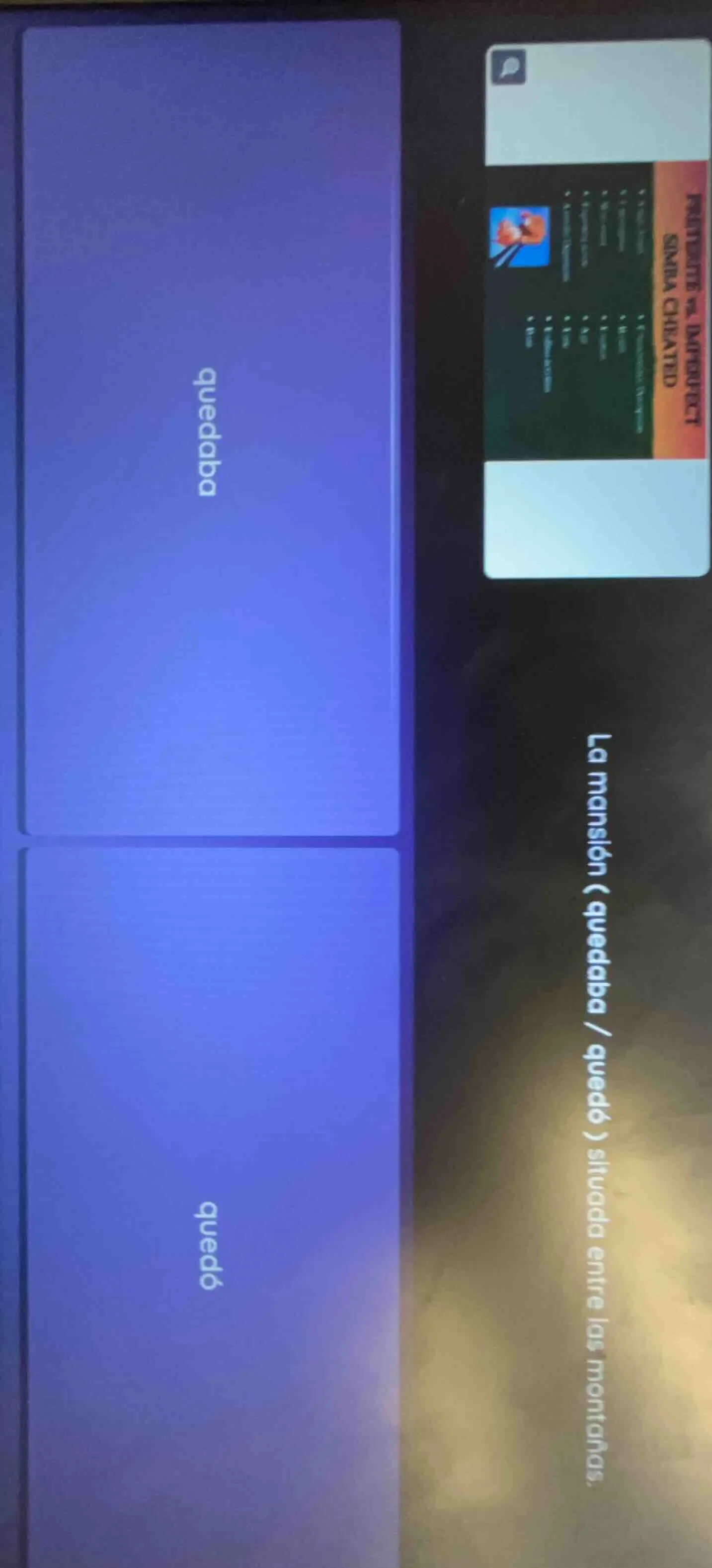
la mansión ( quedaba / quedó ) situada entre las montañas. quedaba quedó
To determine the correct verb form, we analyze the context. The sentence "La mansión (quedaba / quedó) situada entre las montañas" describes a past state of the mansion's location. "Quedaba" is the imperfect tense, used for ongoing or habitual past actions/states, while "quedó" is the preterite, used for completed actions. Since the location of the mansion is a state that was ongoing (or a past state we're describing), "quedaba" is appropriate? Wait, no—actually, "quedar" in the sense of "to be located" can use either, but let's check the subject and tense. Wait, maybe I made a mistake. Wait, "quedó" is preterite, "quedaba" is imperfect. Let's think about the action: the mansion's location is a permanent or past state. Wait, maybe the correct form is "quedaba" if it's a past continuous state, but actually, in Spanish, "quedar" to mean "to be located" can use the imperfect for a past state. Wait, but let's check the options. Wait, the sentence is "La mansión (quedaba / quedó) situada entre las montañas." Let's recall: "quedaba" is imperfect (used for actions/states in the past that were ongoing or habitual), "quedó" is preterite (completed action). The location of the mansion is a state, so if we're talking about how it was situated (a past state), "quedaba" would be used for an ongoing state in the past. But maybe the correct answer is "quedaba"? Wait, no, maybe I'm wrong. Wait, let's check the conjugation: "quedar" has preterite "quedó" (yo quedé, tú quedaste, él/ella quedó) and imperfect "quedaba" (yo quedaba, tú quedabas, él/ella quedaba). The sentence is about the mansion's location, which is a state. So if we're describing a past state, the imperfect is used. So "quedaba" would be correct? Wait, but maybe the answer is "quedó"? Wait, no, let's think again. The action of the mansion being located there—if it's a completed action (like it was located there and that's a fact), but "quedar" as "to be located" is more of a state. So the correct form is "quedaba"? Wait, no, maybe the answer is "quedó". Wait, I'm confused. Wait, let's look at the options. The two options are "quedaba" and "quedó". Let's check the subject: "la mansión" is third person singular. Preterite: quedó. Imperfect: quedaba. The sentence is "La mansión... situada entre las montañas." So the correct form is "quedaba" if it's a past state, or "quedó" if it's a completed action. But "situada" is a past participle, used as an adjective. So "quedaba situada" would be "was situated", and "quedó situada" would be "was situated (completed)". But in Spanish, when describing a past state of location, the imperfect is often used. So the correct answer is "quedaba"? Wait, but maybe the answer is "quedó". Wait, I think I made a mistake. Let me check a reference. "Quedar" as "to be located" can use the imperfect for a past state. So "La mansión quedaba situada entre las montañas" means "The mansion was situated between the mountains" (describing a past state). So the correct option is "quedaba".

Snap & solve any problem in the app
Get step-by-step solutions on Sovi AI
Photo-based solutions with guided steps
Explore more problems and detailed explanations
quedaba