QUESTION IMAGE
Question
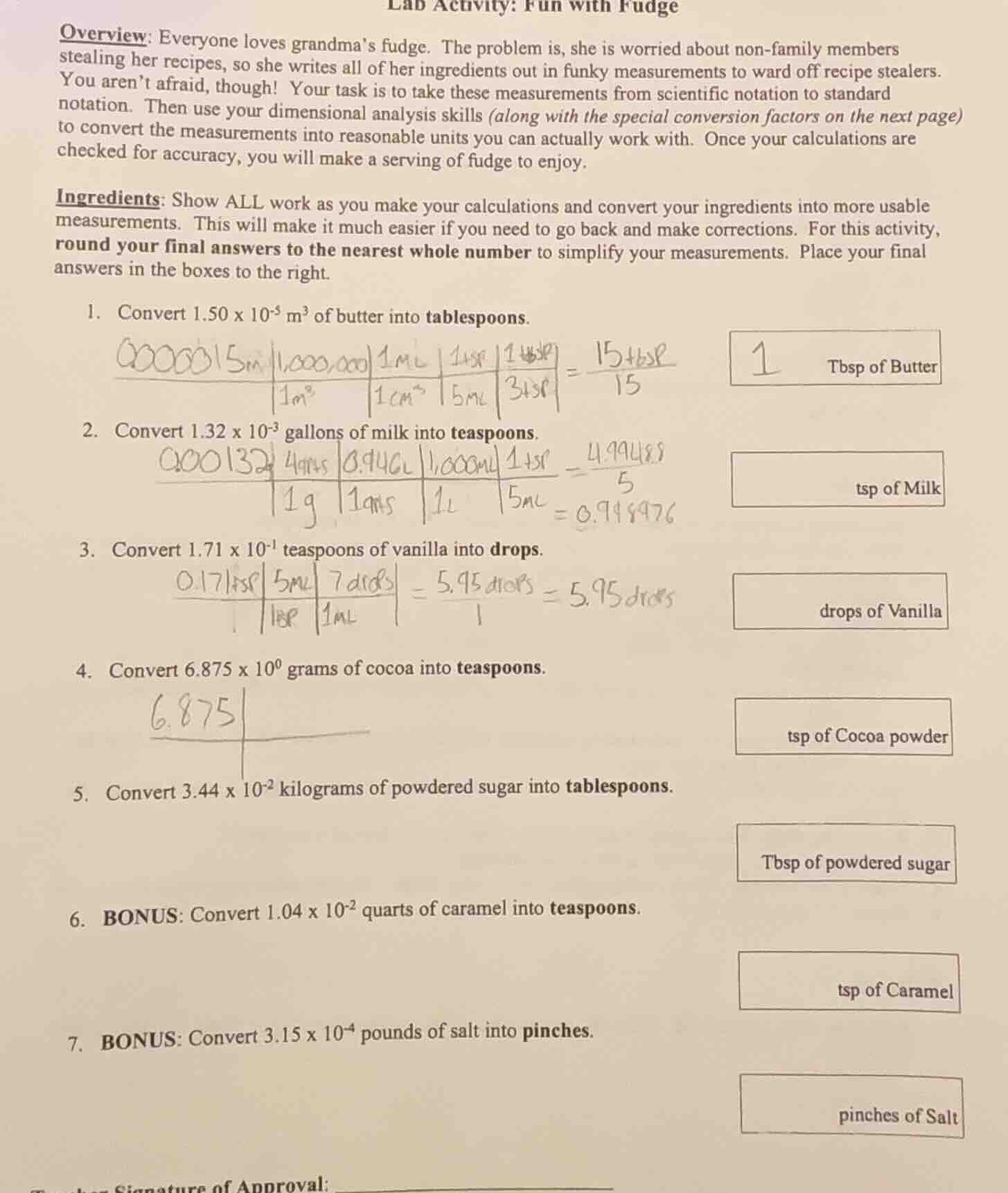
lab activity: fun with fudge
overview: everyone loves grandma’s fudge. the problem is, she is worried about non - family members stealing her recipes, so she writes all of her ingredients out in funky measurements to ward off recipe stealers. you aren’t afraid, though! your task is to take these measurements from scientific notation to standard notation. then use your dimensional analysis skills (along with the special conversion factors on the next page) to convert the measurements into reasonable units you can actually work with. once your calculations are checked for accuracy, you will make a serving of fudge to enjoy.
ingredients: show all work as you make your calculations and convert your ingredients into more usable measurements. this will make it much easier if you need to go back and make corrections. for this activity, round your final answers to the nearest whole number to simplify your measurements. place your final answers in the boxes to the right.
- convert $1.50 \times 10^{-5}\\ m^3$ of butter into tablespoons.
\boxed{1} tbsp of butter
- convert $1.32 \times 10^{-3}$ gallons of milk into teaspoons.
\boxed{} tsp of milk
- convert $1.71 \times 10^{-1}$ teaspoons of vanilla into drops.
\boxed{} drops of vanilla
- convert $6.875 \times 10^{0}$ grams of cocoa into teaspoons.
\boxed{} tsp of cocoa powder
- convert $3.44 \times 10^{-2}$ kilograms of powdered sugar into tablespoons.
\boxed{} tbsp of powdered sugar
- bonus: convert $1.04 \times 10^{-2}$ quarts of caramel into teaspoons.
\boxed{} tsp of caramel
- bonus: convert $3.15 \times 10^{-4}$ pounds of salt into pinches.
\boxed{} pinches of salt
teacher signature of approval:
Problem 2: Convert \( 1.32 \times 10^{-3} \) gallons of milk into teaspoons.
Step 1: Recall conversion factors
We know the following conversion factors:
- \( 1 \) gallon (\( \text{gal} \)) = \( 4 \) quarts (\( \text{qt} \))
- \( 1 \) quart = \( 0.946 \) liters (\( \text{L} \))
- \( 1 \) liter = \( 1000 \) milliliters (\( \text{mL} \))
- \( 1 \) teaspoon (\( \text{tsp} \)) = \( 5 \) milliliters (\( \text{mL} \)) (or equivalently, \( 1 \) mL = \( \frac{1}{5} \) tsp)
Step 2: Convert gallons to quarts
Start with \( 1.32 \times 10^{-3} \) gal. Multiply by the conversion factor for gallons to quarts:
\( 1.32 \times 10^{-3} \, \text{gal} \times \frac{4 \, \text{qt}}{1 \, \text{gal}} = 5.28 \times 10^{-3} \, \text{qt} \)
Step 3: Convert quarts to liters
Multiply the result by the conversion factor for quarts to liters:
\( 5.28 \times 10^{-3} \, \text{qt} \times \frac{0.946 \, \text{L}}{1 \, \text{qt}} \approx 4.99488 \times 10^{-3} \, \text{L} \)
Step 4: Convert liters to milliliters
Multiply by the conversion factor for liters to milliliters:
\( 4.99488 \times 10^{-3} \, \text{L} \times \frac{1000 \, \text{mL}}{1 \, \text{L}} = 4.99488 \, \text{mL} \)
Step 5: Convert milliliters to teaspoons
Multiply by the conversion factor for milliliters to teaspoons:
\( 4.99488 \, \text{mL} \times \frac{1 \, \text{tsp}}{5 \, \text{mL}} \approx 0.998976 \, \text{tsp} \)
Step 6: Round to the nearest whole number
Rounding \( 0.998976 \) to the nearest whole number gives \( 1 \).
Step 1: Recall the conversion factor
Assume \( 1 \) teaspoon (\( \text{tsp} \)) = \( 5 \) milliliters (\( \text{mL} \)) and \( 1 \) milliliter (\( \text{mL} \)) = \( 7 \) drops (common kitchen conversion for drops).
Step 2: Convert teaspoons to milliliters
Start with \( 1.71 \times 10^{-1} \, \text{tsp} \). Multiply by the conversion factor for tsp to mL:
\( 1.71 \times 10^{-1} \, \text{tsp} \times \frac{5 \, \text{mL}}{1 \, \text{tsp}} = 0.855 \, \text{mL} \)
Step 3: Convert milliliters to drops
Multiply by the conversion factor for mL to drops:
\( 0.855 \, \text{mL} \times \frac{7 \, \text{drops}}{1 \, \text{mL}} = 5.985 \, \text{drops} \)
Step 4: Round to the nearest whole number
Rounding \( 5.985 \) to the nearest whole number gives \( 6 \).
Step 1: Recall the conversion factor for cocoa powder
Cocoa powder has a density of approximately \( 0.5 \, \text{g/mL} \), and \( 1 \) teaspoon (\( \text{tsp} \)) = \( 5 \, \text{mL} \). First, find the volume of cocoa in milliliters, then convert to teaspoons.
Step 2: Convert grams to milliliters (using density)
Density \(
ho = \frac{\text{mass}}{\text{volume}} \), so \( \text{volume} = \frac{\text{mass}}{
ho} \). For cocoa, \(
ho \approx 0.5 \, \text{g/mL} \):
\( \text{Volume (mL)} = \frac{6.875 \, \text{g}}{0.5 \, \text{g/mL}} = 13.75 \, \text{mL} \)
Step 3: Convert milliliters to teaspoons
Use \( 1 \, \text{tsp} = 5 \, \text{mL} \):
\( 13.75 \, \text{mL} \times \frac{1 \, \text{tsp}}{5 \, \text{mL}} = 2.75 \, \text{tsp} \)
Step 4: Round to the nearest whole number
Rounding \( 2.75 \) to the nearest whole number gives \( 3 \).

Snap & solve any problem in the app
Get step-by-step solutions on Sovi AI
Photo-based solutions with guided steps
Explore more problems and detailed explanations
\( \boldsymbol{1} \) tsp of Milk