QUESTION IMAGE
Question
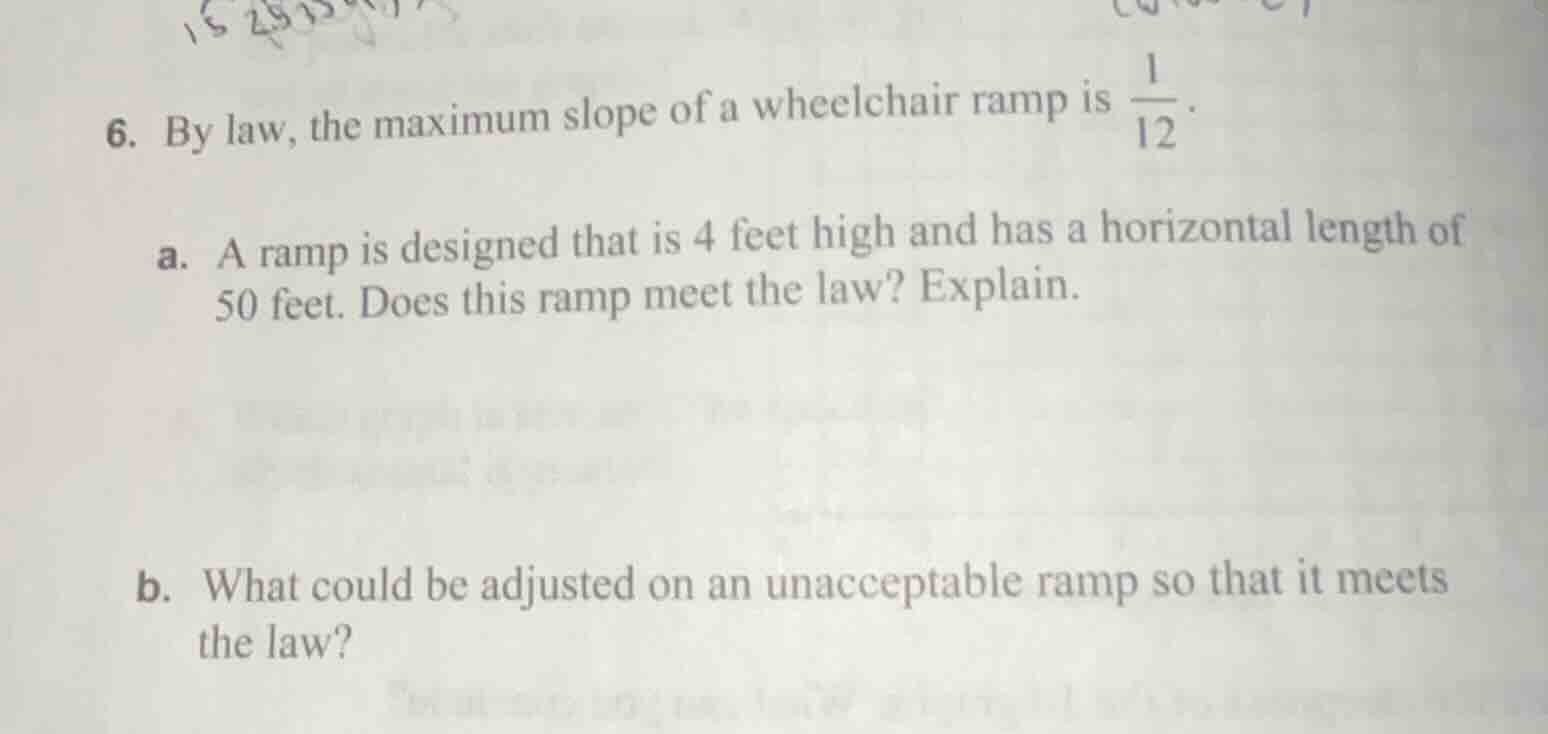
- by law, the maximum slope of a wheelchair ramp is \\(\frac{1}{12}\\).
a. a ramp is designed that is 4 feet high and has a horizontal length of 50 feet. does this ramp meet the law? explain.
b. what could be adjusted on an unacceptable ramp so that it meets the law?
Part (a)
Step 1: Recall the slope formula
The slope \( m \) of a ramp is given by the ratio of the vertical rise (height) to the horizontal run (length), so \( m=\frac{\text{height}}{\text{horizontal length}} \).
Step 2: Calculate the slope of the given ramp
The height of the ramp is 4 feet and the horizontal length is 50 feet. So the slope \( m = \frac{4}{50}\). Simplify this fraction: \( \frac{4}{50}=\frac{2}{25} = 0.08\).
Step 3: Compare with the maximum allowed slope
The maximum allowed slope is \( \frac{1}{12}\approx0.0833\). Since \( 0.08<0.0833 \) (or \( \frac{2}{25}<\frac{1}{12} \) because cross - multiplying: \( 2\times12 = 24\) and \( 25\times1=25\), and \( 24 < 25\)), the slope of the given ramp is less than the maximum allowed slope.
To make an unacceptable ramp meet the law (i.e., have a slope less than or equal to \( \frac{1}{12}\)), we can either: 1) Decrease the vertical height (rise) of the ramp while keeping the horizontal length the same. 2) Increase the horizontal length (run) of the ramp while keeping the vertical height the same. For example, if the slope is too steep (greater than \( \frac{1}{12}\)), we can make the ramp longer horizontally or shorter vertically.

Snap & solve any problem in the app
Get step-by-step solutions on Sovi AI
Photo-based solutions with guided steps
Explore more problems and detailed explanations
Yes, this ramp meets the law. The slope of the ramp is \( \frac{4}{50}=\frac{2}{25}=0.08\), and the maximum allowed slope is \( \frac{1}{12}\approx0.0833\). Since \( \frac{2}{25}<\frac{1}{12}\), the slope of the ramp is less than the maximum allowed slope.