QUESTION IMAGE
Question
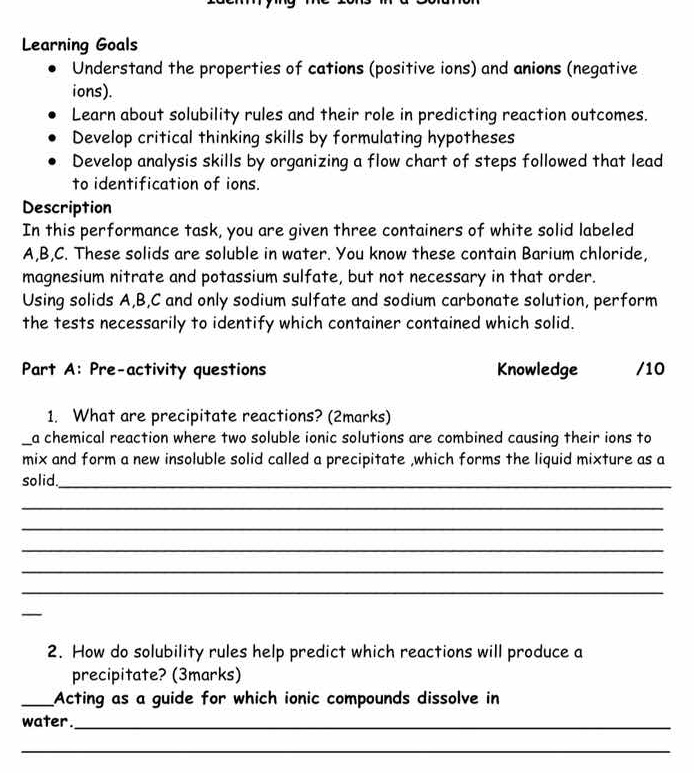
learning goals
- understand the properties of cations (positive ions) and anions (negative ions).
- learn about solubility rules and their role in predicting reaction outcomes.
- develop critical thinking skills by formulating hypotheses
- develop analysis skills by organizing a flow chart of steps followed that lead to identification of ions.
description
in this performance task, you are given three containers of white solid labeled a,b,c. these solids are soluble in water. you know these contain barium chloride, magnesium nitrate and potassium sulfate, but not necessary in that order.
using solids a,b,c and only sodium sulfate and sodium carbonate solution, perform the tests necessarily to identify which container contained which solid.
part a: pre - activity questions knowledge /10
- what are precipitate reactions? (2marks)
a chemical reaction where two soluble ionic solutions are combined causing their ions to mix and form a new insoluble solid called a precipitate, which forms the liquid mixture as a solid.
- how do solubility rules help predict which reactions will produce a precipitate? (3marks)
acting as a guide for which ionic compounds dissolve in water.
- For the first question, a precipitate reaction is defined as a reaction where soluble ionic compounds react to form an insoluble solid precipitate.
- For the second question, solubility rules outline which ionic compounds are soluble/insoluble in water, so they let us predict if mixing ionic solutions will form an insoluble precipitate.

Snap & solve any problem in the app
Get step-by-step solutions on Sovi AI
Photo-based solutions with guided steps
Explore more problems and detailed explanations
- A chemical reaction where two soluble ionic solutions are mixed, and their ions recombine to form an insoluble solid (precipitate) that separates from the liquid mixture.
- Solubility rules provide a reference for which ionic compounds are soluble or insoluble in water. By checking the solubility of the potential products of an ionic reaction, we can determine if an insoluble precipitate will form, thus predicting the reaction outcome.