QUESTION IMAGE
Question
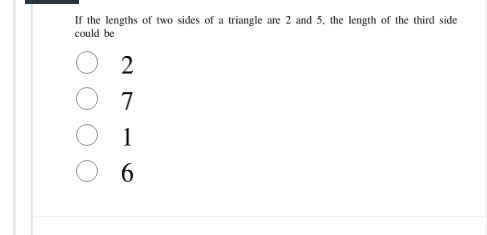
if the lengths of two sides of a triangle are 2 and 5, the length of the third side could be 2 7 1 6
Step1: Recall triangle inequality theorem
The triangle inequality theorem states that the sum of the lengths of any two sides of a triangle must be greater than the length of the remaining side, and the difference of the lengths of any two sides must be less than the length of the remaining side. Mathematically, for a triangle with side lengths \(a\), \(b\), and \(c\), we have \(|a - b| < c < a + b\).
Step2: Apply the theorem to given sides
Let the given sides be \(a = 2\) and \(b = 5\). First, calculate the difference: \(|5 - 2| = 3\). Then, calculate the sum: \(5 + 2 = 7\). So, the length of the third side \(c\) must satisfy \(3 < c < 7\).
Now, check the options:
- For \(2\): \(2\) is not greater than \(3\), so it doesn't satisfy.
- For \(7\): \(7\) is not less than \(7\) (it's equal), so it doesn't satisfy.
- For \(1\): \(1\) is not greater than \(3\), so it doesn't satisfy.
- For \(6\): \(3 < 6 < 7\), so it satisfies.

Snap & solve any problem in the app
Get step-by-step solutions on Sovi AI
Photo-based solutions with guided steps
Explore more problems and detailed explanations
6