QUESTION IMAGE
Question
lesson 11: dividing polynomials (part1)
lt: i will be able to divide polynomials (without remainders) using the box method
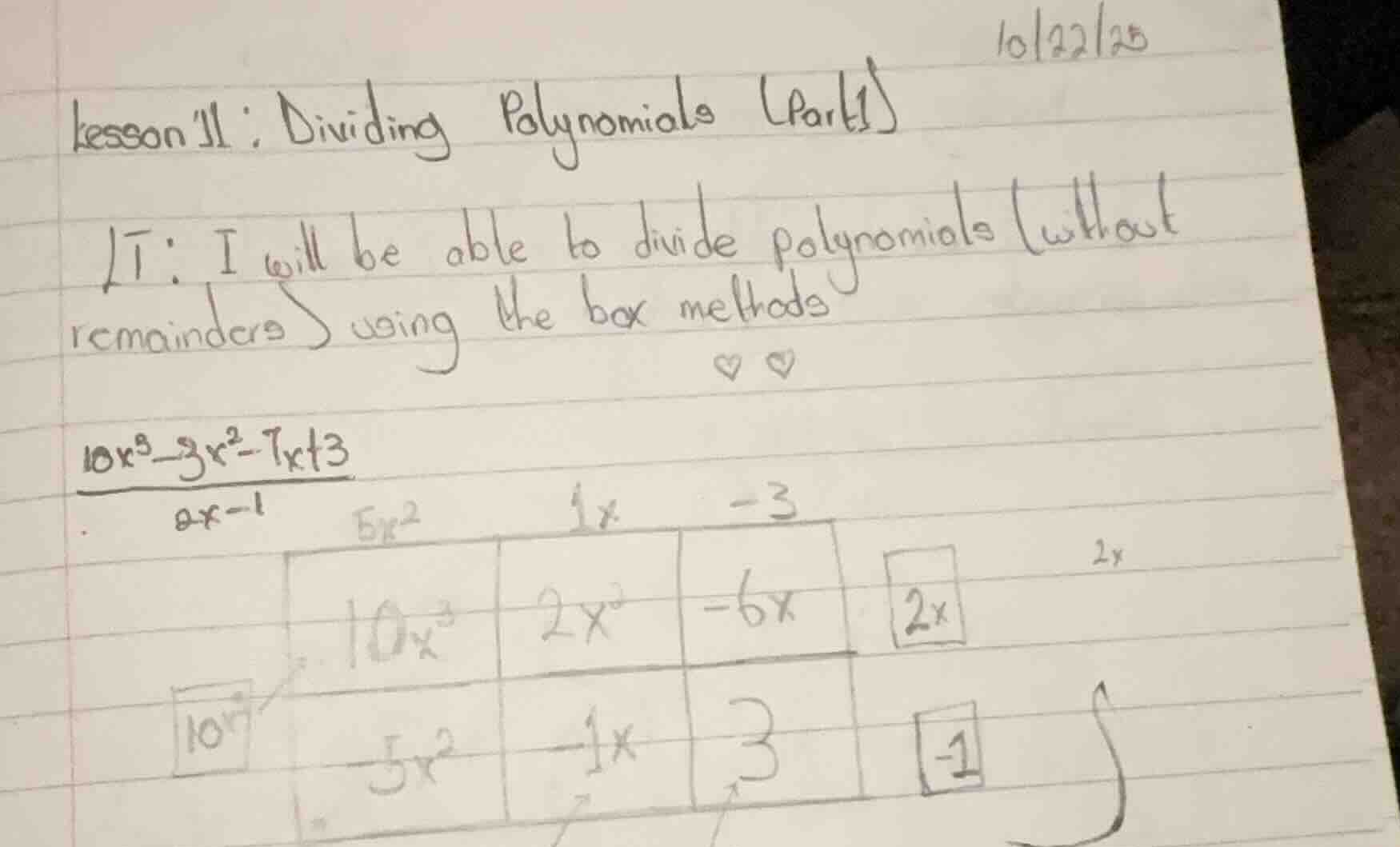
\\(\frac{10x^3 - 3x^2 - 7x + 3}{2x - 1}\\)
(box method diagram with terms like (5x^2), (1x), (-3), (10x^3), (2x^2), (-6x), (2x), (10x^3), (-5x^2), (-1x), (3), (-1))
Step1: Analyze the Box Method
The box method for polynomial division involves breaking down the dividend (numerator) and divisor (denominator) into parts and filling the box with products that sum to the dividend. Here, the divisor is \(2x - 1\) and the dividend is \(10x^3 - 3x^2 - 7x + 3\).
Step2: Check the Box Entries
Looking at the box, the top row (related to the first part of the divisor \(2x\)) and the bottom row (related to the second part \(-1\)) should multiply with the left - hand side terms (the quotient parts) to give the dividend. Let's sum up the terms in the box:
- The first column: \(10x^3\) (from \(5x^2\times2x\))
- The second column: \(2x^2-5x^2=-3x^2\) (from \(x\times2x\) and \(5x^2\times(- 1)\))
- The third column: \(-6x - x=-7x\) (from \(-3\times2x\) and \(x\times(-1)\))
- The fourth column: \(2x\times(-1)=-2x\)? Wait, no, looking at the constant term. Wait, the last part of the dividend is \(+3\). From the bottom - right box, we have \(-1\times(-3) = 3\)? Wait, maybe the quotient is \(5x^2+x - 3\). Let's multiply \((2x - 1)(5x^2+x - 3)\):
\[
\]

Snap & solve any problem in the app
Get step-by-step solutions on Sovi AI
Photo-based solutions with guided steps
Explore more problems and detailed explanations
The quotient when \(\frac{10x^3-3x^2 - 7x + 3}{2x - 1}\) is divided using the box method is \(5x^2+x - 3\)