QUESTION IMAGE
Question
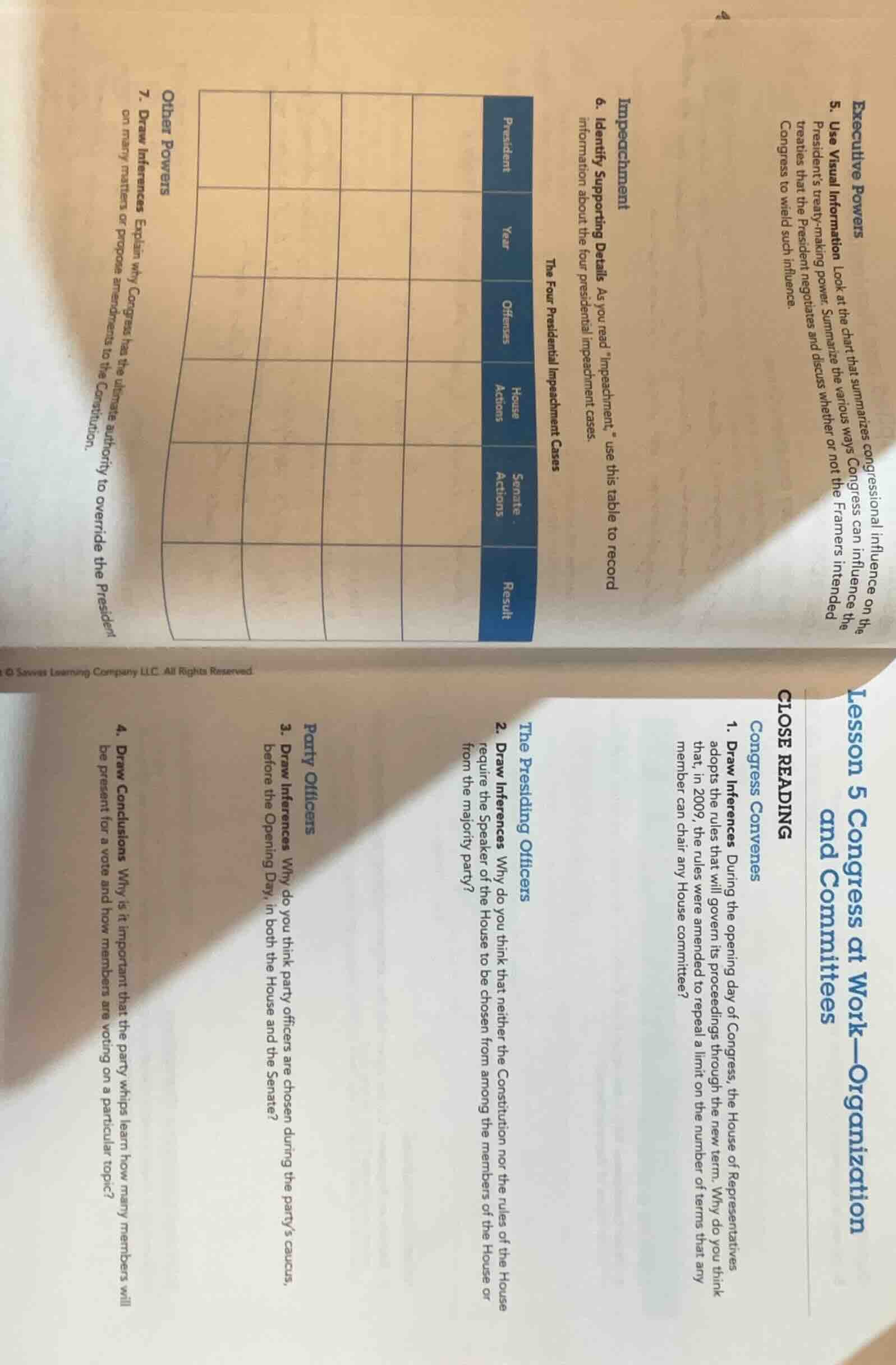
lesson 5 congress at work—organization and committees close reading congress convenes 1. draw inferences during the opening day of congress, the house of representatives adopts the rules that will govern its proceedings through the new term. why do you think that, in 2009, the rules were amended to repeal a limit on the number of terms that any member can chair any house committee? the presiding officers 2. draw inferences why do you think that neither the constitution nor the rules of the house require the speaker of the house to be chosen from among the members of the house or from the majority party? party officers 3. draw inferences why do you think party officers are chosen during the party’s caucus, before the opening day, in both the house and the senate? 4. draw conclusions why is it important that the party whips learn how many members will be present for a vote and how members are voting on a particular topic? executive powers 5. use visual information look at the chart that summarizes congressional influence on the president’s treaty - making power. summarize the various ways congress can influence the treaties that the president negotiates and discuss whether or not the framers intended congress to wield such influence. impeachment 6. identify supporting details as you read “impeachment,” use this table to record information about the four presidential impeachment cases. the four presidential impeachment cases president year offenses house actions senate actions result other powers 7. draw inferences explain why congress has the ultimate authority to override the president on many matters or propose amendments to the constitution.
Congress Convenes (1)
The rule change allowed more flexibility in committee leadership, letting experienced members chair committees long-term, which was seen as beneficial for institutional knowledge and legislative efficiency.
The Presiding Officers (2)
This ensures the Speaker aligns with the majority party's agenda, making it easier to pass the party's legislative priorities, as the Speaker controls the House's legislative schedule.
Party Officers (3)
This lets the party select leaders who are trusted by its members, ensuring alignment with the party's goals and cohesion before the legislative session begins.
Draw Conclusions (4)
Whips track votes to gauge support for legislation, which helps party leaders strategize. Members' voting stances reveal which policies have backing, guiding legislative tactics.
Executive Powers (5)
Congress influences treaties by requiring a 2/3 Senate vote for ratification, and can attach conditions, refuse funding, or pass resolutions. The Framers intended this check to balance the President's power, preventing unilateral treaty-making.
Impeachment (6)
| President | Year | Offenses | House Actions | Senate Actions | Result |
|---|---|---|---|---|---|
| Bill Clinton | 1998 | Perjury, obstruction of justice | Voted to impeach (2 articles) | Acquitted on both counts | Remained in office |
| Donald Trump (1st) | 2019 | Abuse of power, obstruction of Congress | Voted to impeach (2 articles) | Acquitted on both counts | Remained in office |
| Donald Trump (2nd) | 2021 | Incitement of insurrection | Voted to impeach (1 article) | Acquitted (57-43, short of 2/3) | Remained in office (left before final vote) |
Other Powers (7)
Congress has this authority to balance executive power, as the Framers designed a system of checks and balances. Amending the Constitution also lets Congress address national needs that the President may not prioritize.

Snap & solve any problem in the app
Get step-by-step solutions on Sovi AI
Photo-based solutions with guided steps
Explore more problems and detailed explanations
- The rule repeal allowed experienced members to retain committee chairmanships, preserving institutional expertise and enabling longer-term legislative strategy.
- This ensures the Speaker advances the majority party's legislative agenda, as they control the House's workflow.
- This ensures party leaders have the trust of their caucus, fostering unity and alignment with party goals.
- Whips track votes to predict legislative outcomes, helping party leaders adjust strategies; member voting stances show policy support levels.
- Congress influences treaties via a 2/3 Senate ratification vote, attaching conditions, defunding treaty-related actions, or passing critical resolutions. The Framers intended this as a check on presidential power, preventing unilateral international agreements.
- (See completed table above)
- Congress has this authority to balance executive power (checks and balances) and address national priorities the President may ignore, as part of the Framers' separation of powers design.