QUESTION IMAGE
Question
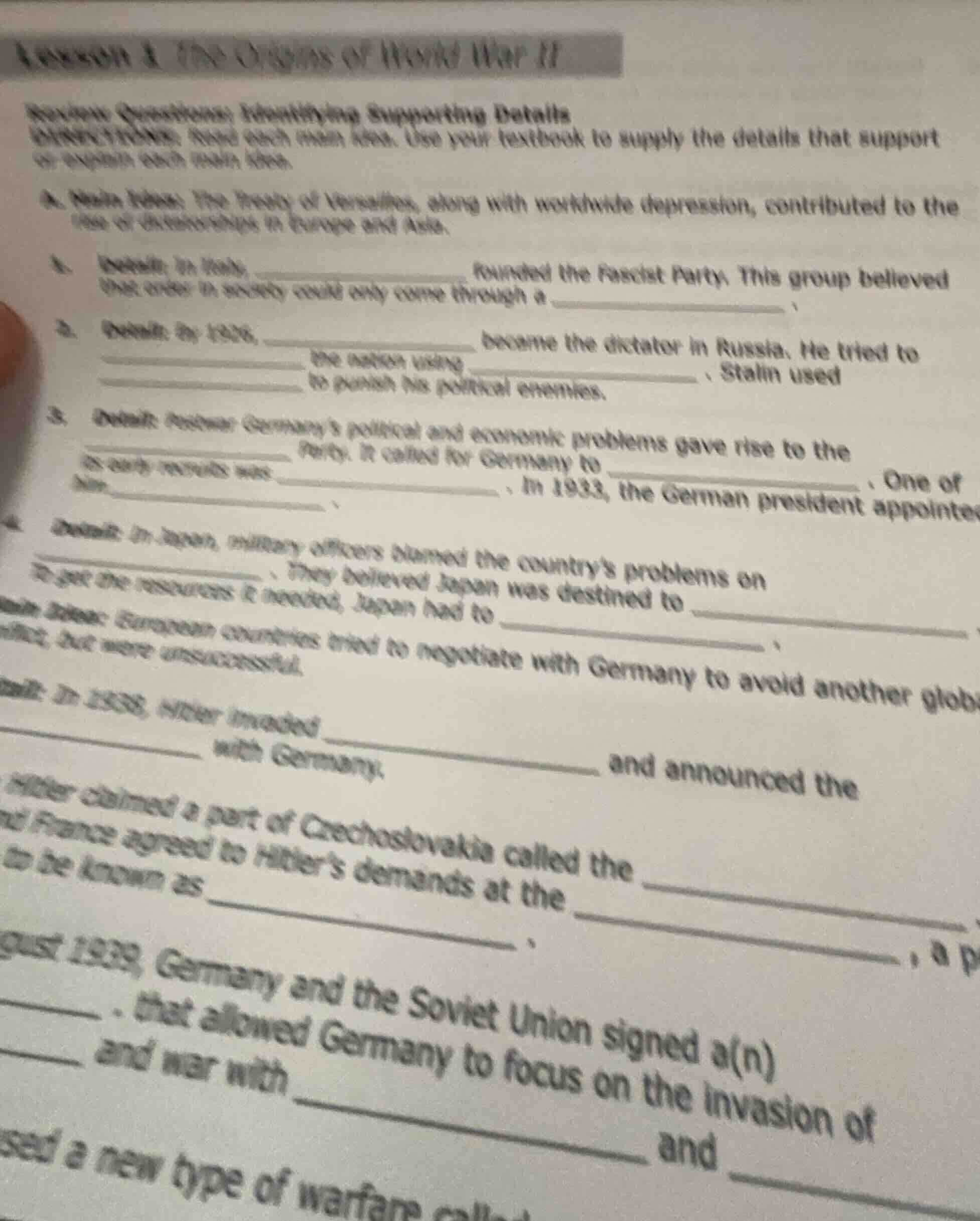
lesson 1 the origins of world war ii
review questions: identifying supporting details
directions: read each main idea. use your textbook to supply the details that support or explain each main idea.
a. main idea: the treaty of versailles, along with worldwide depression, contributed to the rise of dictatorships in europe and asia.
- detail: in italy, _____________ founded the fascist party. this group believed that order in society could only come through a _____________.
- detail: by 1926, _____________ became the dictator in russia. he tried to ___________ the nation using ___________. stalin used _____________ to punish his political enemies.
- detail: postwar germanys political and economic problems gave rise to the _____________ party. it called for germany to ___________. one of its early results was ___________. in 1933, the german president appointed him _____________.
- detail: in japan, military officers blamed the countrys problems on _____________. they believed japan was destined to ___________. to get the resources it needed, japan had to _____________.
main idea: european countries tried to negotiate with germany to avoid another global conflict, but were unsuccessful.
detail: in 1938, hitler invaded _____________ and announced the _____________ with germany.
hitler claimed a part of czechoslovakia called the _____________. britain and france agreed to hitlers demands at the ___________, a policy to be known as _____________.
in august 1939, germany and the soviet union signed a(n) _____________ that allowed germany to focus on the invasion of ___________ and war with _____________.
used a new type of warfare called
The questions cover key historical details about the rise of dictatorships and pre-WW2 events, using standard 20th-century world history facts to fill in the blanks.

Snap & solve any problem in the app
Get step-by-step solutions on Sovi AI
Photo-based solutions with guided steps
Explore more problems and detailed explanations
- Detail: In Italy, Benito Mussolini founded the Fascist Party. This group believed that order in society could only come through a totalitarian, authoritarian state
- Detail: By 1926, Joseph Stalin became the dictator in Russia. He tried to industrialize the nation using five-year plans. Stalin used gulags (forced labor camps/purges) to punish his political enemies.
- Detail: Postwar Germany's political and economic problems gave rise to the National Socialist German Workers' (Nazi) Party. It called for Germany to rebuild its military, reclaim lost territory, and unify all German-speaking peoples. One of its early results was growing nationalist and anti-Semitic sentiment. In 1933, the German president appointed Adolf Hitler as chancellor.
- Detail: In Japan, military officers blamed the country's problems on weak civilian leadership and economic instability. They believed Japan was destined to lead a "Greater East Asia Co-Prosperity Sphere" (dominate East Asia). To get the resources it needed, Japan had to invade and occupy neighboring territories (like Manchuria).
- Detail: In 1938, Hitler invaded Austria and announced the Anschluss (union) with Germany.
- Hitler claimed a part of Czechoslovakia called the Sudetenland. Britain and France agreed to Hitler's demands at the Munich Conference, a policy to be known as appeasement.
- August 1939, Germany and the Soviet Union signed a(n) Non-Aggression Pact that allowed Germany to focus on the invasion of Poland and war with Western Europe