QUESTION IMAGE
Question
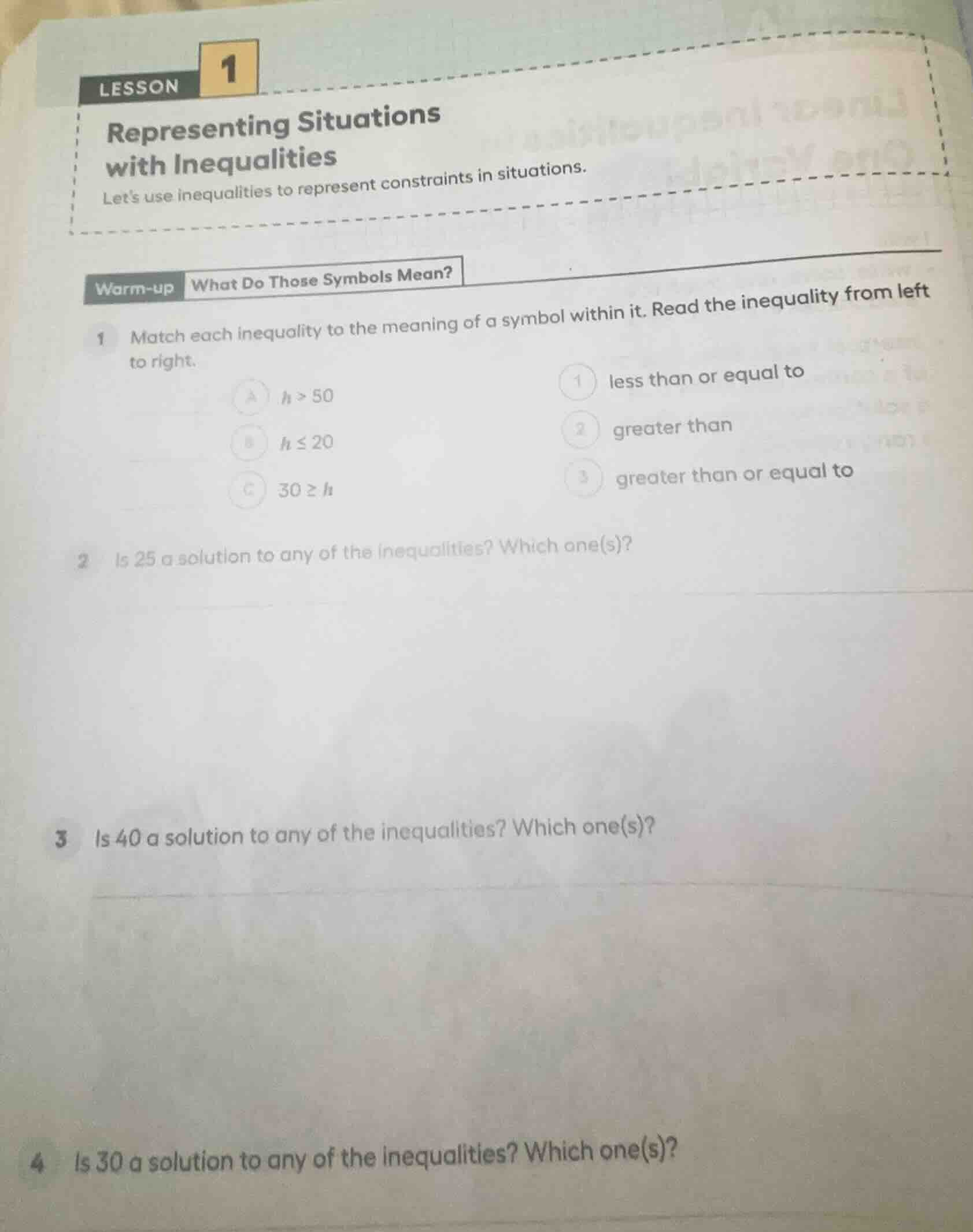
lesson 1
representing situations with inequalities
lets use inequalities to represent constraints in situations.
warm - up what do those symbols mean?
1 match each inequality to the meaning of a symbol within it. read the inequality from left to right.
a ( h > 50 ) 1 less than or equal to
b ( h leq 20 ) 2 greater than
c ( 30 geq h ) 3 greater than or equal to
2 is 25 a solution to any of the inequalities? which one(s)?
3 is 40 a solution to any of the inequalities? which one(s)?
4 is 30 a solution to any of the inequalities? which one(s)?
Question 1
- For \( h > 50 \), the symbol \( > \) means "greater than", so A matches 2.
- For \( h \leq 20 \), the symbol \( \leq \) means "less than or equal to", so B matches 1.
- For \( 30 \geq h \), the symbol \( \geq \) means "greater than or equal to", so C matches 3.
- Check \( h > 50 \): \( 25>50 \) is false.
- Check \( h \leq 20 \): \( 25\leq20 \) is false.
- Check \( 30 \geq h \): \( 30\geq25 \) is true.
So 25 is a solution to \( 30 \geq h \).
- Check \( h > 50 \): \( 40>50 \) is false.
- Check \( h \leq 20 \): \( 40\leq20 \) is false.
- Check \( 30 \geq h \): \( 30\geq40 \) is false.
So 40 is not a solution to any of the inequalities.

Snap & solve any problem in the app
Get step-by-step solutions on Sovi AI
Photo-based solutions with guided steps
Explore more problems and detailed explanations
A. \( h > 50 \) - 2. greater than
B. \( h \leq 20 \) - 1. less than or equal to
C. \( 30 \geq h \) - 3. greater than or equal to