QUESTION IMAGE
Question
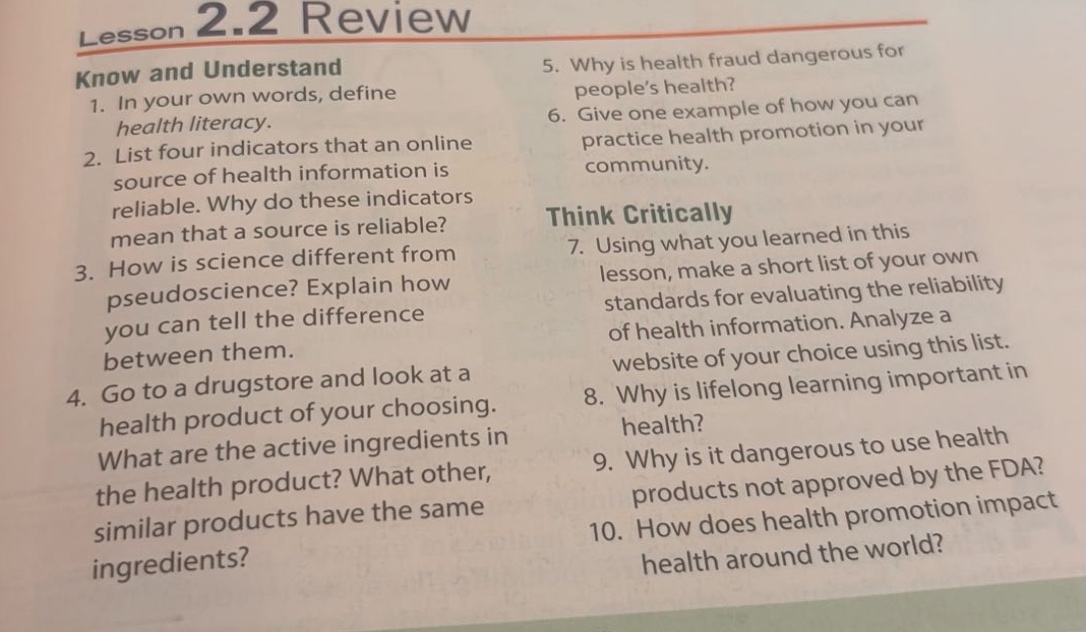
lesson 2.2 review
know and understand
- in your own words, define health literacy.
- list four indicators that an online source of health information is reliable. why do these indicators mean that a source is reliable?
- how is science different from pseudoscience? explain how you can tell the difference between them.
- go to a drugstore and look at a health product of your choosing. what are the active ingredients in the health product? what other, similar products have the same ingredients?
- why is health fraud dangerous for peoples health?
- give one example of how you can practice health promotion in your community.
think critically
- using what you learned in this lesson, make a short list of your own standards for evaluating the reliability of health information. analyze a website of your choice using this list.
- why is lifelong learning important in health?
- why is it dangerous to use health products not approved by the fda?
- how does health promotion impact health around the world?
Brief Explanations
- Defined health literacy as practical health knowledge application.
- Identified 4 reliable source indicators and their purpose.
- Distinguished science from pseudoscience with a test method.
- Outlined steps to analyze a drugstore health product.
- Explained health fraud's direct and indirect health harms.
- Provided a community health promotion example.
- Listed evaluation standards and website analysis steps.
- Linked lifelong health learning to changing health needs.
- Covered risks of unapproved FDA health products.
- Explained global health impacts of health promotion.

Snap & solve any problem in the app
Get step-by-step solutions on Sovi AI
Photo-based solutions with guided steps
Explore more problems and detailed explanations
- Health literacy is the ability to find, understand, and use health information to make good choices about your well-being.
- Four indicators: 1) It is run by a trusted government/academic medical body (e.g., WHO, CDC); 2) It cites peer-reviewed scientific studies; 3) It has no hidden commercial bias (no paid product endorsements); 4) It is regularly updated. These indicators mean the source prioritizes evidence over profit, uses verified research, and stays current with new health findings, so its information is trustworthy.
- Science is based on testable, repeatable experiments that are peer-reviewed, and it revises claims when new evidence emerges. Pseudoscience uses untested, anecdotal claims, avoids peer review, and does not change its claims when evidence contradicts them. You can tell the difference by checking if the claim has been tested by independent researchers and published in a respected scientific journal.
- (Example for a vitamin C supplement): Active ingredient: Ascorbic acid. Similar products with the same ingredient: Generic vitamin C tablets, chewable vitamin C from other brands, and some fortified fruit drinks.
- Health fraud sells unproven, often dangerous products/services that can delay proper medical care, cause physical harm from unsafe ingredients, and waste people's money on treatments that do not work, worsening existing health conditions.
- One example: Organize a free community blood pressure screening event at a local library, partnering with a local clinic to help people monitor their heart health and connect them to care if needed.
- Reliability standards: 1) Author credentials (are they a licensed health professional?); 2) Citation of scientific sources; 3) Absence of commercial bias; 4) Date of last update. (Example analysis for cdc.gov): 1) Authored by CDC public health experts (licensed/credentialed); 2) Cites peer-reviewed public health studies; 3) No product ads or paid promotions; 4) Pages are updated monthly with new data. The site is highly reliable.
- Lifelong learning in health is important because new health research, treatments, and public health threats (like new diseases) emerge constantly. Staying informed helps people adapt their health habits, recognize new risks, and make informed choices as they age and their health needs change.
- The FDA tests health products to ensure they are safe and effective. Unapproved products may contain toxic or harmful ingredients, have no proven benefit, or interact dangerously with other medications, leading to serious injury or death.
- Health promotion (like public education on handwashing, vaccination, or healthy eating) reduces global rates of preventable diseases, lowers healthcare costs, improves quality of life, and helps reduce health inequalities by making health resources and education accessible to more people, especially in low-income communities.