QUESTION IMAGE
Question
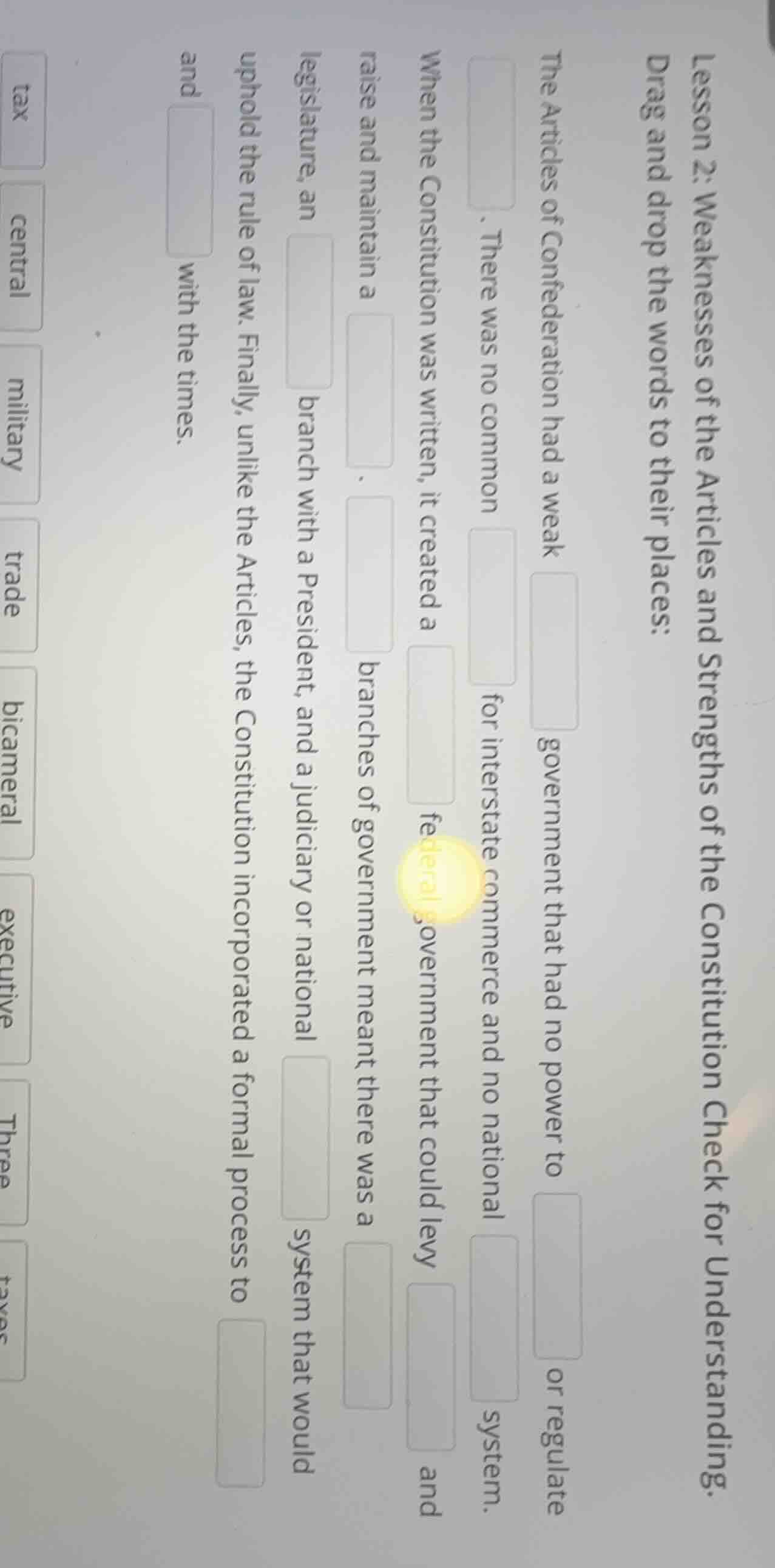
lesson 2: weaknesses of the articles and strengths of the constitution check for understanding. drag and drop the words to their places: the articles of confederation had a weak government that had no power to or regulate. there was no common for interstate commerce and no national system. when the constitution was written, it created a federal government that could levy and raise and maintain a. branches of government meant there was a legislature, an branch with a president, and a judiciary or national system that would uphold the rule of law. finally, unlike the articles, the constitution incorporated a formal process to and with the times. words to drag: tax, central, military, trade, bicameral, executive, three, taxes
To solve this fill - in - the - blank problem about the Articles of Confederation and the Constitution, we analyze each blank based on historical knowledge:
- The Articles of Confederation had a weak central government. This is a key characteristic of the Articles, as the states had more power and the central (federal) government was weak.
- The weak central government had no power to tax or regulate. One of the major weaknesses of the Articles was the inability to tax, which made it hard to raise revenue.
- There was no common trade for interstate commerce and no national system. The lack of a common trade policy led to disputes between states over trade.
- When the Constitution was written, it created a stronger federal government (the word "federal" is already given, but the context implies a stronger one compared to the Articles' government) that could levy taxes and raise and maintain a military. The new federal government under the Constitution had the power to tax to fund itself and maintain a military for defense.
- The Constitution created three branches of government (executive, legislative, judicial), meaning there was a bicameral legislature (Congress has two houses), an executive branch with a President, and a judiciary or national court system that would uphold the rule of law.
- Finally, unlike the Articles, the Constitution incorporated a formal process to amend and keep up with the times. The amendment process allows the Constitution to be changed as the country evolves.

Snap & solve any problem in the app
Get step-by-step solutions on Sovi AI
Photo-based solutions with guided steps
Explore more problems and detailed explanations
- The Articles of Confederation had a weak \boxed{central} government that had no power to \boxed{tax} or regulate.
- There was no common \boxed{trade} for interstate commerce and no national system.
- When the Constitution was written, it created a \boxed{stronger} federal government that could levy \boxed{taxes} and raise and maintain a \boxed{military}.
- It created \boxed{three} branches of government, meaning there was a \boxed{bicameral} legislature, an \boxed{executive} branch with a President, and a judiciary or national court system that would uphold the rule of law.
- Finally, unlike the Articles, the Constitution incorporated a formal process to \boxed{amend} and keep up with the times.