QUESTION IMAGE
Question
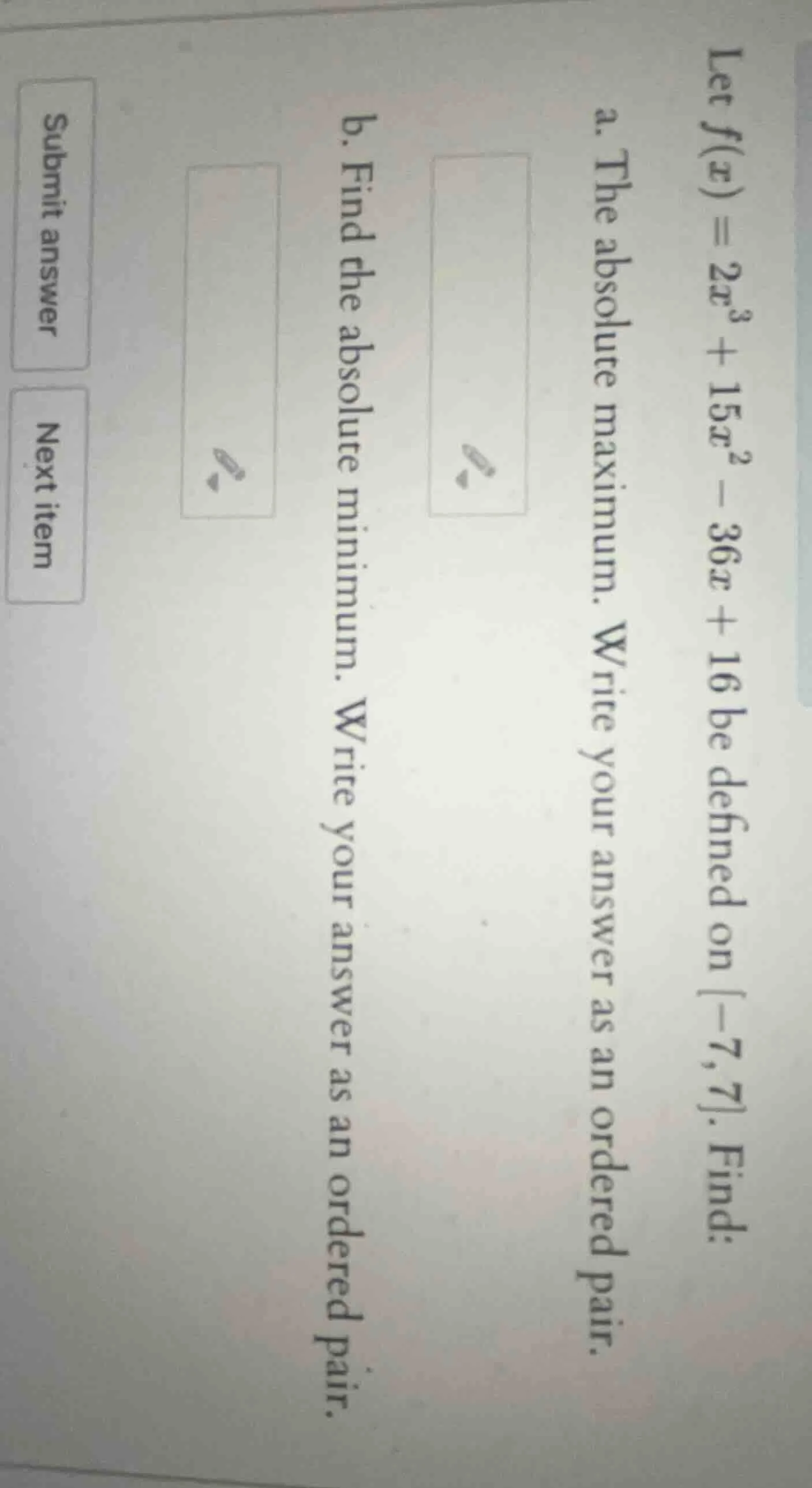
let $f(x) = 2x^3 + 15x^2 - 36x + 16$ be defined on $-7, 7$. find:
a. the absolute maximum. write your answer as an ordered pair.
b. find the absolute minimum. write your answer as an ordered pair.
Part a: Find the absolute maximum
Step 1: Find the derivative of \( f(x) \)
The function is \( f(x) = 2x^3 + 15x^2 - 36x + 16 \). Using the power rule, the derivative \( f'(x) \) is:
\( f'(x) = \frac{d}{dx}(2x^3) + \frac{d}{dx}(15x^2) - \frac{d}{dx}(36x) + \frac{d}{dx}(16) \)
\( f'(x) = 6x^2 + 30x - 36 \)
Step 2: Find critical points
Set \( f'(x) = 0 \):
\( 6x^2 + 30x - 36 = 0 \)
Divide both sides by 6:
\( x^2 + 5x - 6 = 0 \)
Factor the quadratic:
\( (x + 6)(x - 1) = 0 \)
So, the critical points are \( x = -6 \) and \( x = 1 \).
Step 3: Evaluate \( f(x) \) at critical points and endpoints
The interval is \( [-7, 7] \), so endpoints are \( x = -7 \) and \( x = 7 \), and critical points \( x = -6 \) and \( x = 1 \).
- For \( x = -7 \):
\( f(-7) = 2(-7)^3 + 15(-7)^2 - 36(-7) + 16 \)
\( = 2(-343) + 15(49) + 252 + 16 \)
\( = -686 + 735 + 252 + 16 \)
\( = 317 \)
- For \( x = -6 \):
\( f(-6) = 2(-6)^3 + 15(-6)^2 - 36(-6) + 16 \)
\( = 2(-216) + 15(36) + 216 + 16 \)
\( = -432 + 540 + 216 + 16 \)
\( = 340 \)
- For \( x = 1 \):
\( f(1) = 2(1)^3 + 15(1)^2 - 36(1) + 16 \)
\( = 2 + 15 - 36 + 16 \)
\( = -3 \)
- For \( x = 7 \):
\( f(7) = 2(7)^3 + 15(7)^2 - 36(7) + 16 \)
\( = 2(343) + 15(49) - 252 + 16 \)
\( = 686 + 735 - 252 + 16 \)
\( = 1185 \)
Step 4: Determine the absolute maximum
Compare the values: \( f(-7) = 317 \), \( f(-6) = 340 \), \( f(1) = -3 \), \( f(7) = 1185 \). The largest value is 1185 at \( x = 7 \).
Part b: Find the absolute minimum
From the evaluations above: \( f(-7) = 317 \), \( f(-6) = 340 \), \( f(1) = -3 \), \( f(7) = 1185 \). The smallest value is -3 at \( x = 1 \).

Snap & solve any problem in the app
Get step-by-step solutions on Sovi AI
Photo-based solutions with guided steps
Explore more problems and detailed explanations
s:
a. The absolute maximum is at the ordered pair \( \boldsymbol{(7, 1185)} \)
b. The absolute minimum is at the ordered pair \( \boldsymbol{(1, -3)} \)