QUESTION IMAGE
Question
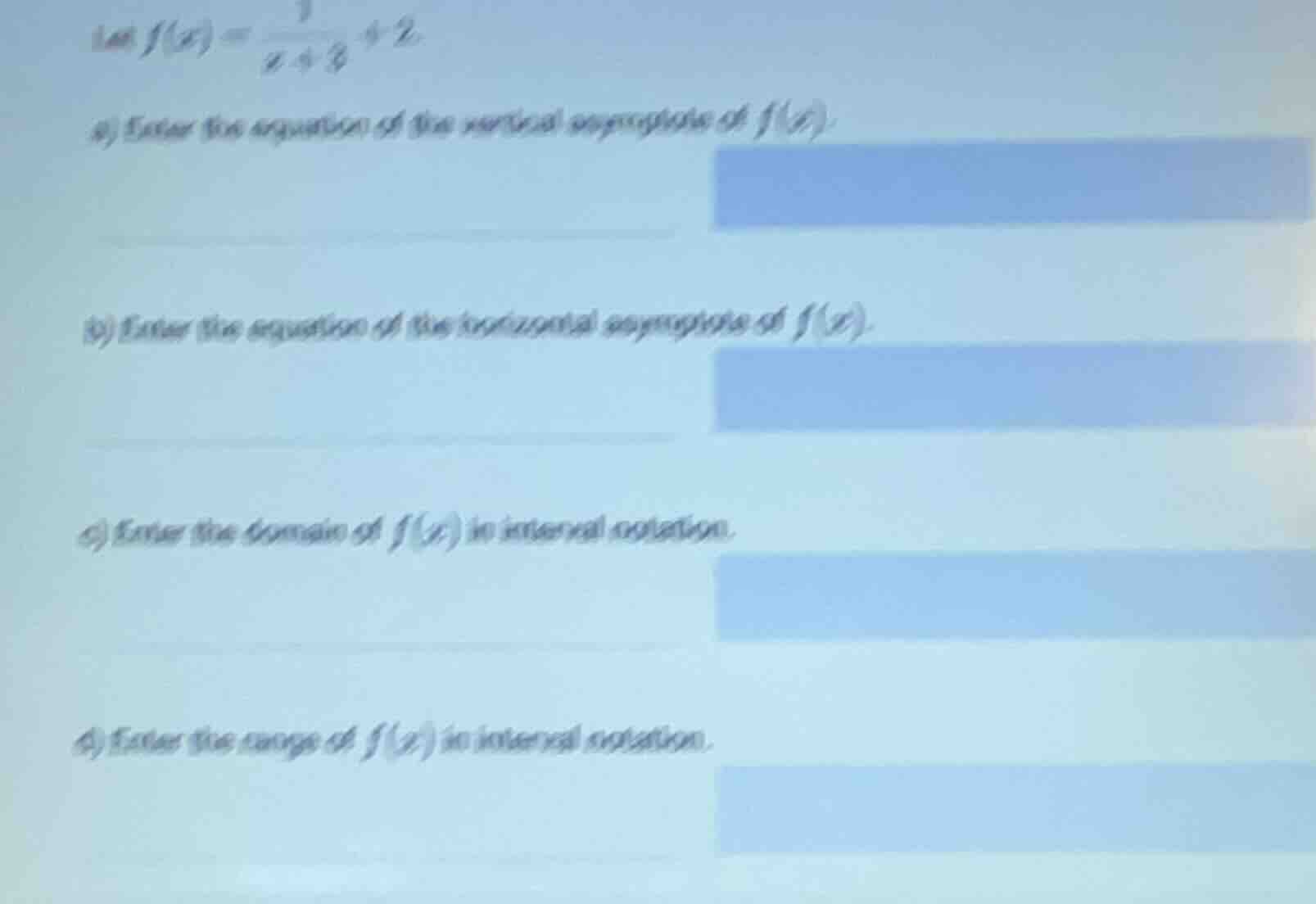
let ( f(x) = \frac{1}{x + 3} + 2 ).
a) enter the equation of the vertical asymptote of ( f(x) ).
b) enter the equation of the horizontal asymptote of ( f(x) ).
c) enter the domain of ( f(x) ) in interval notation.
d) enter the range of ( f(x) ) in interval notation.
Part (a)
Step1: Recall vertical asymptote rule
For a function \( f(x)=\frac{1}{x + 3}+2 \), the vertical asymptote occurs where the denominator is zero (since division by zero is undefined).
Set \( x + 3=0 \).
Step2: Solve for x
\( x+3 = 0\implies x=-3 \).
Step1: Recall horizontal asymptote rule for rational functions
For a function of the form \( y=\frac{a}{x - h}+k \), the horizontal asymptote is \( y = k \). Here, \( f(x)=\frac{1}{x + 3}+2 \), so \( k = 2 \).
Step1: Determine domain restrictions
The function \( f(x)=\frac{1}{x + 3}+2 \) is undefined when \( x+3 = 0\) (i.e., \( x=-3 \)). For all other real numbers, the function is defined.
Step2: Write domain in interval notation
The domain is all real numbers except \( x=-3 \), so in interval notation, it is \( (-\infty,-3)\cup(-3,\infty) \).

Snap & solve any problem in the app
Get step-by-step solutions on Sovi AI
Photo-based solutions with guided steps
Explore more problems and detailed explanations
\( x = - 3 \)