QUESTION IMAGE
Question
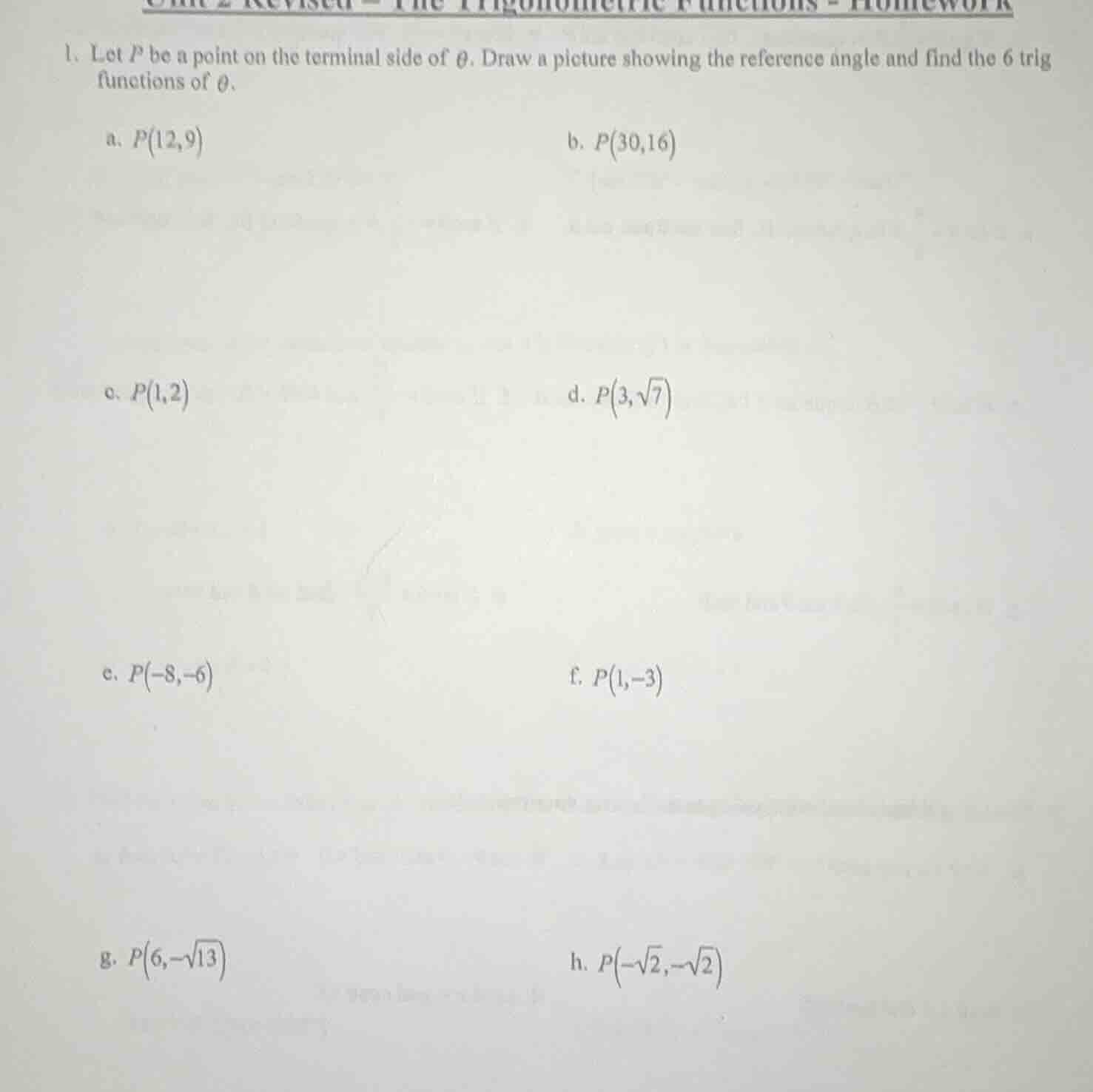
- let ( p ) be a point on the terminal side of ( \theta ). draw a picture showing the reference angle and find the 6 trig functions of ( \theta ).
a. ( p(12,9) )
b. ( p(30,16) )
c. ( p(1,2) )
d. ( p(3,sqrt{7}) )
e. ( p(-8,-6) )
f. ( p(1,-3) )
g. ( p(6,-sqrt{13}) )
h. ( p(-sqrt{2},-sqrt{2}) )
For each point \(P(x,y)\):
Step1: Calculate radius \(r\)
\(r = \sqrt{x^2 + y^2}\)
Step2: Define 6 trig functions
- \(\sin\theta = \frac{y}{r}\)
- \(\cos\theta = \frac{x}{r}\)
- \(\tan\theta = \frac{y}{x}\)
- \(\csc\theta = \frac{r}{y}\)
- \(\sec\theta = \frac{r}{x}\)
- \(\cot\theta = \frac{x}{y}\)
---
Part a: \(P(12,9)\)
Step1: Compute \(r\)
\(r = \sqrt{12^2 + 9^2} = \sqrt{144+81} = \sqrt{225} = 15\)
Step2: Compute trig functions
\(\sin\theta = \frac{9}{15} = \frac{3}{5}\)
\(\cos\theta = \frac{12}{15} = \frac{4}{5}\)
\(\tan\theta = \frac{9}{12} = \frac{3}{4}\)
\(\csc\theta = \frac{15}{9} = \frac{5}{3}\)
\(\sec\theta = \frac{15}{12} = \frac{5}{4}\)
\(\cot\theta = \frac{12}{9} = \frac{4}{3}\)
---
Part b: \(P(30,16)\)
Step1: Compute \(r\)
\(r = \sqrt{30^2 + 16^2} = \sqrt{900+256} = \sqrt{1156} = 34\)
Step2: Compute trig functions
\(\sin\theta = \frac{16}{34} = \frac{8}{17}\)
\(\cos\theta = \frac{30}{34} = \frac{15}{17}\)
\(\tan\theta = \frac{16}{30} = \frac{8}{15}\)
\(\csc\theta = \frac{34}{16} = \frac{17}{8}\)
\(\sec\theta = \frac{34}{30} = \frac{17}{15}\)
\(\cot\theta = \frac{30}{16} = \frac{15}{8}\)
---
Part c: \(P(1,2)\)
Step1: Compute \(r\)
\(r = \sqrt{1^2 + 2^2} = \sqrt{1+4} = \sqrt{5}\)
Step2: Compute trig functions
\(\sin\theta = \frac{2}{\sqrt{5}} = \frac{2\sqrt{5}}{5}\)
\(\cos\theta = \frac{1}{\sqrt{5}} = \frac{\sqrt{5}}{5}\)
\(\tan\theta = \frac{2}{1} = 2\)
\(\csc\theta = \frac{\sqrt{5}}{2}\)
\(\sec\theta = \sqrt{5}\)
\(\cot\theta = \frac{1}{2}\)
---
Part d: \(P(3,\sqrt{7})\)
Step1: Compute \(r\)
\(r = \sqrt{3^2 + (\sqrt{7})^2} = \sqrt{9+7} = \sqrt{16} = 4\)
Step2: Compute trig functions
\(\sin\theta = \frac{\sqrt{7}}{4}\)
\(\cos\theta = \frac{3}{4}\)
\(\tan\theta = \frac{\sqrt{7}}{3}\)
\(\csc\theta = \frac{4}{\sqrt{7}} = \frac{4\sqrt{7}}{7}\)
\(\sec\theta = \frac{4}{3}\)
\(\cot\theta = \frac{3}{\sqrt{7}} = \frac{3\sqrt{7}}{7}\)
---
Part e: \(P(-8,-6)\)
Step1: Compute \(r\)
\(r = \sqrt{(-8)^2 + (-6)^2} = \sqrt{64+36} = \sqrt{100} = 10\)
Step2: Compute trig functions
\(\sin\theta = \frac{-6}{10} = -\frac{3}{5}\)
\(\cos\theta = \frac{-8}{10} = -\frac{4}{5}\)
\(\tan\theta = \frac{-6}{-8} = \frac{3}{4}\)
\(\csc\theta = \frac{10}{-6} = -\frac{5}{3}\)
\(\sec\theta = \frac{10}{-8} = -\frac{5}{4}\)
\(\cot\theta = \frac{-8}{-6} = \frac{4}{3}\)
---
Part f: \(P(1,-3)\)
Step1: Compute \(r\)
\(r = \sqrt{1^2 + (-3)^2} = \sqrt{1+9} = \sqrt{10}\)
Step2: Compute trig functions
\(\sin\theta = \frac{-3}{\sqrt{10}} = -\frac{3\sqrt{10}}{10}\)
\(\cos\theta = \frac{1}{\sqrt{10}} = \frac{\sqrt{10}}{10}\)
\(\tan\theta = \frac{-3}{1} = -3\)
\(\csc\theta = -\frac{\sqrt{10}}{3}\)
\(\sec\theta = \sqrt{10}\)
\(\cot\theta = -\frac{1}{3}\)
---
Part g: \(P(6,-\sqrt{13})\)
Step1: Compute \(r\)
\(r = \sqrt{6^2 + (-\sqrt{13})^2} = \sqrt{36+13} = \sqrt{49} = 7\)
Step2: Compute trig functions
\(\sin\theta = -\frac{\sqrt{13}}{7}\)
\(\cos\theta = \frac{6}{7}\)
\(\tan\theta = -\frac{\sqrt{13}}{6}\)
\(\csc\theta = -\frac{7}{\sqrt{13}} = -\frac{7\sqrt{13}}{13}\)
\(\sec\theta = \frac{7}{6}\)
\(\cot\theta = -\frac{6}{\sqrt{13}} = -\frac{6\sqrt{13}}{13}\)
---
Part h: \(P(-\sqrt{2},-\sqrt{2})\)
Step1: Compute \(r\)
\(r = \sqrt{(-\sqrt{2})^2 + (-\sqrt{2})^2} = \sqrt{2+2} = \sqrt{4} = 2\)
Step2: Compute trig functions
\(\sin\theta = \frac{-\sqrt{2}}{2}\)
\(\cos\theta = \frac{-\sqrt{2}}{2}\)
\(\tan\theta = \frac{-\sqrt{2}}{-\sqrt{2}} = 1\)
\(\csc\theta = -\frac{2}{\sqrt{2}} = -\sqrt{2}\)
\(\sec\theta = -\frac{2}{\sqrt{2}} = -\sqrt{2}\)
\(\cot\theta = 1\)

Snap & solve any problem in the app
Get step-by-step solutions on Sovi AI
Photo-based solutions with guided steps
Explore more problems and detailed explanations
a.
$\sin\theta=\frac{3}{5}$, $\cos\theta=\frac{4}{5}$, $\tan\theta=\frac{3}{4}$, $\csc\theta=\frac{5}{3}$, $\sec\theta=\frac{5}{4}$, $\cot\theta=\frac{4}{3}$
b.
$\sin\theta=\frac{8}{17}$, $\cos\theta=\frac{15}{17}$, $\tan\theta=\frac{8}{15}$, $\csc\theta=\frac{17}{8}$, $\sec\theta=\frac{17}{15}$, $\cot\theta=\frac{15}{8}$
c.
$\sin\theta=\frac{2\sqrt{5}}{5}$, $\cos\theta=\frac{\sqrt{5}}{5}$, $\tan\theta=2$, $\csc\theta=\frac{\sqrt{5}}{2}$, $\sec\theta=\sqrt{5}$, $\cot\theta=\frac{1}{2}$
d.
$\sin\theta=\frac{\sqrt{7}}{4}$, $\cos\theta=\frac{3}{4}$, $\tan\theta=\frac{\sqrt{7}}{3}$, $\csc\theta=\frac{4\sqrt{7}}{7}$, $\sec\theta=\frac{4}{3}$, $\cot\theta=\frac{3\sqrt{7}}{7}$
e.
$\sin\theta=-\frac{3}{5}$, $\cos\theta=-\frac{4}{5}$, $\tan\theta=\frac{3}{4}$, $\csc\theta=-\frac{5}{3}$, $\sec\theta=-\frac{5}{4}$, $\cot\theta=\frac{4}{3}$
f.
$\sin\theta=-\frac{3\sqrt{10}}{10}$, $\cos\theta=\frac{\sqrt{10}}{10}$, $\tan\theta=-3$, $\csc\theta=-\frac{\sqrt{10}}{3}$, $\sec\theta=\sqrt{10}$, $\cot\theta=-\frac{1}{3}$
g.
$\sin\theta=-\frac{\sqrt{13}}{7}$, $\cos\theta=\frac{6}{7}$, $\tan\theta=-\frac{\sqrt{13}}{6}$, $\csc\theta=-\frac{7\sqrt{13}}{13}$, $\sec\theta=\frac{7}{6}$, $\cot\theta=-\frac{6\sqrt{13}}{13}$
h.
$\sin\theta=-\frac{\sqrt{2}}{2}$, $\cos\theta=-\frac{\sqrt{2}}{2}$, $\tan\theta=1$, $\csc\theta=-\sqrt{2}$, $\sec\theta=-\sqrt{2}$, $\cot\theta=1$
(Note: To draw the reference angle, for each point, sketch the terminal side from the origin to \(P\), then draw the acute angle between the terminal side and the x-axis (the reference angle), which shares the same trigonometric absolute values as \(\theta\), with signs determined by the quadrant of \(P\).)