QUESTION IMAGE
Question
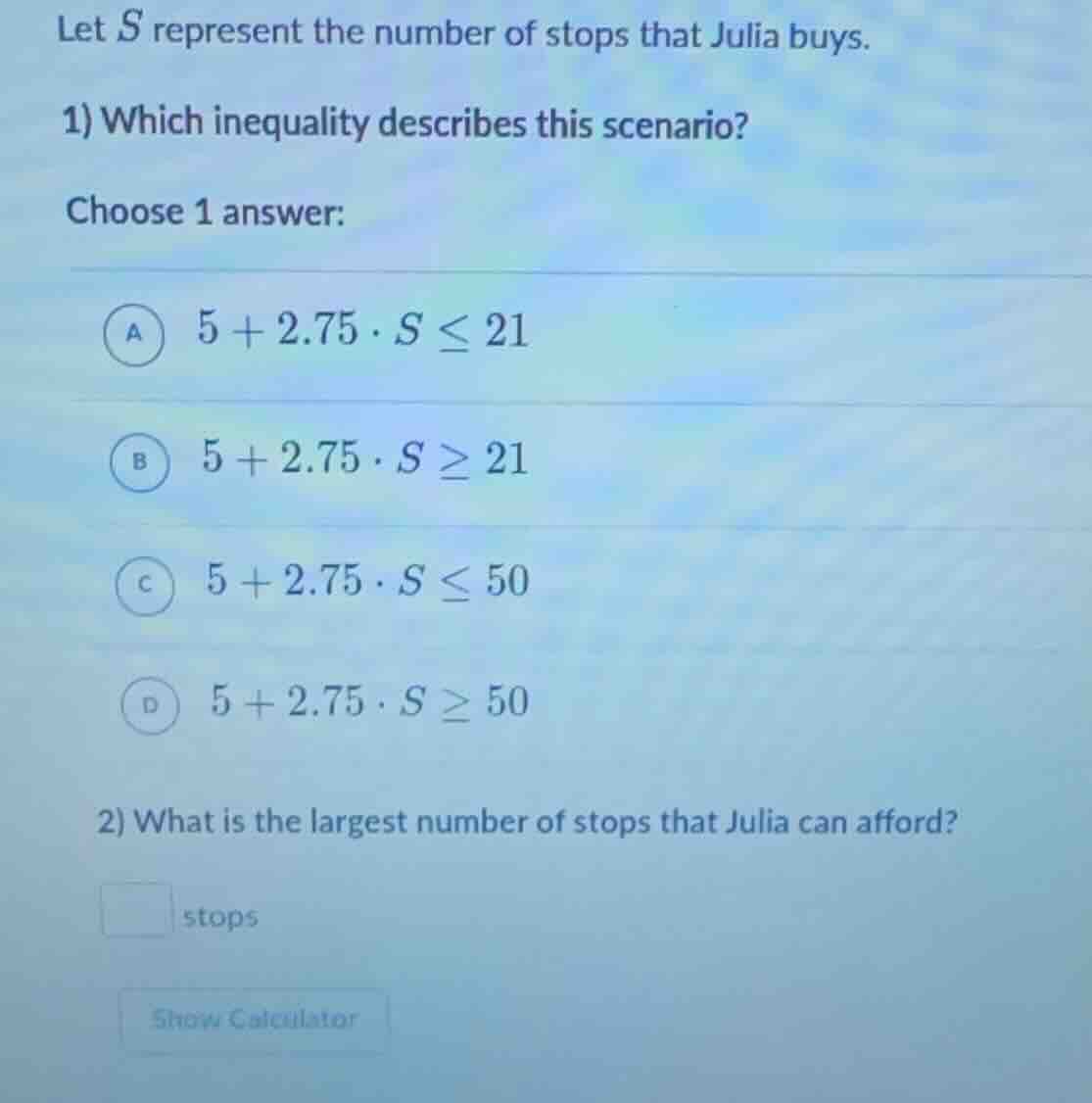
let s represent the number of stops that julia buys.1) which inequality describes this scenario?choose 1 answer:a) $5 + 2.75 \cdot s \leq 21$b) $5 + 2.75 \cdot s \geq 21$c) $5 + 2.75 \cdot s \leq 50$d) $5 + 2.75 \cdot s \geq 50$2) what is the largest number of stops that julia can afford?\boxed{} stopsshow calculator
1)
In a typical fare - related scenario, we assume Julia has a budget (let's say $21$ here, as the other option $50$ seems less likely for a stop - buying scenario without context). The cost structure is a fixed cost of $5$ plus a variable cost of $2.75$ per stop ($S$). The total cost $5 + 2.75S$ should be less than or equal to her budget (so she can afford it). So the inequality is $5+2.75\cdot S\leq21$, which is option A.
Step1: Start with the inequality
We have the inequality $5 + 2.75S\leq21$. First, subtract $5$ from both sides.
$5+2.75S - 5\leq21 - 5$
$2.75S\leq16$
Step2: Solve for S
Divide both sides by $2.75$:
$S\leq\frac{16}{2.75}$
$\frac{16}{2.75}=\frac{16\times4}{2.75\times4}=\frac{64}{11}\approx5.818$
Since the number of stops $S$ must be a non - negative integer, the largest integer value of $S$ that satisfies the inequality is $5$.

Snap & solve any problem in the app
Get step-by-step solutions on Sovi AI
Photo-based solutions with guided steps
Explore more problems and detailed explanations
A. $5 + 2.75\cdot S\leq21$