QUESTION IMAGE
Question
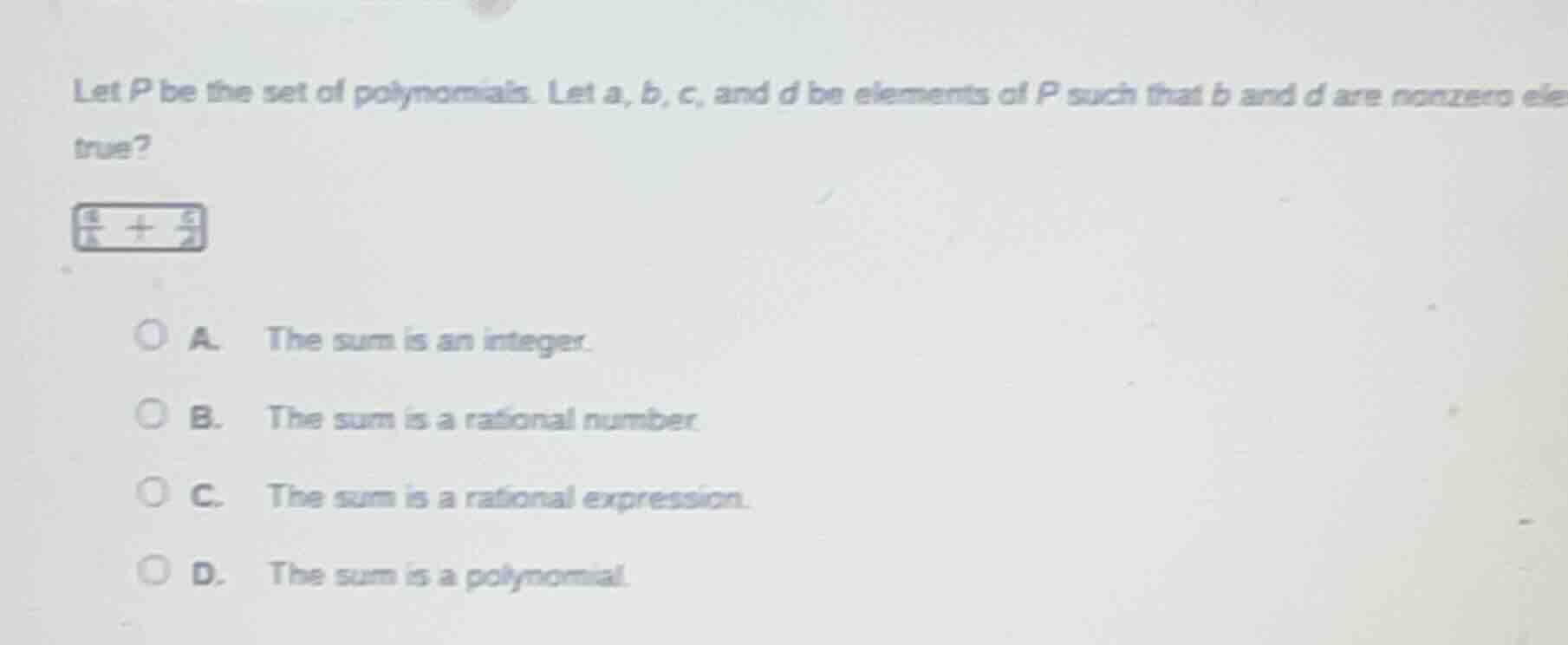
let p be the set of polynomials. let a, b, c, and d be elements of p such that b and d are nonzero ele true? \boxed{\frac{a}{b} + \frac{c}{d}} \
\bigcirc a. the sum is an integer. \
\bigcirc b. the sum is a rational number. \
\bigcirc c. the sum is a rational expression. \
\bigcirc d. the sum is a polynomial.
Step1: Define rational expressions
A rational expression is a ratio of two polynomials where the denominator is non-zero. Here, $\frac{a}{b}$ and $\frac{c}{d}$ are rational expressions since $a,b,c,d$ are polynomials and $b,d
eq0$.
Step2: Add the rational expressions
To add $\frac{a}{b} + \frac{c}{d}$, find a common denominator:
$$\frac{a}{b} + \frac{c}{d} = \frac{ad + bc}{bd}$$
Since $b,d$ are non-zero polynomials, $bd
eq0$. The numerator $ad+bc$ is a polynomial (sum/products of polynomials are polynomials), so the result is a ratio of two polynomials, i.e., a rational expression.
Step3: Eliminate other options
- A/B: The sum is not necessarily an integer or rational number, as $a,b,c,d$ are arbitrary polynomials (not just constants).
- D: The sum is not a polynomial unless $b$ divides $a$ and $d$ divides $c$, which is not guaranteed.

Snap & solve any problem in the app
Get step-by-step solutions on Sovi AI
Photo-based solutions with guided steps
Explore more problems and detailed explanations
C. The sum is a rational expression.