QUESTION IMAGE
Question
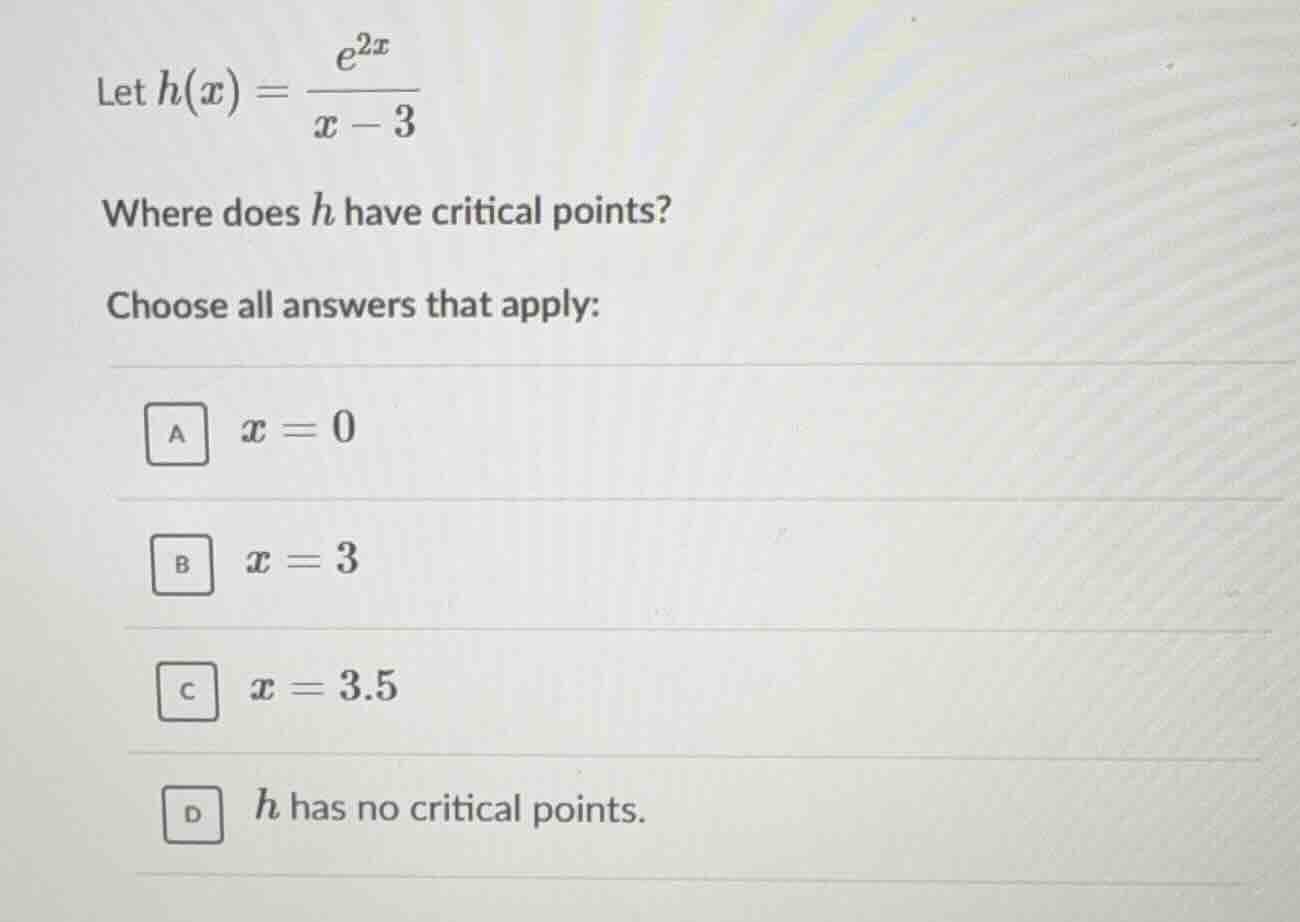
let $h(x) = \frac{e^{2x}}{x - 3}$
where does $h$ have critical points?
choose all answers that apply:
a $x = 0$
b $x = 3$
c $x = 3.5$
d $h$ has no critical points.
Step1: Find the derivative of \( h(x) \)
To find critical points, we first find the derivative of \( h(x)=\frac{e^{2x}}{x - 3} \) using the quotient rule. The quotient rule states that if \( h(x)=\frac{f(x)}{g(x)} \), then \( h'(x)=\frac{f'(x)g(x)-f(x)g'(x)}{(g(x))^2} \). Here, \( f(x)=e^{2x} \) and \( g(x)=x - 3 \).
The derivative of \( f(x)=e^{2x} \) is \( f'(x)=2e^{2x} \) (using the chain rule), and the derivative of \( g(x)=x - 3 \) is \( g'(x)=1 \).
So, \( h'(x)=\frac{2e^{2x}(x - 3)-e^{2x}(1)}{(x - 3)^2}=\frac{e^{2x}(2(x - 3)-1)}{(x - 3)^2}=\frac{e^{2x}(2x-6 - 1)}{(x - 3)^2}=\frac{e^{2x}(2x - 7)}{(x - 3)^2} \)
Step2: Find where \( h'(x)=0 \) or \( h'(x) \) is undefined
- Where \( h'(x)=0 \): The numerator \( e^{2x}(2x - 7) \) must be zero. Since \( e^{2x}>0 \) for all real \( x \), we set \( 2x - 7 = 0 \), which gives \( x=\frac{7}{2}=3.5 \).
- Where \( h'(x) \) is undefined: The denominator \( (x - 3)^2=0 \) when \( x = 3 \). But we need to check if \( x = 3 \) is in the domain of \( h(x) \). The function \( h(x)=\frac{e^{2x}}{x - 3} \) is undefined at \( x = 3 \), so \( x = 3 \) is not in the domain of \( h(x) \), and thus not a critical point (critical points must be in the domain of the function).
Now, we check the options:
- Option A: \( x = 0 \). Substitute \( x = 0 \) into \( h'(x) \), \( h'(0)=\frac{e^{0}(2(0)-7)}{(0 - 3)^2}=\frac{-7}{9}
eq0 \), so \( x = 0 \) is not a critical point.
- Option B: \( x = 3 \) is not in the domain of \( h(x) \), so not a critical point.
- Option C: \( x = 3.5 \) is a solution to \( h'(x)=0 \) and is in the domain of \( h(x) \) (since \( 3.5-3=0.5
eq0 \)), so \( x = 3.5 \) is a critical point.
- Option D: Since we found a critical point at \( x = 3.5 \), this is incorrect.

Snap & solve any problem in the app
Get step-by-step solutions on Sovi AI
Photo-based solutions with guided steps
Explore more problems and detailed explanations
C. \( x = 3.5 \)