QUESTION IMAGE
Question
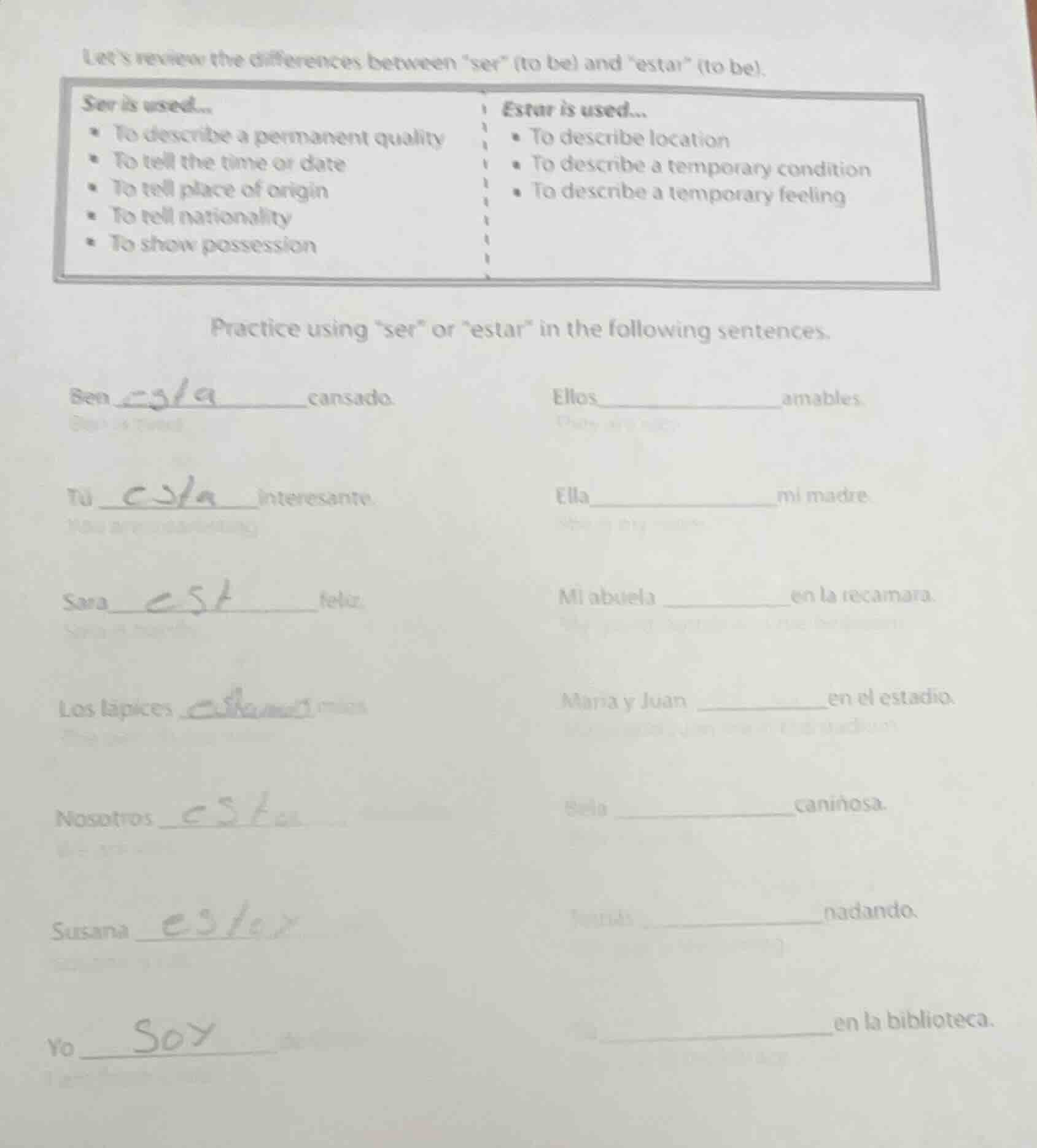
lets review the differences between \ser\ (to be) and \estar\ (to be).
ser is used...
- to describe a permanent quality
- to tell the time or date
- to tell place of origin
- to tell nationality
- to show possession
estar is used...
- to describe location
- to describe a temporary condition
- to describe a temporary feeling
practice using \ser\ or \estar\ in the following sentences.
ben ______ cansado.
(he is tired.)
ellos ______ amables.
(they are nice.)
tú ______ interesante.
(you are interesting.)
ella ______ mi madre.
(she is my mother.)
sara ______ feliz.
(sara is happy.)
mi abuela ______ en la recamara.
(my grandmother is in the bedroom.)
los lapices ______ rojos.
(the pencils are red.)
maria y juan ______ en el estadio.
(maria and juan are in the stadium.)
nosotros ______...
(we are...)
bella ______ cariñosa.
(bella is affectionate.)
susana ______...
(susana is...)
todos ______ nadando.
(everyone is swimming.)
yo ______...
(i am...)
______ en la biblioteca.
(______ in the library.)
- Ben ____ cansado: "Cansado" (tired) is a temporary feeling, so use estar, conjugated to está for singular subject Ben.
- Ellos ____ amables: "Amables" (kind) is a permanent personality trait, so use ser, conjugated to son for plural subject Ellos.
- Tú ____ interesante: "Interesante" (interesting) is a permanent quality, so use ser, conjugated to eres for singular subject Tú.
- Ella ____ mi madre: This describes a permanent familial relationship, so use ser, conjugated to es for singular subject Ella.
- Sara ____ feliz: "Feliz" (happy) is a temporary feeling, so use estar, conjugated to está for singular subject Sara.
- Mi abuela ____ en la recamara: This describes location, so use estar, conjugated to está for singular subject Mi abuela.
- Los lápices ____ míos: This shows possession, so use ser, conjugated to son for plural subject Los lápices.
- María y Juan ____ en el estadio: This describes location, so use estar, conjugated to están for plural subject María y Juan.
- Nosotros ____ altos: "Altos" (tall) is a permanent physical quality, so use ser, conjugated to somos for plural subject Nosotros.
- Bella ____ cariñosa: "Cariñosa" (affectionate) is a permanent personality trait, so use ser, conjugated to es for singular subject Bella.
- Susana ____ enferma: "Enferma" (sick) is a temporary condition, so use estar, conjugated to está for singular subject Susana.
- Tú ____ nadando: This describes an ongoing temporary action, so use estar, conjugated to estás for singular subject Tú.
- Yo ____ alto: "Alto" (tall) is a permanent physical quality, so use ser, conjugated to soy for singular subject Yo.
- Nosotros ____ en la biblioteca: This describes location, so use estar, conjugated to estamos for plural subject Nosotros.

Snap & solve any problem in the app
Get step-by-step solutions on Sovi AI
Photo-based solutions with guided steps
Explore more problems and detailed explanations
- Ben está cansado.
- Ellos son amables.
- Tú eres interesante.
- Ella es mi madre.
- Sara está feliz.
- Mi abuela está en la recamara.
- Los lápices son míos.
- María y Juan están en el estadio.
- Nosotros somos altos.
- Bella es cariñosa.
- Susana está enferma.
- Tú estás nadando.
- Yo soy alto.
- Nosotros estamos en la biblioteca.