QUESTION IMAGE
Question
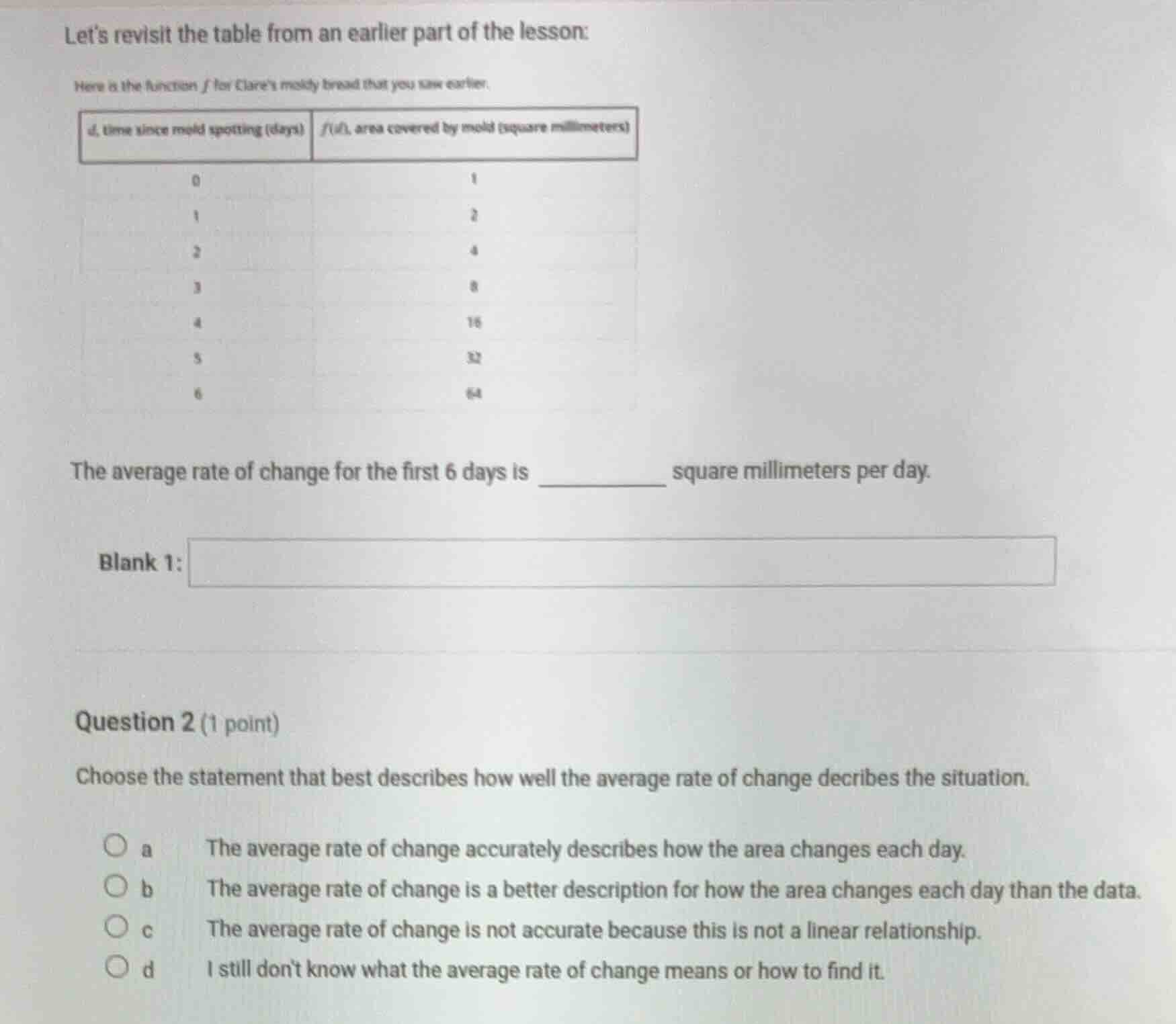
lets revisit the table from an earlier part of the lesson:
here is the function $f$ for clares moldy bread that you saw earlier.
$d$, time since mold spotting (days) | $f(d)$, area covered by mold (square millimeters)
0 | 1
1 | 2
2 | 4
3 | 8
4 | 16
5 | 32
6 | 64
the average rate of change for the first 6 days is __________ square millimeters per day.
blank 1:
question 2 (1 point)
choose the statement that best describes how well the average rate of change decribes the situation.
a. the average rate of change accurately describes how the area changes each day.
b. the average rate of change is a better description for how the area changes each day than the data.
c. the average rate of change is not accurate because this is not a linear relationship.
d. i still dont know what the average rate of change means or how to find it.
Step1: Recall average rate of change formula
The average rate of change of a function $f(d)$ over $[d_1,d_2]$ is $\frac{f(d_2)-f(d_1)}{d_2-d_1}$.
Step2: Identify values from the table
For the first 6 days: $d_1=0$, $f(d_1)=1$; $d_2=6$, $f(d_2)=64$.
Step3: Calculate the average rate of change
$\frac{64 - 1}{6 - 0} = \frac{63}{6} = 10.5$
Step4: Analyze the relationship type
The function $f(d)=2^d$ is exponential, not linear. The average rate of change does not reflect the daily exponential growth.

Snap & solve any problem in the app
Get step-by-step solutions on Sovi AI
Photo-based solutions with guided steps
Explore more problems and detailed explanations
Blank 1: $10.5$
Question 2: c. The average rate of change is not accurate because this is not a linear relationship.