QUESTION IMAGE
Question
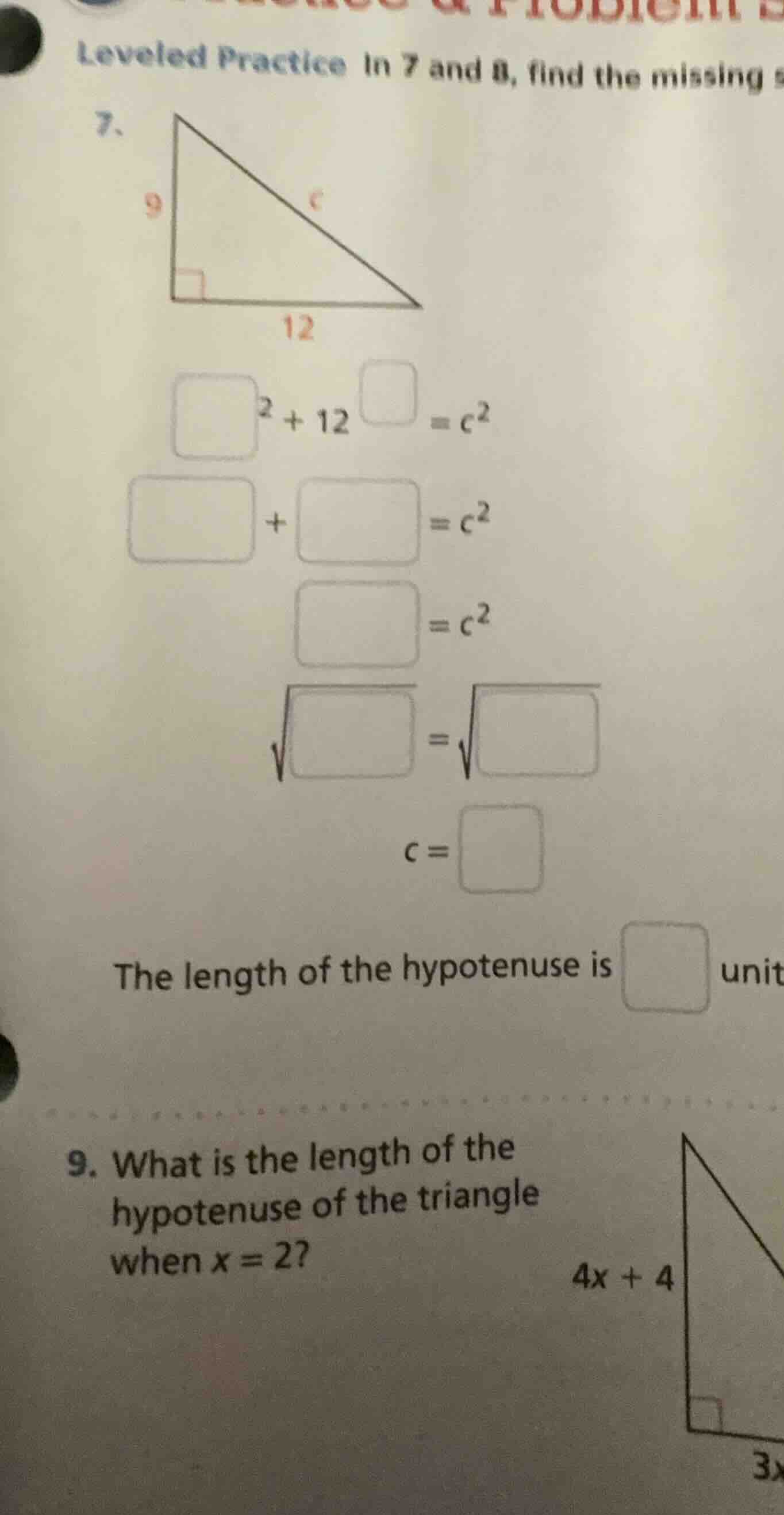
leveled practice in 7 and 8, find the missing 7.
$\square^2 + 12\square = c^2$
$\square + \square = c^2$
$\square = c^2$
$\sqrt{\square}=\sqrt{\square}$
$c = \square$
the length of the hypotenuse is $\square$ unit
- what is the length of the hypotenuse of the triangle when $x = 2$?
Problem 7
Step1: Apply Pythagorean theorem
In a right - triangle, the Pythagorean theorem states that \(a^{2}+b^{2}=c^{2}\), where \(a\) and \(b\) are the lengths of the legs and \(c\) is the length of the hypotenuse. Here, \(a = 9\) and \(b=12\). So we have \(9^{2}+12^{2}=c^{2}\)
Step2: Calculate the squares
\(9^{2}=81\) and \(12^{2} = 144\). So the equation becomes \(81 + 144=c^{2}\)
Step3: Sum the values
\(81+144 = 225\), so \(225=c^{2}\)
Step4: Take square roots
Take the square root of both sides: \(\sqrt{225}=\sqrt{c^{2}}\)
Step5: Simplify the square roots
Since \(\sqrt{225} = 15\) and \(\sqrt{c^{2}}=c\) (for \(c\geq0\) as it represents a length), we get \(c = 15\)
Problem 9 (assuming it's a right - triangle and we need to find the hypotenuse using the Pythagorean theorem, but we need more information about the other leg. However, if we assume the other leg is also expressed in terms of \(x\) or we have a right - triangle with legs \(4x + 4\) and another leg (maybe we missed the other leg's expression, but if we assume the other leg is, say, \(3x\) from the partial view). Let's assume the right - triangle has legs \(4x + 4\) and \(3x\) (from the partial text "3x" at the bottom). Then we can find the hypotenuse when \(x = 2\)):
Step1: Find the lengths of the legs when \(x = 2\)
For the leg \(4x+4\): Substitute \(x = 2\) into \(4x + 4\), we get \(4\times2+4=8 + 4=12\)
For the leg \(3x\): Substitute \(x = 2\) into \(3x\), we get \(3\times2 = 6\)
Step2: Apply the Pythagorean theorem
Using \(a = 12\), \(b = 6\) and \(a^{2}+b^{2}=c^{2}\), we have \(12^{2}+6^{2}=c^{2}\)
Step3: Calculate the squares
\(12^{2}=144\) and \(6^{2}=36\). So \(144 + 36=c^{2}\)
Step4: Sum the values
\(144+36=180\), so \(c^{2}=180\)
Step5: Simplify the square root
\(c=\sqrt{180}=\sqrt{36\times5}=6\sqrt{5}\approx13.42\) (but if we made a wrong assumption about the other leg, the answer will change. Since the problem's diagram is not fully visible, if we assume it's a right - triangle with legs \(4x + 4\) and another leg, and we only have one leg's expression, we need more information. But if we assume it's a different case, for example, if it's an isosceles right - triangle or a different type, but with the given partial information, we proceed with the assumption of two legs \(4x + 4\) and \(3x\))
If we assume the other leg is not given and it's a different problem, but based on the partial text, we will correct it if more information is provided. But with the current assumption:

Snap & solve any problem in the app
Get step-by-step solutions on Sovi AI
Photo-based solutions with guided steps
Explore more problems and detailed explanations
(for the assumed case):
If the right - triangle has legs \(4x + 4\) and \(3x\), when \(x = 2\), the hypotenuse \(c=\sqrt{(4x + 4)^{2}+(3x)^{2}}\). Substituting \(x = 2\):
\(4x+4=12\), \(3x = 6\)
\(c=\sqrt{12^{2}+6^{2}}=\sqrt{144 + 36}=\sqrt{180}=6\sqrt{5}\approx13.42\) (or if we made a wrong assumption, the answer will vary)
But for problem 7: