QUESTION IMAGE
Question
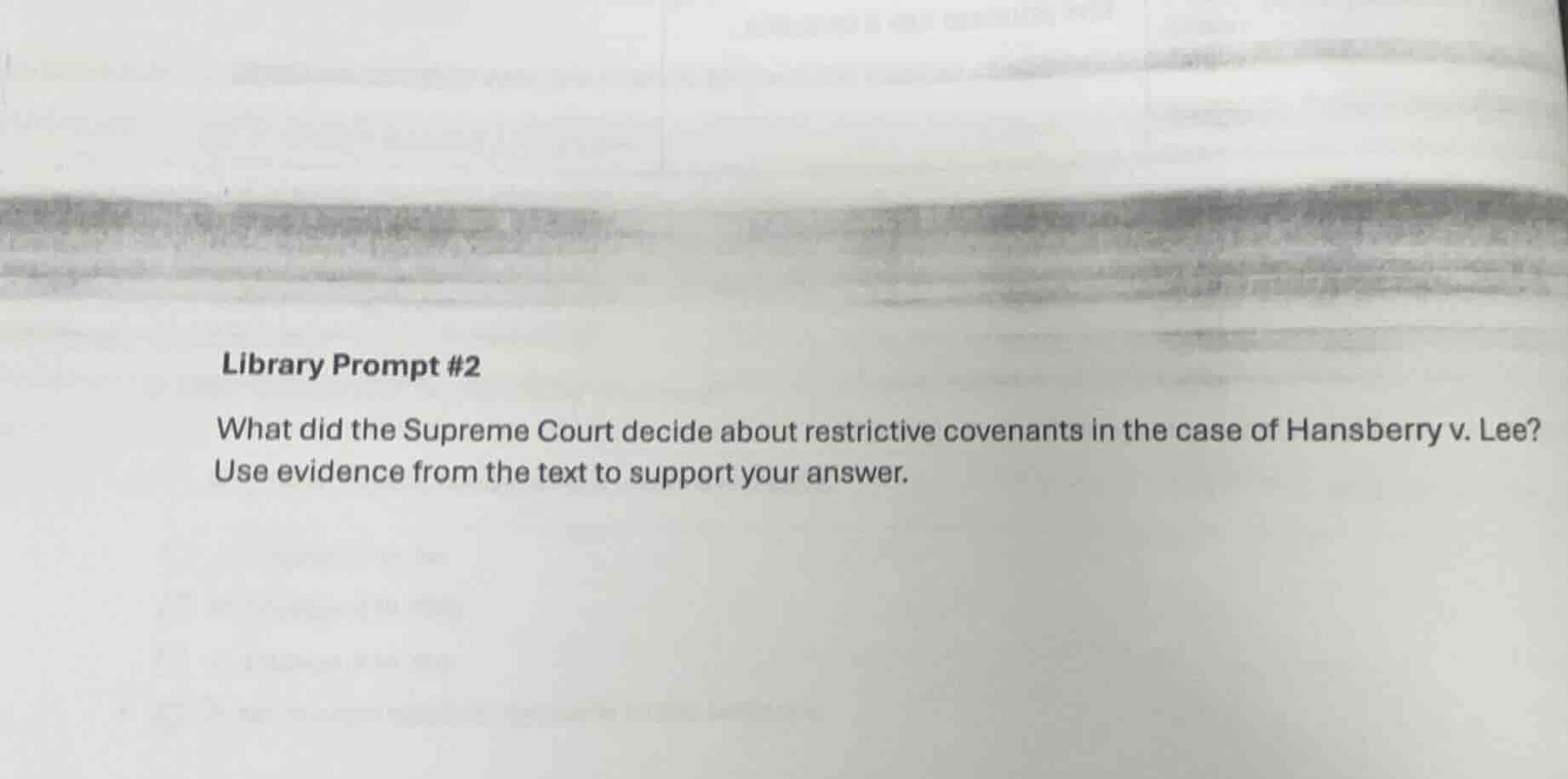
library prompt #2
what did the supreme court decide about restrictive covenants in the case of hansberry v. lee?
use evidence from the text to support your answer.
To answer this, we analyze the case: In Hansberry v. Lee (1940), the Supreme Court held that a judgment in a class action suit involving a racially restrictive covenant (aimed at excluding non - white people from a neighborhood) could not bind class members who had not been properly represented in the original suit. The Court ruled that the restrictive covenant at issue, which was part of a neighborhood agreement to exclude African - Americans, was unenforceable against plaintiffs who were not bound by the prior judgment (as the prior suit's class representation was defective). The key was that the class in the prior litigation did not adequately represent all those bound by the covenant, so the new plaintiffs (Hansberry and others) were not bound by the earlier decision upholding the covenant. Thus, the Supreme Court determined that the racially restrictive covenant could not be enforced against the plaintiffs in this case, as the prior judicial approval of the covenant (in a suit where class representation was flawed) did not bind the new group of property owners who were affected by the covenant but not properly represented in the original action.
In Hansberry v. Lee (1940), the Supreme Court ruled that a racially restrictive covenant (aimed at excluding non - white people from a neighborhood) could not be enforced against plaintiffs not bound by a prior flawed class - action judgment. The prior suit's class representation was defective, so the new plaintiffs (like Hansberry) weren't bound by the earlier decision upholding the covenant.

Snap & solve any problem in the app
Get step-by-step solutions on Sovi AI
Photo-based solutions with guided steps
Explore more problems and detailed explanations
In Hansberry v. Lee (1940), the Supreme Court held that a racially restrictive covenant (intended to exclude non - white individuals from a neighborhood) could not be enforced against the plaintiffs (Hansberry and others) because the prior class - action judgment upholding the covenant was based on a flawed class representation, and thus did not bind the new group of property owners affected by the covenant but not properly represented in the original action.