QUESTION IMAGE
Question
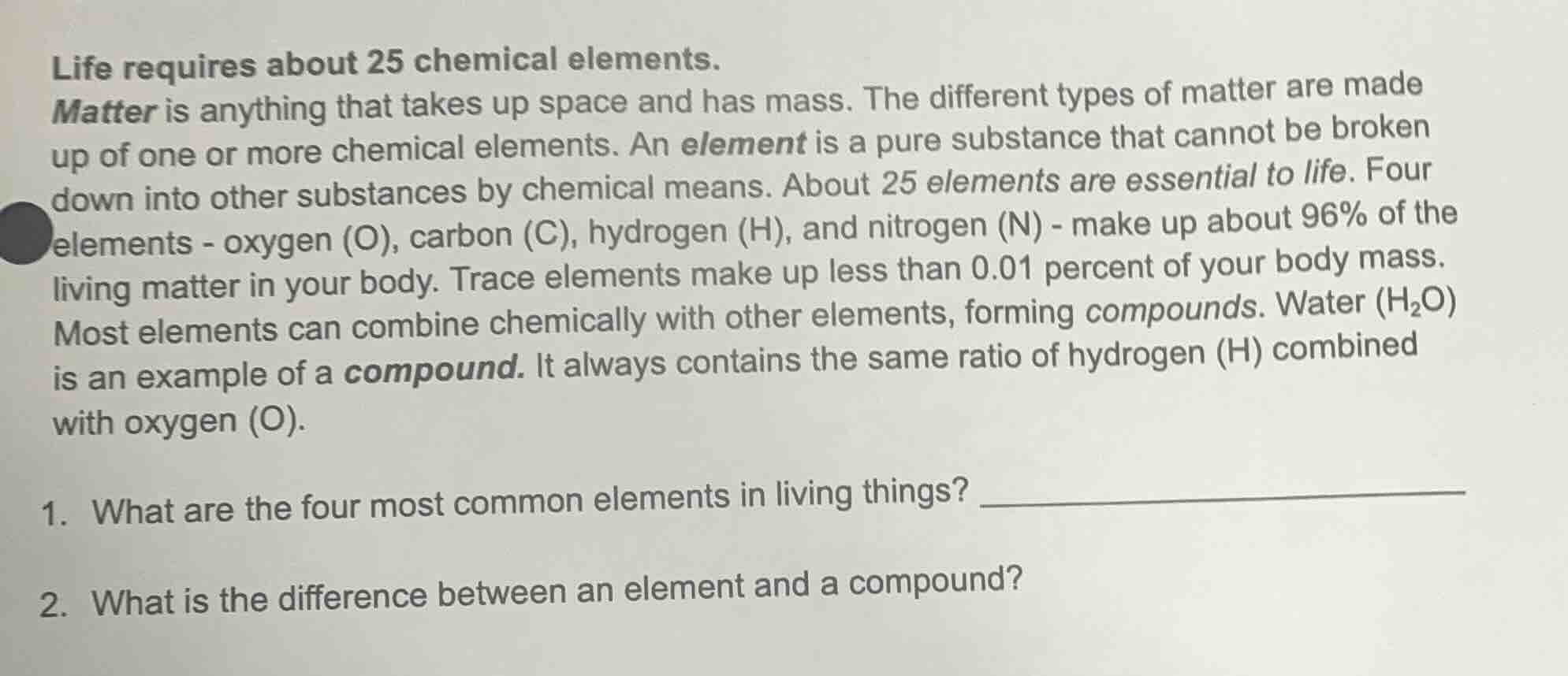
life requires about 25 chemical elements. matter is anything that takes up space and has mass. the different types of matter are made up of one or more chemical elements. an element is a pure substance that cannot be broken down into other substances by chemical means. about 25 elements are essential to life. four elements - oxygen (o), carbon (c), hydrogen (h), and nitrogen (n) - make up about 96% of the living matter in your body. trace elements make up less than 0.01 percent of your body mass. most elements can combine chemically with other elements, forming compounds. water ($h_2o$) is an example of a compound. it always contains the same ratio of hydrogen (h) combined with oxygen (o). 1. what are the four most common elements in living things? 2. what is the difference between an element and a compound?
Sub - Question 1
From the text, it is stated that "Four elements - oxygen (O), carbon (C), hydrogen (H), and nitrogen (N) - make up about 96% of the living matter in your body". So we can directly get the four most common elements in living things from this sentence.
The text says "An element is a pure substance that cannot be broken down into other substances by chemical means" and "Most elements can combine chemically with other elements, forming compounds. Water ($\ce{H_2O}$) is an example of a compound. It always contains the same ratio of hydrogen (H) combined with oxygen (O)". So we can summarize the difference between an element and a compound from these descriptions.

Snap & solve any problem in the app
Get step-by-step solutions on Sovi AI
Photo-based solutions with guided steps
Explore more problems and detailed explanations
Oxygen (O), Carbon (C), Hydrogen (H), Nitrogen (N)