QUESTION IMAGE
Question
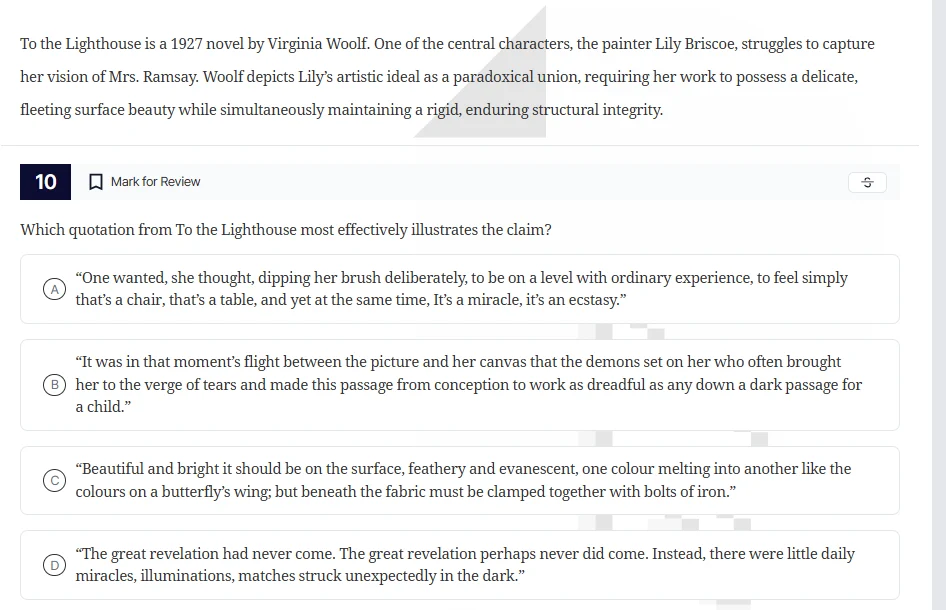
to the lighthouse is a 1927 novel by virginia woolf. one of the central characters, the painter lily briscoe, struggles to capture her vision of mrs. ramsay. woolf depicts lilys artistic ideal as a paradoxical union, requiring her work to possess a delicate, fleeting surface beauty while simultaneously maintaining a rigid, enduring structural integrity.
10
which quotation from to the lighthouse most effectively illustrates the claim?
a \one wanted, she thought, dipping her brush deliberately, to be on a level with ordinary experience, to feel simply thats a chair, thats a table, and yet at the same time, its a miracle, its an ecstasy.\
b \it was in that moments flight between the picture and her canvas that the demons set on her who often brought her to the verge of tears and made this passage from conception to work as dreadful as any down a dark passage for a child.\
c \beautiful and bright it should be on the surface, feathery and evanescent, one colour melting into another like the colours on a butterflys wing; but beneath the fabric must be clamped together with bolts of iron.\
d \the great revelation had never come. the great revelation perhaps never did come. instead, there were little daily miracles, illuminations, matches struck unexpectedly in the dark.\
The claim is about Lily's artistic ideal needing a delicate, fleeting surface beauty and rigid, enduring structural integrity. Option C describes the surface as "beautiful and bright", "feathery and evanescent" (matching fleeting surface beauty) and beneath as "clamped together with bolts of iron" (matching rigid structural integrity). Other options don't address both aspects.

Snap & solve any problem in the app
Get step-by-step solutions on Sovi AI
Photo-based solutions with guided steps
Explore more problems and detailed explanations
C. “Beautiful and bright it should be on the surface, feathery and evanescent, one colour melting into another like the colours on a butterfly's wing; but beneath the fabric must be clamped together with bolts of iron.”