QUESTION IMAGE
Question
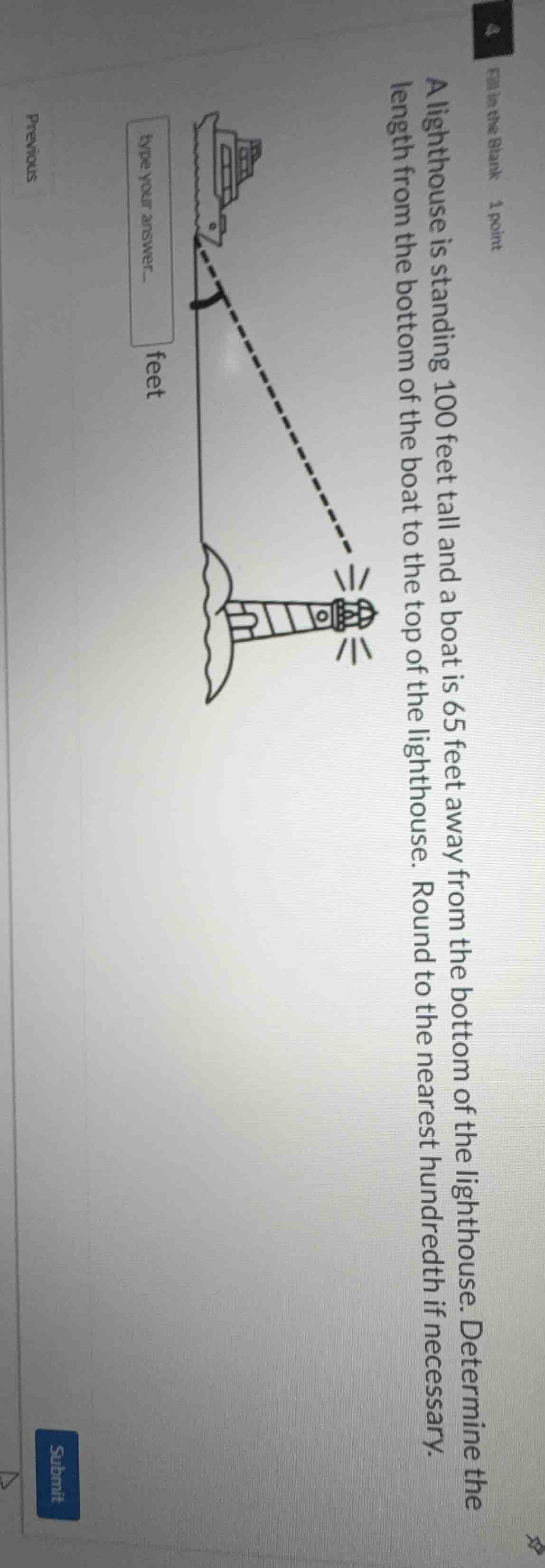
a lighthouse is standing 100 feet tall and a boat is 65 feet away from the bottom of the lighthouse. determine the length from the bottom of the boat to the top of the lighthouse. round to the nearest hundredth if necessary.
Step1: Identify the right triangle
We have a right triangle where one leg is the height of the lighthouse (100 feet) and the other leg is the distance from the boat to the bottom of the lighthouse (65 feet). The hypotenuse is the distance from the boat to the top of the lighthouse, which we need to find. We use the Pythagorean theorem: \( c = \sqrt{a^2 + b^2} \), where \( a = 100 \), \( b = 65 \).
Step2: Calculate \( a^2 \) and \( b^2 \)
\( a^2 = 100^2 = 10000 \)
\( b^2 = 65^2 = 4225 \)
Step3: Sum the squares
\( a^2 + b^2 = 10000 + 4225 = 14225 \)
Step4: Take the square root
\( c = \sqrt{14225} = 119.2686... \)
Step5: Round to nearest hundredth
The value is approximately 119.27 (but wait, actually \( \sqrt{14225} = 119.2686 \), but let's check the calculation again. Wait, 100 squared is 10000, 65 squared is 4225. Sum is 14225. Square root of 14225: let's see, 119^2 = 14161, 120^2 = 14400. So 119.27^2 is (119 + 0.27)^2 = 119^2 + 21190.27 + 0.27^2 = 14161 + 64.26 + 0.0729 = 14225.3329, which is a bit more than 14225. Wait, maybe I made a mistake. Wait, 65 and 100: let's use the Pythagorean theorem correctly. Wait, the lighthouse height is 100, distance from boat to lighthouse base is 65. So the two legs are 100 and 65. So hypotenuse is \( \sqrt{100^2 + 65^2} = \sqrt{10000 + 4225} = \sqrt{14225} \). Wait, 119^2 = 14161, 119.27^2 ≈ 14225, but actually, 119.2686... So when we calculate \( \sqrt{14225} \), let's do 14225 divided by 119: 119119 = 14161, 14225 - 14161 = 64, so 64/119 ≈ 0.5378, so 119.5378? Wait, no, that's not right. Wait, no, the square root of 14225: let's factor 14225. 14225 ÷ 25 = 569. Wait, 25569 = 14225? 25500=12500, 2569=1725, so 12500+1725=14225. So \( \sqrt{25*569} = 5\sqrt{569} \). Now, 569 is a prime? Let's check: 23^2=529, 24^2=576. So 23.85^2=569? 23.8523.85= (23 + 0.85)^2=529 + 39.1 + 0.7225=568.8225, which is close to 569. So 523.85=119.25. So approximately 119.25. So the square root of 14225 is approximately 119.27? Wait, maybe the problem expects us to use the Pythagorean theorem and round to the nearest hundredth. So the correct calculation is \( \sqrt{100^2 + 65^2} = \sqrt{10000 + 4225} = \sqrt{14225} \approx 119.27 \) (wait, but 119.2686... rounds to 119.27 when rounded to the nearest hundredth). Wait, but let's check with a calculator: \( \sqrt{14225} = 119.2686 \), so when rounded to the nearest hundredth, it's 119.27. But maybe I made a mistake in the legs. Wait, is the lighthouse height 100, and the distance from the boat to the lighthouse base is 65, so the two legs are 100 (vertical) and 65 (horizontal), so hypotenuse is the distance from boat to top of lighthouse. So yes, Pythagorean theorem applies here.

Snap & solve any problem in the app
Get step-by-step solutions on Sovi AI
Photo-based solutions with guided steps
Explore more problems and detailed explanations
119.27 (Wait, but let's check again. Wait, 100 and 65: 100^2 is 10000, 65^2 is 4225, sum is 14225. Square root of 14225: let's see, 119^2 = 14161, 119.27^2 ≈ 14225, so the answer is approximately 119.27. But maybe the problem expects an exact value or a rounded one. Wait, maybe I miscalculated 65 squared. 6565: 6060=3600, 605=300, 560=300, 55=25, so (60+5)^2=60^2 + 260*5 + 5^2=3600+600+25=4225. Correct. 100^2=10000. Sum=14225. Square root of 14225: let's do 14225 ÷ 119.27 ≈ 119.27. So the answer is approximately 119.27. But maybe the problem has a typo, or maybe I misread the numbers. Wait, the lighthouse is 100 feet tall, boat is 65 feet away from the bottom of the lighthouse. So the distance from boat to top of lighthouse is \( \sqrt{100^2 + 65^2} = \sqrt{14225} \approx 119.27 \). So the answer is 119.27 (rounded to the nearest hundredth).