QUESTION IMAGE
Question
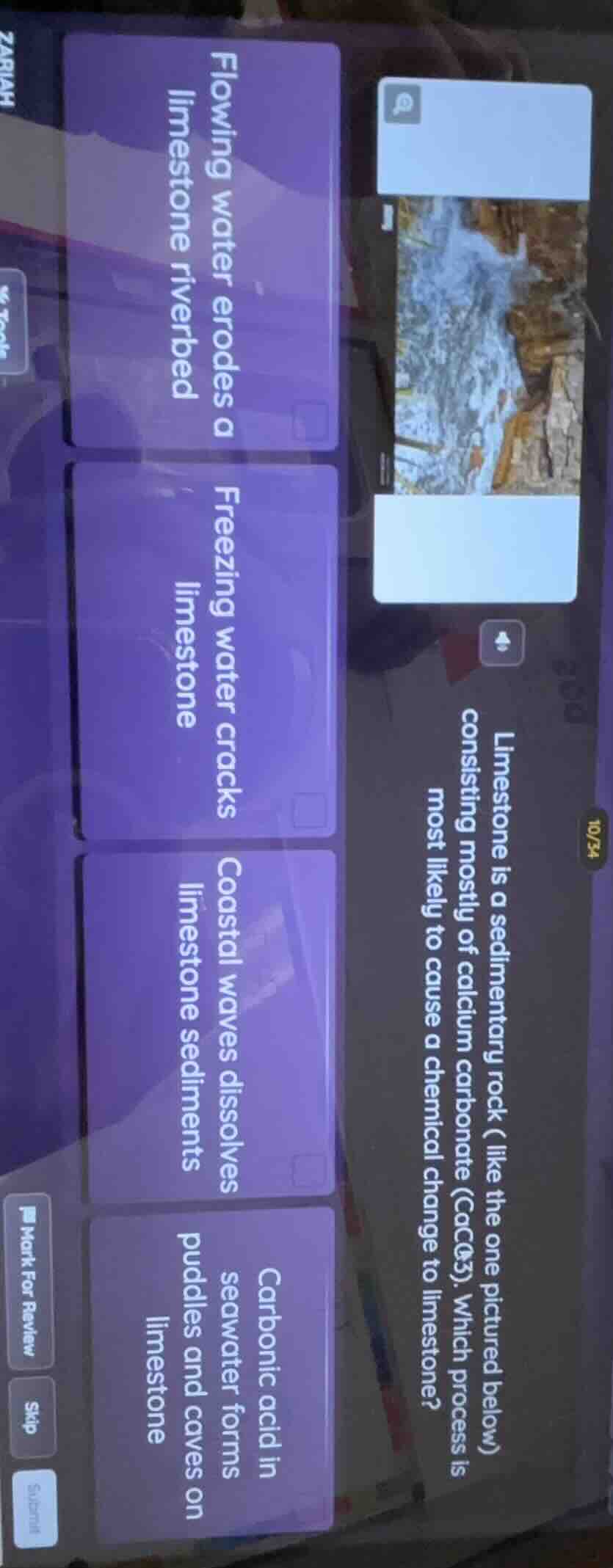
limestone is a sedimentary rock ( like the one pictured below ) consisting mostly of calcium carbonate (caco₃). which process is most likely to cause a chemical change to limestone? flowing water erodes a limestone riverbed freezing water cracks limestone coastal waves dissolves limestone sediments carbonic acid in seawater forms puddles and caves on limestone
To determine which process causes a chemical change to limestone (composed of \( \text{CaCO}_3 \)), we analyze each option:
- "Flowing water erodes a limestone riverbed": Erosion is a physical process (breaking into smaller pieces, no chemical reaction).
- "Freezing water cracks limestone": Freezing expands water, causing physical cracking (no chemical change).
- "Coastal waves dissolve limestone sediments": Dissolving sediments here is likely physical (e.g., mechanical breakdown or physical dissolution without chemical reaction).
- "Carbonic acid in seawater forms puddles and caves on limestone": Carbonic acid (\( \text{H}_2\text{CO}_3 \)) reacts with \( \text{CaCO}_3 \) (limestone) in a chemical reaction: \( \text{CaCO}_3 + \text{H}_2\text{CO}_3
ightarrow \text{Ca(HCO}_3\text{)}_2 \), which dissolves the limestone, forming caves/puddles (a chemical change).

Snap & solve any problem in the app
Get step-by-step solutions on Sovi AI
Photo-based solutions with guided steps
Explore more problems and detailed explanations
Carbonic acid in seawater forms puddles and caves on limestone