QUESTION IMAGE
Question
limiting reactant - regular
problem 9.23
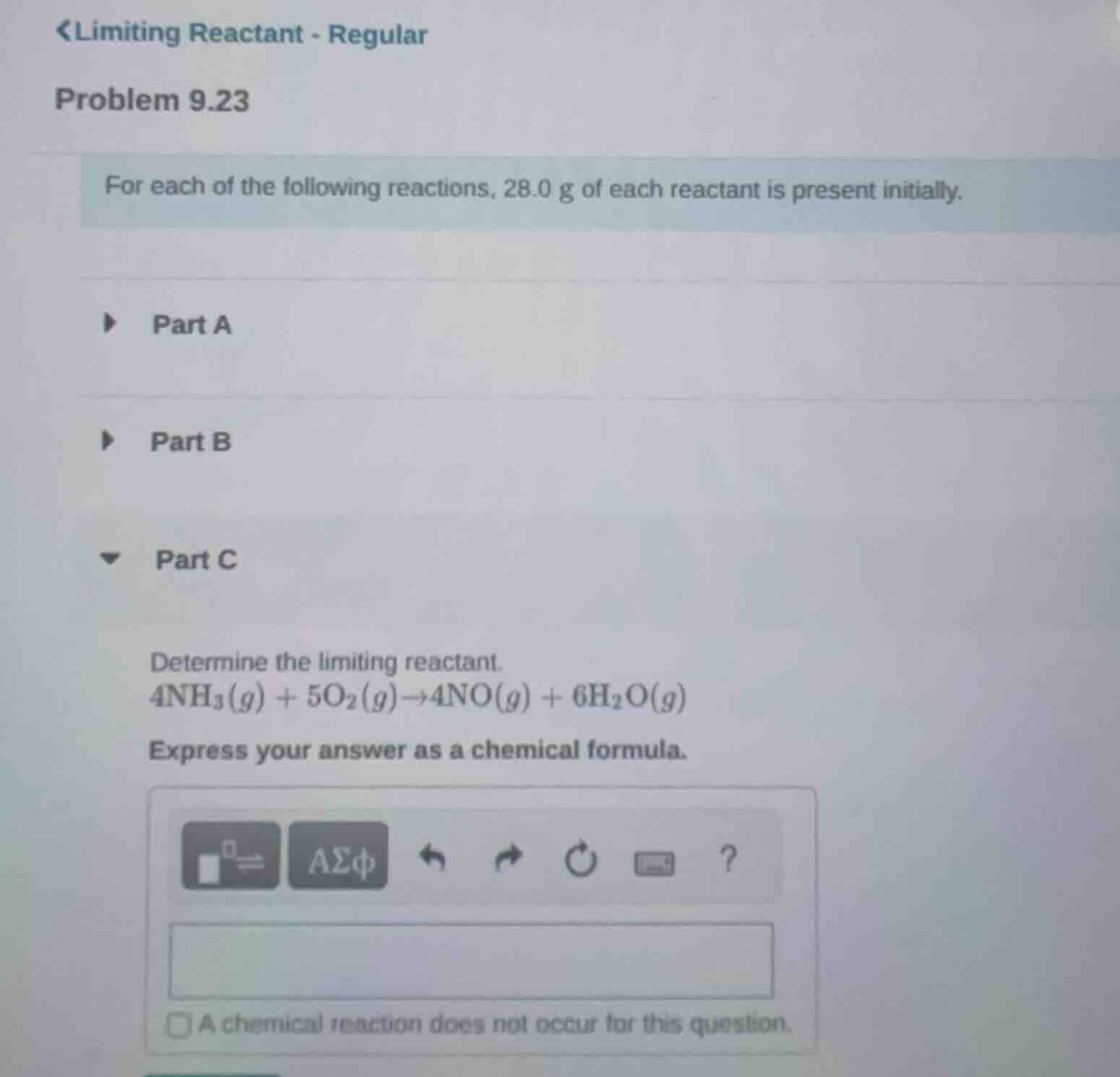
for each of the following reactions, 28.0 g of each reactant is present initially.
part a
part b
part c
determine the limiting reactant.
$\ce{4nh_{3}(g) + 5o_{2}(g)\
ightarrow 4no(g) + 6h_{2}o(g)}$
express your answer as a chemical formula.
a chemical reaction does not occur for this question.
Step1: Calculate moles of $\text{NH}_3$
Molar mass of $\text{NH}_3$ = $14.01 + 3\times1.008 = 17.034$ g/mol
$\text{Moles of NH}_3 = \frac{28.0\ \text{g}}{17.034\ \text{g/mol}} \approx 1.644\ \text{mol}$
Step2: Calculate moles of $\text{O}_2$
Molar mass of $\text{O}_2$ = $2\times16.00 = 32.00$ g/mol
$\text{Moles of O}_2 = \frac{28.0\ \text{g}}{32.00\ \text{g/mol}} = 0.875\ \text{mol}$
Step3: Find mole ratio from reaction
Reaction: $4\text{NH}_3(g) + 5\text{O}_2(g)
ightarrow4\text{NO}(g) + 6\text{H}_2\text{O}(g)$
Mole ratio $\frac{\text{NH}_3}{\text{O}_2} = \frac{4}{5} = 0.8$
Step4: Calculate actual mole ratio
$\text{Actual ratio} = \frac{1.644\ \text{mol}}{0.875\ \text{mol}} \approx 1.879$
Actual ratio > Stoichiometric ratio, so $\text{O}_2$ is limiting.

Snap & solve any problem in the app
Get step-by-step solutions on Sovi AI
Photo-based solutions with guided steps
Explore more problems and detailed explanations
$\text{O}_2$