QUESTION IMAGE
Question
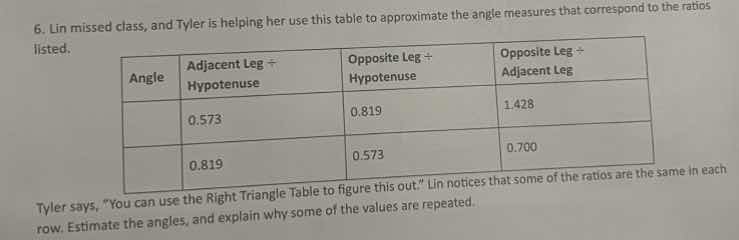
- lin missed class, and tyler is helping her use this table to approximate the angle measures that correspond to the ratios listed.
| angle | adjacent leg ÷ hypotenuse | opposite leg ÷ hypotenuse | opposite leg ÷ adjacent leg |
|---|---|---|---|
| 0.819 | 0.573 | 0.700 |
tyler says, \you can use the right triangle table to figure this out.\ lin notices that some of the ratios are the same in each row. estimate the angles, and explain why some of the values are repeated.
Step1: Identify trigonometric ratios
Recall that for a right triangle:
- $\cos(\theta) = \frac{\text{Adjacent Leg}}{\text{Hypotenuse}}$
- $\sin(\theta) = \frac{\text{Opposite Leg}}{\text{Hypotenuse}}$
- $\tan(\theta) = \frac{\text{Opposite Leg}}{\text{Adjacent Leg}}$
Step2: Calculate first angle
Use inverse cosine for $\cos(\theta)=0.573$:
$\theta = \cos^{-1}(0.573) \approx 55^\circ$
Verify: $\sin(55^\circ) \approx 0.819$, $\tan(55^\circ) \approx 1.428$, which matches the first row.
Step3: Calculate second angle
Use inverse cosine for $\cos(\theta)=0.819$:
$\theta = \cos^{-1}(0.819) \approx 35^\circ$
Verify: $\sin(35^\circ) \approx 0.573$, $\tan(35^\circ) \approx 0.700$, which matches the second row.
Step4: Explain repeated ratios
In a right triangle, the two acute angles are complementary: $\theta + (90^\circ - \theta) = 90^\circ$. By co-function identities:
$\sin(\theta) = \cos(90^\circ - \theta)$, $\cos(\theta) = \sin(90^\circ - \theta)$
So the sine of one angle equals the cosine of its complementary angle.

Snap & solve any problem in the app
Get step-by-step solutions on Sovi AI
Photo-based solutions with guided steps
Explore more problems and detailed explanations
- The angles are approximately $55^\circ$ (for the first row of ratios) and $35^\circ$ (for the second row of ratios).
- The ratios repeat because the two acute angles in a right triangle are complementary (they add to $90^\circ$). The sine of one angle is equal to the cosine of its complementary angle, which is why the adjacent/hypotenuse ratio of one angle matches the opposite/hypotenuse ratio of the other angle.