QUESTION IMAGE
Question
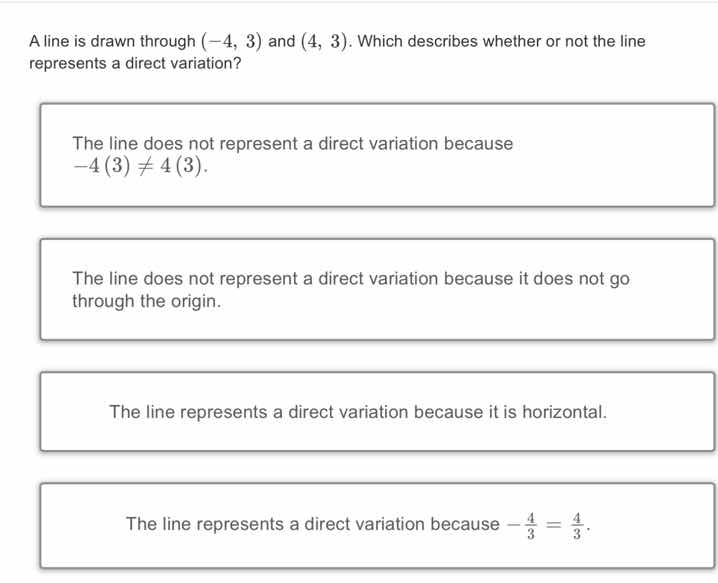
a line is drawn through $(-4, 3)$ and $(4, 3)$. which describes whether or not the line represents a direct variation?
the line does not represent a direct variation because $-4(3) \
eq 4(3)$.
the line does not represent a direct variation because it does not go through the origin.
the line represents a direct variation because it is horizontal.
the line represents a direct variation because $-\frac{4}{3} = \frac{4}{3}$.
Step1: Recall direct variation definition
A direct variation is a relationship of the form \( y = kx \), where \( k \) is a constant. The graph of a direct variation must pass through the origin \((0,0)\) because when \( x = 0 \), \( y = 0 \).
Step2: Find the equation of the given line
The line passes through \((-4, 3)\) and \((4, 3)\). The slope \( m \) of the line is \( \frac{3 - 3}{4 - (-4)}=\frac{0}{8} = 0 \). Using the point - slope form \( y - y_1=m(x - x_1) \) (using the point \((-4,3)\)), we get \( y - 3=0(x + 4) \), so \( y=3 \). This is a horizontal line.
Step3: Check if the line passes through the origin
For the origin \((0,0)\), when \( x = 0 \), \( y = 3
eq0 \). So the line \( y = 3\) does not pass through the origin. Since a direct variation must pass through the origin, the line does not represent a direct variation.

Snap & solve any problem in the app
Get step-by-step solutions on Sovi AI
Photo-based solutions with guided steps
Explore more problems and detailed explanations
The line does not represent a direct variation because it does not go through the origin.