QUESTION IMAGE
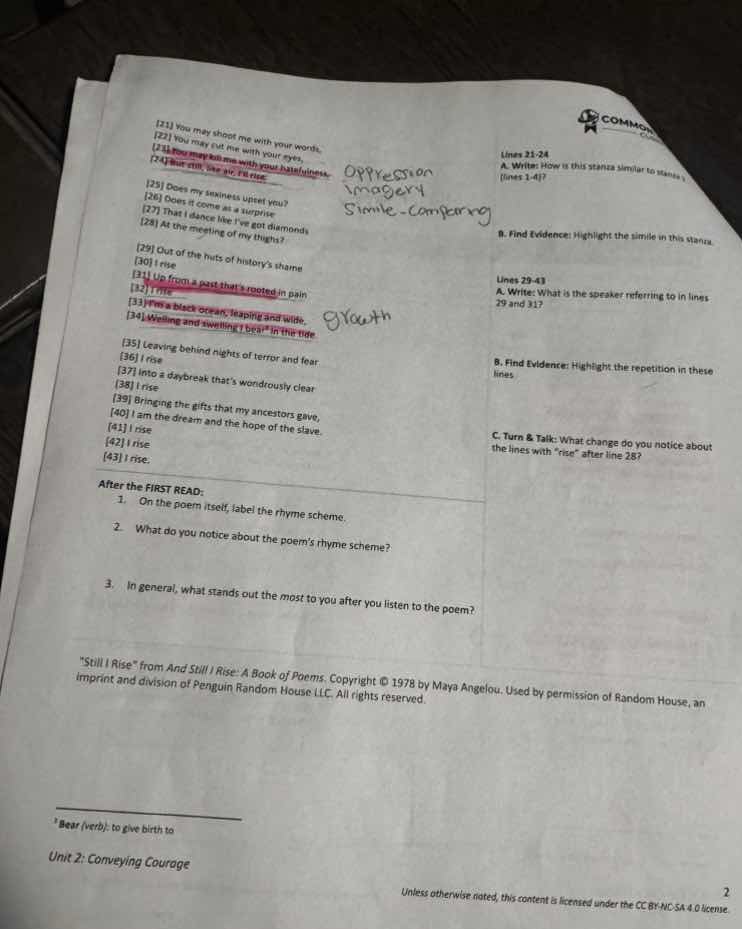
Question
lines 21-24
a. write: how is this stanza similar to stanza 1 (lines 1-4)?
b. find evidence: highlight the simile in this stanza.
lines 29-43
a. write: what is the speaker referring to in lines 29 and 31?
b. find evidence: highlight the repetition in these lines.
c. turn & talk: what change do you notice about the lines with
ise\ after line 28?
after the first read:
- on the poem itself, label the rhyme scheme.
- what do you notice about the poems rhyme scheme?
- in general, what stands out the most to you after you listen to the poem?
\still i rise\ from and still i rise: a book of poems. copyright © 1978 by maya angelou. used by permission of random house, an imprint and division of penguin random house llc. all rights reserved.
¹bear (verb): to give birth to
- The rhyme scheme is identified by assigning a unique letter to each new ending sound in the poem's lines.
- The rhyme scheme shifts after line 28 to emphasize the speaker's rising resolve.
- The most striking element is the repetitive, triumphant refrain "I rise" that builds emotional power.

Snap & solve any problem in the app
Get step-by-step solutions on Sovi AI
Photo-based solutions with guided steps
Explore more problems and detailed explanations
- Rhyme scheme labeling (lines 21-43):
Lines 21-24: A, B, A, B
Lines 25-28: C, C, D, D
Lines 29-32: E, F, E, F
Lines 33-34: G, G
Lines 35-38: H, I, H, I
Lines 39-43: J, K, L, L, L
- After line 28, the rhyme scheme becomes more irregular, and the final lines abandon a paired rhyme structure entirely to focus on the repeated, unrhymed (in a paired sense) "I rise" to emphasize the speaker's unbroken momentum.
- The repetitive, declarative refrain "I rise" stands out most, as it builds a powerful, unyielding tone of resilience and triumph over oppression.