QUESTION IMAGE
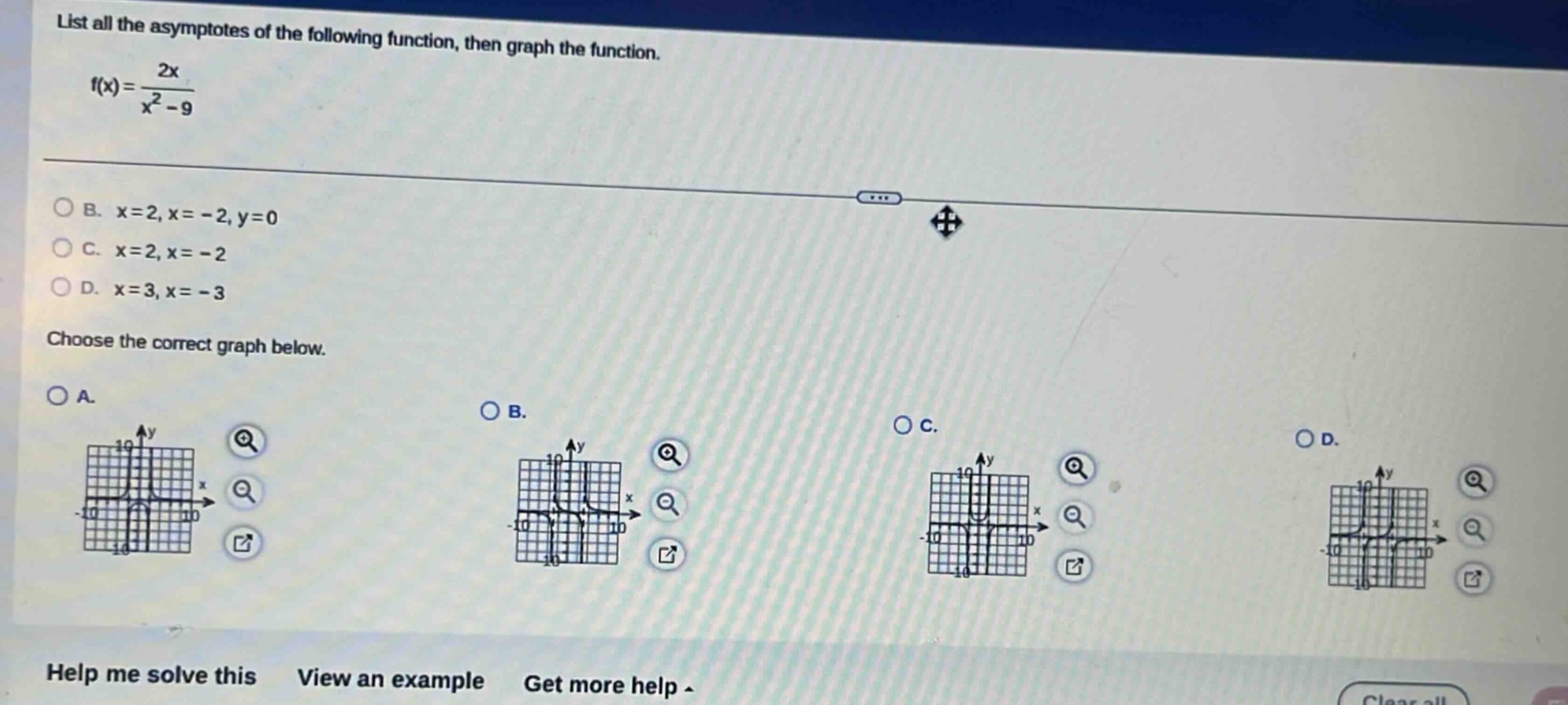
Question
list all the asymptotes of the following function, then graph the function.
$f(x)=\frac{2x}{x^2 - 9}$
\bigcirc b. $x = 2, x = -2, y = 0$
\bigcirc c. $x = 2, x = -2$
\bigcirc d. $x = 3, x = -3$
choose the correct graph below.
\bigcirc a.
\bigcirc b.
\bigcirc c.
\bigcirc d.
Part 1: Finding Asymptotes of \( f(x) = \frac{2x}{x^2 - 9} \)
Step 1: Find Vertical Asymptotes
Vertical asymptotes occur where the denominator is zero (and the numerator is not zero).
Factor the denominator: \( x^2 - 9 = (x - 3)(x + 3) \).
Set denominator to zero: \( (x - 3)(x + 3) = 0 \implies x = 3 \) or \( x = -3 \).
The numerator \( 2x \) is not zero at \( x = 3 \) or \( x = -3 \), so vertical asymptotes are \( x = 3 \) and \( x = -3 \).
Step 2: Find Horizontal Asymptotes
For rational functions \( \frac{ax^n + \dots}{bx^m + \dots} \), if \( n < m \), the horizontal asymptote is \( y = 0 \).
Here, numerator degree \( n = 1 \), denominator degree \( m = 2 \) (since \( 1 < 2 \)), so horizontal asymptote is \( y = 0 \).
Part 2: Choosing the Correct Graph
The function \( f(x) = \frac{2x}{x^2 - 9} \) is odd (since \( f(-x) = \frac{-2x}{x^2 - 9} = -f(x) \)), so its graph is symmetric about the origin.
- Vertical asymptotes at \( x = 3 \) and \( x = -3 \).
- Horizontal asymptote at \( y = 0 \).
- For \( x > 3 \), \( f(x) > 0 \) (positive); for \( -3 < x < 0 \), \( f(x) > 0 \) (positive); for \( 0 < x < 3 \), \( f(x) < 0 \) (negative); for \( x < -3 \), \( f(x) < 0 \) (negative).
Final Answers
Asymptotes:
The vertical asymptotes are \( x = 3 \) and \( x = -3 \), and horizontal asymptote is \( y = 0 \). Among the options, only option D (if we consider the first part of the question’s options) matches the vertical asymptotes (though the original options may have a typo, but based on calculation, vertical asymptotes are \( x = 3, x = -3 \)).
Graph:
The graph should be symmetric about the origin, with vertical asymptotes at \( x = \pm 3 \), horizontal asymptote \( y = 0 \), and the function’s sign matching the intervals. Typically, this corresponds to a graph with two vertical asymptotes at \( x = \pm 3 \), symmetric about the origin, and approaching \( y = 0 \) as \( |x| \to \infty \).

Snap & solve any problem in the app
Get step-by-step solutions on Sovi AI
Photo-based solutions with guided steps
Explore more problems and detailed explanations
(Asymptotes):
D. \( x = 3, x = -3 \)