QUESTION IMAGE
Question
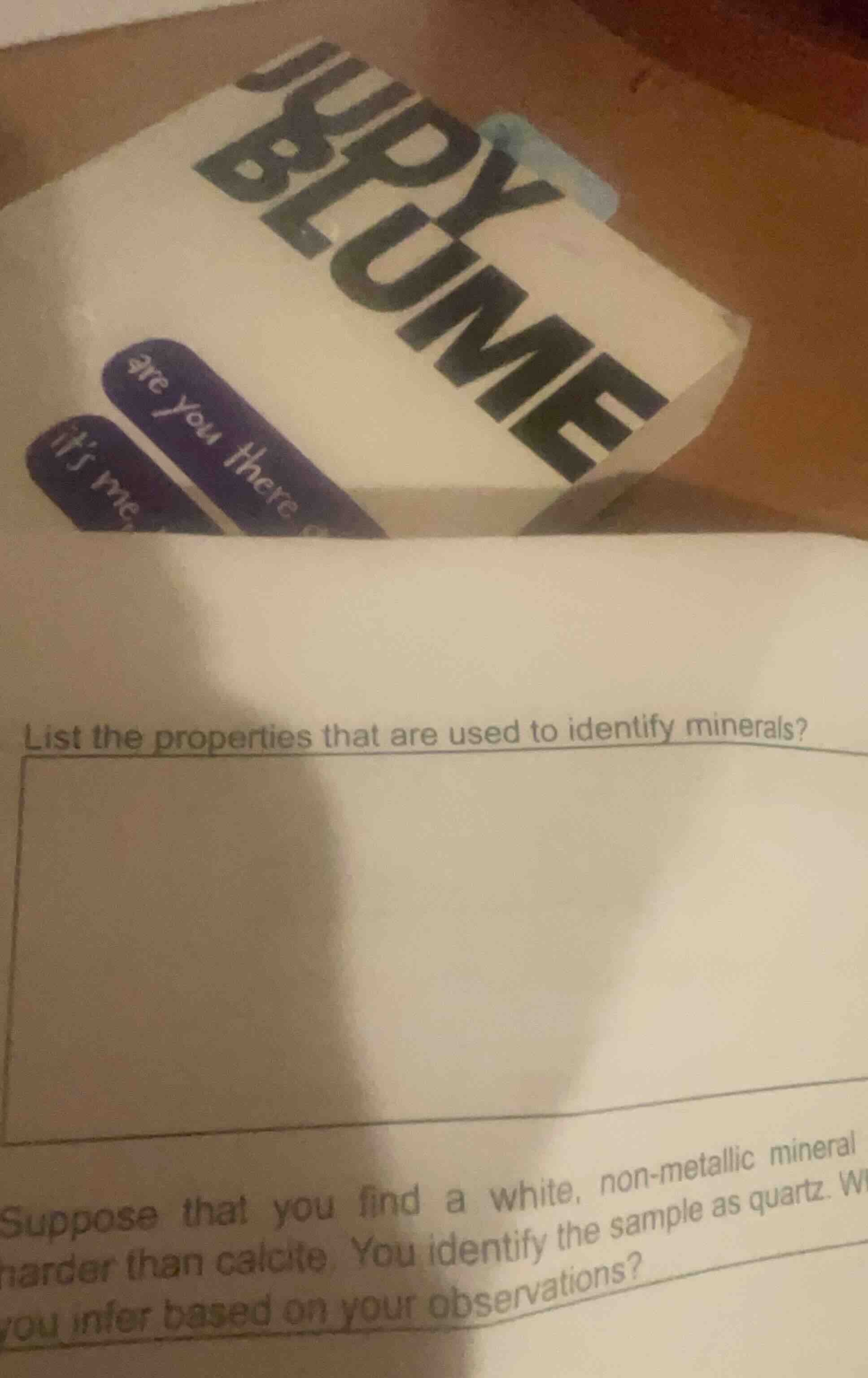
list the properties that are used to identify minerals?
suppose that you find a white, non - metallic mineral harder than calcite. you identify the sample as quartz. wyou infer based on your observations?
Brief Explanations
To identify minerals, several key properties are used. These include:
- Color: The apparent color of the mineral, though it can be variable due to impurities.
- Luster: How the mineral reflects light (e.g., metallic, non - metallic like vitreous, pearly, dull).
- Hardness: Measured on the Mohs scale (1 - 10, with talc = 1 and diamond = 10), indicating how easily the mineral can be scratched.
- Streak: The color of the mineral's powder when it is scraped across an unglazed porcelain plate.
- Cleavage and Fracture: Cleavage is the way a mineral breaks along flat, smooth planes (e.g., mica has perfect cleavage), while fracture is the way it breaks when not along cleavage planes (e.g., conchoidal fracture in quartz).
- Crystal Form: The geometric shape of the mineral's crystals (e.g., cubic for halite, hexagonal for quartz).
- Density (Specific Gravity): The ratio of the mineral's mass to the mass of an equal volume of water.
- Magnetism: Some minerals (like magnetite) are magnetic.
- Reaction to Acid: For example, calcite fizzes in dilute hydrochloric acid.
- Transparency/Translucency/Opaqueness: Whether light passes through the mineral (transparent), partially passes through (translucent), or does not pass through (opaque).

Snap & solve any problem in the app
Get step-by-step solutions on Sovi AI
Photo-based solutions with guided steps
Explore more problems and detailed explanations
The properties used to identify minerals are: color, luster, hardness, streak, cleavage and fracture, crystal form, density (specific gravity), magnetism, reaction to acid, and transparency/translucency/opaqueness.