QUESTION IMAGE
Question
listen and learn
comprehension check
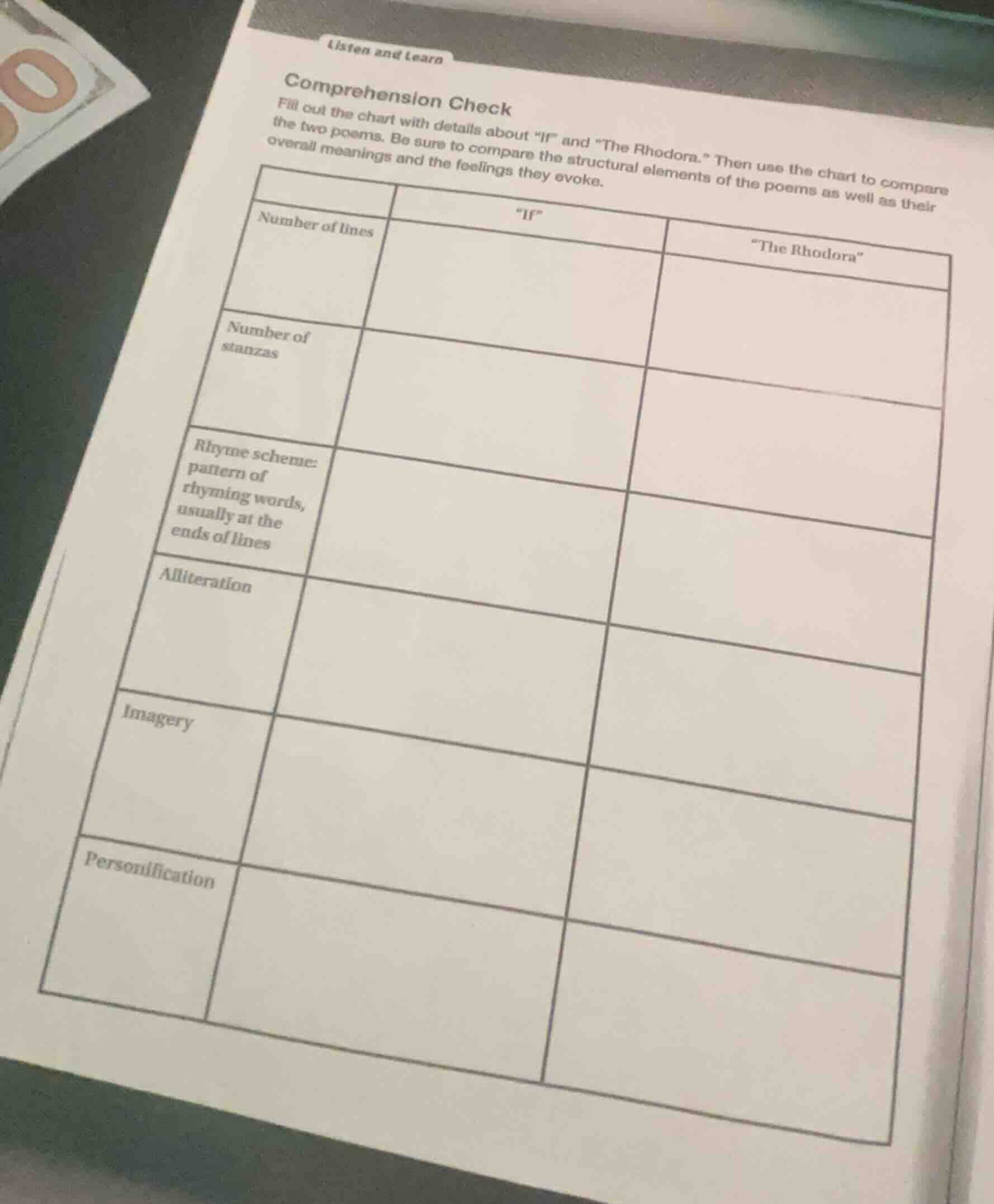
fill out the chart with details about \if\ and \the rhodora.\ then use the chart to compare the two poems. be sure to compare the structural elements of the poems as well as their overall meanings and the feelings they evoke.
| \if\ | \the rhodora\ | |
|---|---|---|
| number of stanzas | ||
| rhyme scheme: pattern of rhyming words, usually at the ends of lines | ||
| alliteration | ||
| imagery | ||
| personification |
To fill out the chart for the poems "If" (by Rudyard Kipling) and "The Rhodora" (by Ralph Waldo Emerson), we analyze their structural and literary elements:
1. Number of Lines
- "If": 32 lines (organized into 4 stanzas of 8 lines each).
- "The Rhodora": 16 lines (organized into 2 stanzas of 8 lines each).
2. Number of Stanzas
- "If": 4 stanzas (each with 8 lines).
- "The Rhodora": 2 stanzas (each with 8 lines).
3. Rhyme Scheme
- "If": Follows an ABAB CDCD EFEF GHGH rhyme scheme (alternating rhymes in each 8 - line stanza). For example, in the first stanza: *“If you can dream—and not make dreams your master; (A)
If you can think—and not make thoughts your aim; (B)
If you can meet with Triumph and Disaster (A)
And treat those two impostors just the same; (B)”*
- "The Rhodora": Follows an ABAB CDCD rhyme scheme (alternating rhymes in each 8 - line stanza). For example, in the first stanza: *“In May, when sea - winds pierced our solitudes, (A)
I found the fresh Rhodora in the woods, (A)
Spreading its leafless blooms in a damp nook, (B)
To please the desert and the sluggish brook. (B)”*
4. Alliteration
- "If": Examples include “dream—and not make dreams”, “think—and not make thoughts”, “Triumph and Disaster” (repeats initial consonant sounds for emphasis).
- "The Rhodora": Examples include “sea - winds”, “fresh Rhodora”, “damp nook” (repeats initial consonant sounds to create rhythm).
5. Imagery
- "If": Uses moral/philosophical imagery (e.g., “Triumph and Disaster” as impostors, “walk with Kings—nor lose the common touch”) to convey life lessons.
- "The Rhodora": Uses natural imagery (e.g., “fresh Rhodora in the woods”, “damp nook”, “sluggish brook”, “purple petals fallen in the pool”) to depict nature and its beauty.
6. Personification
- "If": Personifies abstract concepts (e.g., “Triumph and Disaster” as “impostors” with human - like deception).
- "The Rhodora": Personifies the flower (e.g., “pleased the desert and the sluggish brook” implies the Rhodora acts with intent to please).
Filled Chart:
| Element | "If" (Rudyard Kipling) | "The Rhodora" (Ralph Waldo Emerson) |
|---|---|---|
| Number of Stanzas | 4 | 2 |
| Rhyme Scheme | ABAB CDCD EFEF GHGH | ABAB CDCD |
| Alliteration | “dream—and not make dreams”, “Triumph and Disaster” | “sea - winds”, “fresh Rhodora”, “damp nook” |
| Imagery | Moral/philosophical (e.g., “Triumph/Disaster as impostors”) | Natural (e.g., “fresh Rhodora in the woods”) |
| Personification | “Triumph and Disaster” as impostors | Rhodora “pleased the desert/brook” |
Overall Meanings & Feelings
- "If": Explores the qualities of a virtuous person (resilience, humility, self - control) and evokes a tone of wise, encouraging advice (like a fatherly guide).
- "The Rhodora": Celebrates nature’s beauty and its connection to the divine, evoking a tone of awe and spiritual reflection (Emerson’s transcendentalist theme: nature as a path to truth).
To complete the chart, transfer…

Snap & solve any problem in the app
Get step-by-step solutions on Sovi AI
Photo-based solutions with guided steps
Explore more problems and detailed explanations
To fill out the chart for the poems "If" (by Rudyard Kipling) and "The Rhodora" (by Ralph Waldo Emerson), we analyze their structural and literary elements:
1. Number of Lines
- "If": 32 lines (organized into 4 stanzas of 8 lines each).
- "The Rhodora": 16 lines (organized into 2 stanzas of 8 lines each).
2. Number of Stanzas
- "If": 4 stanzas (each with 8 lines).
- "The Rhodora": 2 stanzas (each with 8 lines).
3. Rhyme Scheme
- "If": Follows an ABAB CDCD EFEF GHGH rhyme scheme (alternating rhymes in each 8 - line stanza). For example, in the first stanza: *“If you can dream—and not make dreams your master; (A)
If you can think—and not make thoughts your aim; (B)
If you can meet with Triumph and Disaster (A)
And treat those two impostors just the same; (B)”*
- "The Rhodora": Follows an ABAB CDCD rhyme scheme (alternating rhymes in each 8 - line stanza). For example, in the first stanza: *“In May, when sea - winds pierced our solitudes, (A)
I found the fresh Rhodora in the woods, (A)
Spreading its leafless blooms in a damp nook, (B)
To please the desert and the sluggish brook. (B)”*
4. Alliteration
- "If": Examples include “dream—and not make dreams”, “think—and not make thoughts”, “Triumph and Disaster” (repeats initial consonant sounds for emphasis).
- "The Rhodora": Examples include “sea - winds”, “fresh Rhodora”, “damp nook” (repeats initial consonant sounds to create rhythm).
5. Imagery
- "If": Uses moral/philosophical imagery (e.g., “Triumph and Disaster” as impostors, “walk with Kings—nor lose the common touch”) to convey life lessons.
- "The Rhodora": Uses natural imagery (e.g., “fresh Rhodora in the woods”, “damp nook”, “sluggish brook”, “purple petals fallen in the pool”) to depict nature and its beauty.
6. Personification
- "If": Personifies abstract concepts (e.g., “Triumph and Disaster” as “impostors” with human - like deception).
- "The Rhodora": Personifies the flower (e.g., “pleased the desert and the sluggish brook” implies the Rhodora acts with intent to please).
Filled Chart:
| Element | "If" (Rudyard Kipling) | "The Rhodora" (Ralph Waldo Emerson) |
|---|---|---|
| Number of Stanzas | 4 | 2 |
| Rhyme Scheme | ABAB CDCD EFEF GHGH | ABAB CDCD |
| Alliteration | “dream—and not make dreams”, “Triumph and Disaster” | “sea - winds”, “fresh Rhodora”, “damp nook” |
| Imagery | Moral/philosophical (e.g., “Triumph/Disaster as impostors”) | Natural (e.g., “fresh Rhodora in the woods”) |
| Personification | “Triumph and Disaster” as impostors | Rhodora “pleased the desert/brook” |
Overall Meanings & Feelings
- "If": Explores the qualities of a virtuous person (resilience, humility, self - control) and evokes a tone of wise, encouraging advice (like a fatherly guide).
- "The Rhodora": Celebrates nature’s beauty and its connection to the divine, evoking a tone of awe and spiritual reflection (Emerson’s transcendentalist theme: nature as a path to truth).
To complete the chart, transfer these details into the respective cells.