QUESTION IMAGE
Question
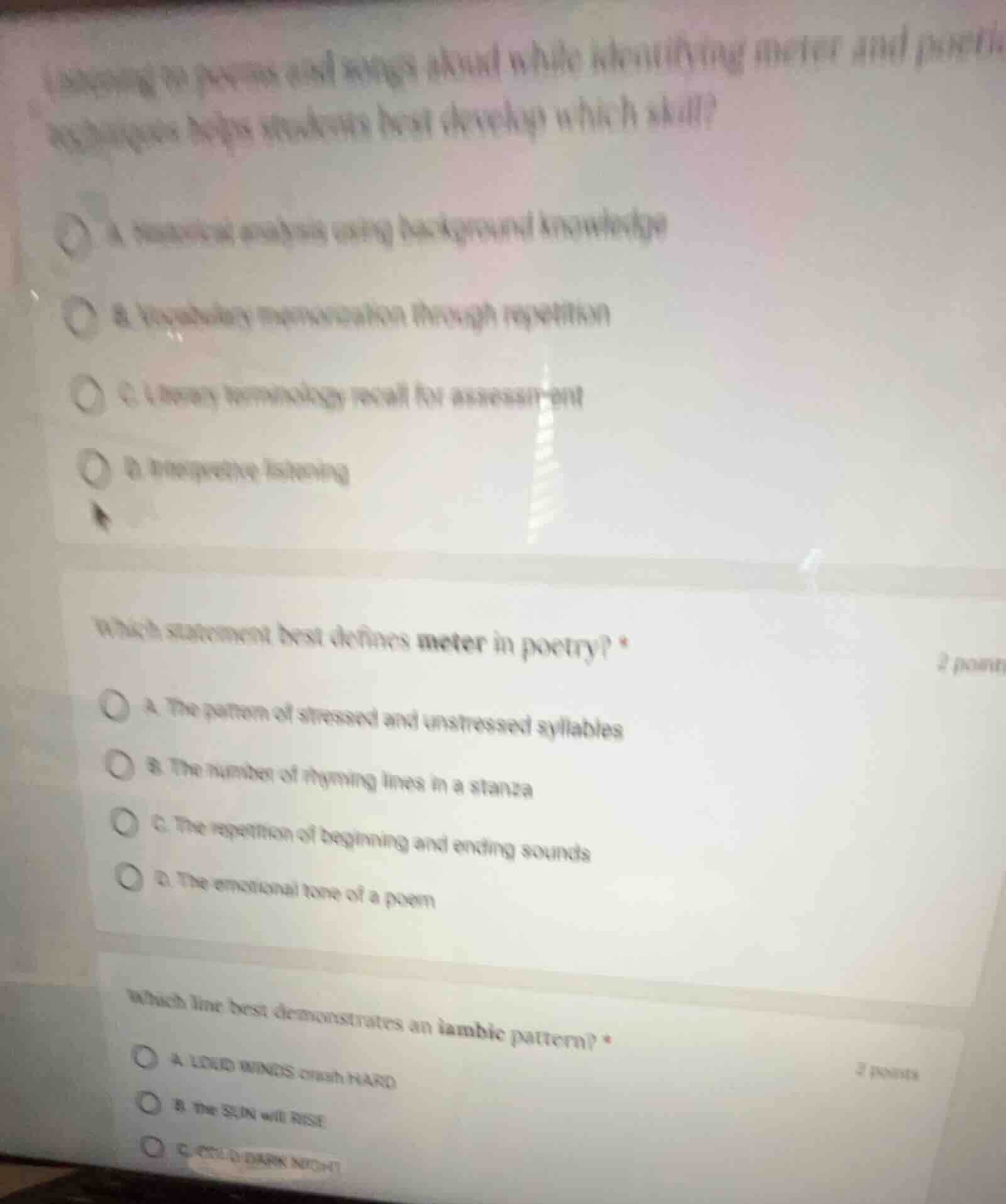
listening to poems and songs aloud while identifying meter and poetic techniques helps students best develop which skill?
a. textual analysis using background knowledge
b. vocabulary memorization through repetition
c. literary terminology recall for assessment
d. interpretive listening
which statement best defines meter in poetry? *
a. the pattern of stressed and unstressed syllables
b. the number of rhyming lines in a stanza
c. the repetition of beginning and ending sounds
d. the emotional tone of a poem
which line best demonstrates an iambic pattern? *
a. loud winds crash hard
b. the sun will rise
c. still dark night
First Question (Skill Development):
- Option A: Historical analysis isn't related to reading poems/songs aloud for meter and poetic devices.
- Option B: Memorization through repetition isn't the focus here; the task is identifying meter/devices, not memorizing vocabulary.
- Option C: Literary terminology recall for assessment isn't developed by reading aloud to identify meter/devices.
- Option D: Introspective listening involves actively analyzing what's heard (meter, poetic devices), which aligns with reading aloud to identify these elements.
- Option A: Meter in poetry is the pattern of stressed (accented) and unstressed (unaccented) syllables in a line, matching this definition.
- Option B: Number of rhyming lines refers to rhyme scheme, not meter.
- Option C: Repetition of beginning/ending sounds is alliteration or other sound devices, not meter.
- Option D: Emotional tone is mood/tone, not meter.
- An iambic pattern has an unstressed syllable followed by a stressed syllable (˘ ´).
- Option A: "LOUD WINDS crash HARD" has stressed-unstressed or other patterns, not iambic.
- Option B: "the SUN will RISE" breaks down as "the (˘) SUN (´) will (˘) RISE (´)" – iambic (unstressed-stressed) pattern.
- Option C: "STILL DARK NIGHT" (assuming full option) likely has stressed-unstressed or other, not iambic.

Snap & solve any problem in the app
Get step-by-step solutions on Sovi AI
Photo-based solutions with guided steps
Explore more problems and detailed explanations
D. Introspective listening