QUESTION IMAGE
Question
literacy and vocabulary
proving triangles similar
the column on the left shows the steps used to solve a proportion.
use the column on the left to answer each question in the column on the right.
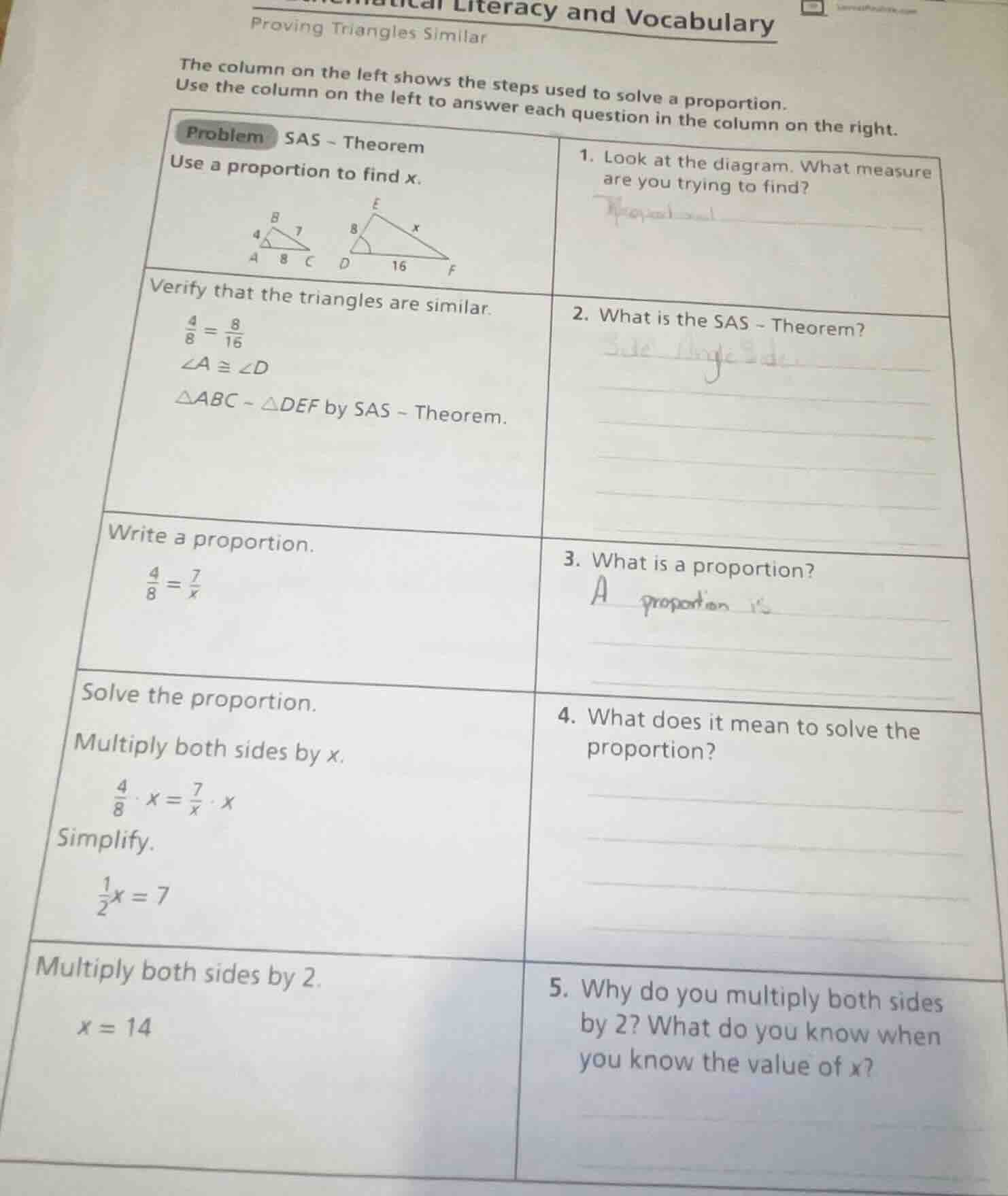
problem sas - theorem
use a proportion to find x.
diagram of two triangles
- look at the diagram. what measure are you trying to find?
verify that the triangles are similar.
\\(\frac{4}{8} = \frac{8}{16}\\)
\\(\angle a \cong \angle d\\)
\\(\triangle abc \sim \triangle def\\) by sas - theorem.
- what is the sas - theorem?
write a proportion.
\\(\frac{4}{8} = \frac{7}{x}\\)
- what is a proportion?
solve the proportion.
multiply both sides by x.
\\(\frac{4}{8} \cdot x = \frac{7}{x} \cdot x\\)
simplify.
\\(\frac{1}{2}x = 7\\)
- what does it mean to solve the proportion?
multiply both sides by 2.
\\(x = 14\\)
- why do you multiply both sides by 2? what do you know when you know the value of x?
- Identify the unknown side in the diagram.
- Define the SAS Similarity Theorem for triangles.
- Explain the mathematical definition of a proportion.
- Describe the goal of solving a proportion.
- Justify the algebraic step and state the result.

Snap & solve any problem in the app
Get step-by-step solutions on Sovi AI
Photo-based solutions with guided steps
Explore more problems and detailed explanations
- The length of side $\overline{EF}$ (or the value of $x$)
- The SAS (Side-Angle-Side) Similarity Theorem states that if two sides of one triangle are proportional to two sides of another triangle, and the included angles are congruent, then the two triangles are similar.
- A proportion is an equation that states that two ratios are equal, e.g., $\frac{a}{b}=\frac{c}{d}$.
- To solve a proportion means to find the value of the unknown variable that makes the equation (the equal ratios) true.
- Multiplying both sides by 2 isolates the variable $x$ (since $\frac{1}{2}x \times 2 = x$). When we know the value of $x$, we know the length of the corresponding side in the similar triangle, $\overline{EF}$.