QUESTION IMAGE
Question
literary / text elements poetic structure: blank verse
meter is a regular rhythmical pattern of stressed and unstressed syllables. these stressed and
unstressed syllables are divided into metrical units called feet. for example, an iamb is a metrical
foot that includes one unstressed //(or weak) syllable followed by a stressed / / (or strong)
syllable. iambic pentameter is a meter that includes five iambs in each line. blank verse is
unrhymed poetry that uses iambic pentameter.
to scan the meter of a line of poetry, follow these steps:
- first, count the number of syllables.
- next, identify the stressed and unstressed syllables.
- then, mark unstressed syllables with a horseshoe symbol / and stressed
syllables with an accent / /.
the following example of iambic pentameter is from william shakespeares \sonnet 18.\ scan
the pattern of unstressed and stressed syllables in each of the five metrical feet.
shall i compare thee to a summers day?
shall / com pare thee to a sum mers day?
weak strong weak strong weak strong weak strong weak strong
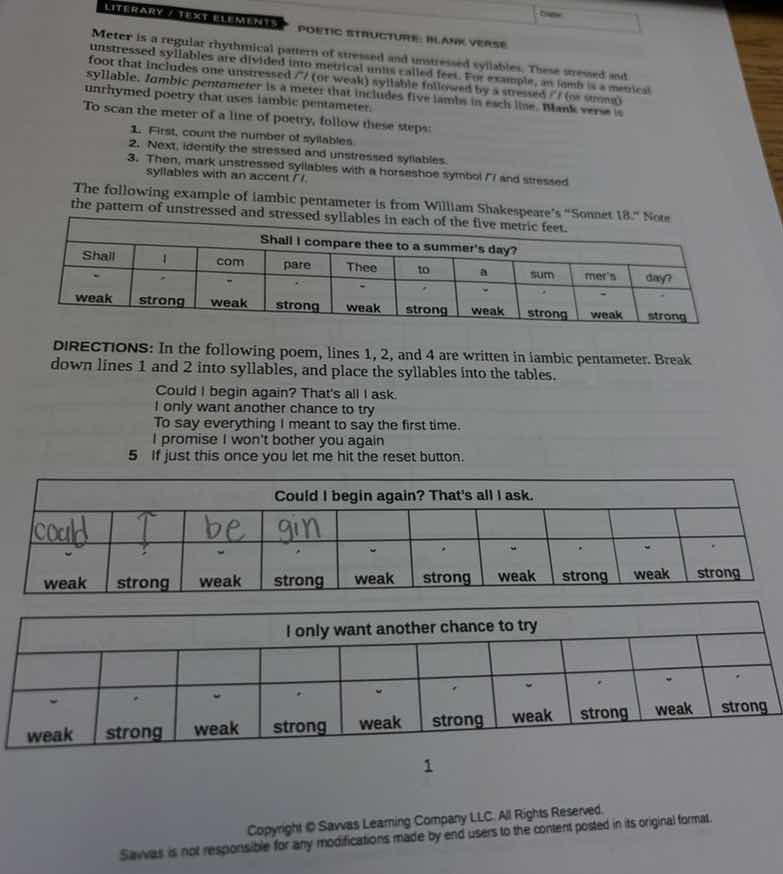
directions: in the following poem, lines 1, 2, and 4 are written in iambic pentameter. break
down lines 1 and 2 into syllables, and place the syllables into the tables.
could i begin again? thats all i ask.
i only want another chance to try
to say everything i meant to say the first time.
i promise i wont bother you again
5 if just this once you let me hit the reset button.
could i begin again? thats all i ask.
weak strong weak strong weak strong weak strong weak strong
i only want another chance to try
weak strong weak strong weak strong weak strong weak strong
1
copyright © savvas learning company llc. all rights reserved.
savvas is not responsible for any modifications made by end users to the content posted in its original format.
For the line "I only want another chance to try"
Step 1: Identify each syllable
The word - by - word syllables: "I" (1 syllable), "on - ly" (2 syllables: on, ly), "want" (1 syllable), "an - oth - er" (3 syllables: an, oth, er), "chance" (1 syllable), "to" (1 syllable), "try" (1 syllable). But when considering the iambic pentameter (5 metrical feet, each with an unstressed and a stressed syllable), we group them as follows:
- First foot: "I" (unstressed, marked with ˘) and we need to pair it with the next syllable. Wait, actually, let's list each syllable in order: I, on, ly, want, an, oth, er, chance, to, try.
Step 2: Mark unstressed (˘) and stressed (/) syllables according to iambic (unstressed - stressed) pattern
- Foot 1: ˘I, /on
- Foot 2: ˘ly, /want
- Foot 3: ˘an, /oth
- Foot 4: ˘er, /chance
- Foot 5: ˘to, /try
So filling in the table:
| Syllable 1 | Syllable 2 | Syllable 3 | Syllable 4 | Syllable 5 | Syllable 6 | Syllable 7 | Syllable 8 | Syllable 9 | Syllable 10 |
|---|---|---|---|---|---|---|---|---|---|
| weak | strong | weak | strong | weak | strong | weak | strong | weak | strong |
For the line "Could I begin again? That's all I ask." (completing the table)
We already have some starts. Let's correct and complete:
- The words and their syllables: "Could" (1 syllable: Could), "I" (1 syllable: I), "be - gin" (2 syllables: be, gin), "a - gain" (2 syllables: a, gain), "That's" (1 syllable: That's), "all" (1 syllable: all), "I" (1 syllable: I), "ask" (1 syllable: ask). But for iambic pentameter (5 feet, 10 syllables):
- Foot 1: ˘Could, /I
- Foot 2: ˘be, /gin
- Foot 3: ˘a, /gain
- Foot 4: ˘That's, /all
- Foot 5: ˘I, /ask
So the completed table:
| Syllable 1 | Syllable 2 | Syllable 3 | Syllable 4 | Syllable 5 | Syllable 6 | Syllable 7 | Syllable 8 | Syllable 9 | Syllable 10 |
|---|---|---|---|---|---|---|---|---|---|
| weak | strong | weak | strong | weak | strong | weak | strong | weak | strong |
(Note: The original hand - written "could" in the first table should be "Could" with the correct stress marking. Also, we need to ensure that each foot has an unstressed and a stressed syllable following the iambic pattern.)

Snap & solve any problem in the app
Get step-by-step solutions on Sovi AI
Photo-based solutions with guided steps
Explore more problems and detailed explanations
For the line "I only want another chance to try"
Step 1: Identify each syllable
The word - by - word syllables: "I" (1 syllable), "on - ly" (2 syllables: on, ly), "want" (1 syllable), "an - oth - er" (3 syllables: an, oth, er), "chance" (1 syllable), "to" (1 syllable), "try" (1 syllable). But when considering the iambic pentameter (5 metrical feet, each with an unstressed and a stressed syllable), we group them as follows:
- First foot: "I" (unstressed, marked with ˘) and we need to pair it with the next syllable. Wait, actually, let's list each syllable in order: I, on, ly, want, an, oth, er, chance, to, try.
Step 2: Mark unstressed (˘) and stressed (/) syllables according to iambic (unstressed - stressed) pattern
- Foot 1: ˘I, /on
- Foot 2: ˘ly, /want
- Foot 3: ˘an, /oth
- Foot 4: ˘er, /chance
- Foot 5: ˘to, /try
So filling in the table:
| Syllable 1 | Syllable 2 | Syllable 3 | Syllable 4 | Syllable 5 | Syllable 6 | Syllable 7 | Syllable 8 | Syllable 9 | Syllable 10 |
|---|---|---|---|---|---|---|---|---|---|
| weak | strong | weak | strong | weak | strong | weak | strong | weak | strong |
For the line "Could I begin again? That's all I ask." (completing the table)
We already have some starts. Let's correct and complete:
- The words and their syllables: "Could" (1 syllable: Could), "I" (1 syllable: I), "be - gin" (2 syllables: be, gin), "a - gain" (2 syllables: a, gain), "That's" (1 syllable: That's), "all" (1 syllable: all), "I" (1 syllable: I), "ask" (1 syllable: ask). But for iambic pentameter (5 feet, 10 syllables):
- Foot 1: ˘Could, /I
- Foot 2: ˘be, /gin
- Foot 3: ˘a, /gain
- Foot 4: ˘That's, /all
- Foot 5: ˘I, /ask
So the completed table:
| Syllable 1 | Syllable 2 | Syllable 3 | Syllable 4 | Syllable 5 | Syllable 6 | Syllable 7 | Syllable 8 | Syllable 9 | Syllable 10 |
|---|---|---|---|---|---|---|---|---|---|
| weak | strong | weak | strong | weak | strong | weak | strong | weak | strong |
(Note: The original hand - written "could" in the first table should be "Could" with the correct stress marking. Also, we need to ensure that each foot has an unstressed and a stressed syllable following the iambic pattern.)